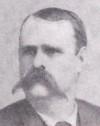
Merle Delore Collison, 34, a White male, died on January 29, 1958, near Douglas, Wyoming, in the final violent moments of Charles Starkweather’s rampage across Nebraska and Wyoming. Online historical accounts and contemporaneous reporting identify Collison as a traveling shoe salesman from Great Falls, Montana, who had pulled off along the highway west of Douglas.
The scene has the stillness of a winter roadside stop abruptly broken by a killer desperate for another car and another chance to keep running. Starkweather, already the target of a massive manhunt, came upon Collison’s parked Buick and tried to take it. When Collison would not give up the vehicle, he was shot and left mortally wounded beside the road.
What happened next unfolded with cruel speed. Starkweather tried to escape in Collison’s Buick, but he could not master the unfamiliar parking brake. That small mechanical failure helped bring the spree to its end. A passing motorist, identified in historical accounts as geologist Joe Sprinkle, stopped to help and stumbled into the aftermath. An altercation followed, and almost immediately law enforcement closed in. Natrona County Deputy William Romer arrived as the situation was coming apart, and Caril Ann Fugate ran toward the officer, identifying Starkweather. Starkweather then fled, leading officers through Douglas in a high-speed chase before he was finally stopped and taken into custody that same day. Collison’s death became the last killing in the spree, the final life taken before the long panic that had gripped the region finally snapped shut around its central figure.
As for suspects and arrests, the online record points squarely to Charles Starkweather as the killer in Collison’s death. A contemporaneous newspaper account reported that Starkweather was charged in Wyoming with first-degree murder for shooting the Montana shoe salesman just minutes before his own capture. Historical Wyoming sources likewise place him as the perpetrator and note that he was later extradited to Nebraska, where he was tried, convicted of first-degree murder in that state, and executed in 1959. Caril Ann Fugate was arrested with him near Douglas and remained central to the broader legal story. She was later prosecuted in Nebraska as an accomplice in the overall murder spree, convicted, and sentenced to life in prison before eventually being paroled years later. Still, in the specific killing of Merle Collison, the strongest online sources do not show a separate arrest or conviction naming another killer; instead, they consistently treat Starkweather as the man responsible, even though questions and accusations swirled around Fugate’s role in the spree as a whole.
That leaves Collison’s death with the bleak shape common to so many roadside murders of that era: an ordinary man traveling for work, pausing for a moment along a Wyoming highway, and crossing paths with someone who had already abandoned any boundary between panic and predation. The public memory of the Starkweather case often lingers on the chase, the headlines, and the notorious pair in custody, but the record shows Collison as more than a final tally mark. He was a husband and father, a salesman on the road, and the last victim in a spree that had already horrified two states before it ended in the cold outside Douglas.