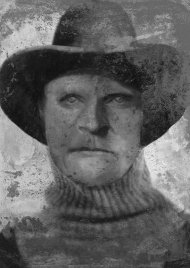
For more than four decades, he was known only as the Buffalo Cave John Doe. The headless torso, wrapped in burlap and buried in a shallow grave inside a remote Idaho cave, presented a mystery that stumped investigators for generations. Only in 2019, through the painstaking work of forensic genealogists, was his identity finally revealed: Joseph Henry Loveless, a bootlegger, outlaw, and murder suspect who vanished from a jail cell in 1916. His own violent death, however, remains an unsolved homicide.
Joseph Henry Loveless, a 45-year-old man of white/Caucasian descent, was born in Utah Territory on December 3, 1870, to Mormon pioneers. His life was marked by frequent clashes with the law and a reputation for escaping custody. He married twice, first to Harriet Jane Savage, who divorced him for abandonment, and then to Agnes Octavia Caldwell Loveless, with whom he had four children.
By 1916, Loveless, who used aliases like Charles Smith and Walter Cairns, was a known bootlegger living with his family in a tent on the outskirts of Dubois, Idaho.
The series of events that likely led to his death began on May 5, 1916, when his wife Agnes was brutally attacked with an axe. She died from her injuries a few days later. Loveless, identified as the primary suspect, was arrested and placed in the jail in St. Anthony, Idaho. But true to his reputation, his incarceration was brief. On May 18, 1916, Loveless sawed through the bars of his cell using a tool he had hidden in his shoe and escaped. A wanted poster was issued, but Joseph Henry Loveless was never seen alive again. At his wife’s funeral, one of their children was reportedly heard saying, "Papa never stayed in jail very long and he'll soon be out."
The case went cold for 63 years. On August 26, 1979, a family searching for arrowheads in the Buffalo Cave system near Dubois stumbled upon the burlap-wrapped torso. The discovery launched a major investigation, but with no head, identification seemed impossible. The mystery deepened on March 30, 1991, when an 11-year-old girl exploring the same cave found a mummified hand. Further excavation by law enforcement and Idaho State University anthropologists uncovered an arm and two legs, also wrapped in burlap. Forensic analysis determined the victim was a man of European descent, around 40 years old, whose body had been dismembered with sharp tools.
For years, the remains sat in storage as a perplexing cold case. The breakthrough came in 2019 when the Clark County Sheriff's Office partnered with the DNA Doe Project, a non-profit organization that uses genetic genealogy to identify unknown remains. Experts from Othram Inc. successfully extracted a DNA profile from the bones. Volunteers then built an extensive family tree, navigating the complexities of Loveless's pioneer ancestry, which included a polygamous grandfather. The search eventually led them to an 87-year-old grandson of Loveless, who confirmed the genetic link.
The identification was further solidified by the clothing found with the remains: a light-colored hat, a maroon sweater, and blue overalls over black trousers. These items matched the description on the 1916 wanted poster issued after Loveless’s final escape, strongly suggesting he was killed shortly after he fled jail. The discovery answered the question of what happened to the fugitive outlaw but opened another: who killed him? His head has never been found.
As of January 2020, the Clark County Sheriff's Office considers the death of Joseph Henry Loveless an open homicide investigation. Sheriff Bart May has noted that in 1916, the region was still part of the "Wild West," and it’s possible that locals took justice into their own hands. Bioarchaeologists have speculated that family members of his murdered wife, Agnes, may have sought revenge. With his killer or killers never identified, the century-old case of the outlaw who met a brutal end in the Idaho wilderness remains officially unsolved.