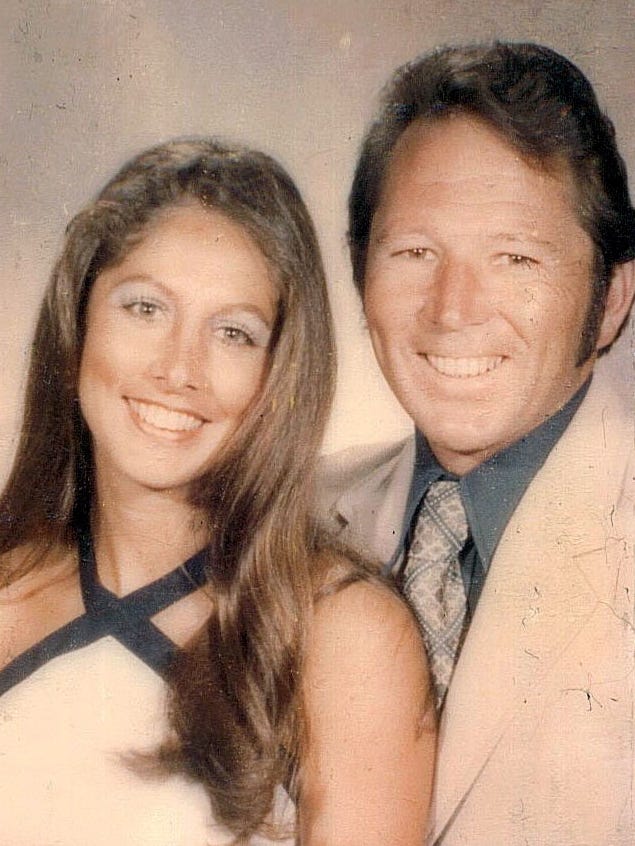
Janna Kathleen Rowe, a vibrant 25-year-old woman, was just beginning a new chapter of her life in Southern California when it was brutally cut short. Born on October 23, 1961, in Salt Lake City, Utah, Janna had recently moved to Newbury Park, a community in Ventura County, where she worked as a waitress. She was building a new life for herself, only to have it stolen by a man who would evade justice for her murder for decades.
The day after Christmas 1986, on December 27, Janna’s body was discovered. She had been strangled and left on a trash pile near the Ventura River. The investigation into the young woman's death soon focused on a man named Horace Van Vaultz Jr., who claimed to have befriended Janna after her recent move from Utah. He admitted to having seen her at a Ventura motel the day before she was found, but provided an alibi for the time of her death.
Despite his conflicting statements and his presence at the motel around the time Janna was killed, the case against him was circumstantial. In January 1988, to the devastation of Janna’s family, a jury acquitted Van Vaultz of her murder. At the time, the forensic technology that would later prove his guilt did not exist for trial use.
For more than 30 years, Janna's case went cold, but her family never lost their conviction that Van Vaultz was responsible. The injustice of the acquittal was a wound that never healed. The break in the case came from an unexpected source: the advancement of DNA technology and the rise of investigative genetic genealogy. In the 2000s, detectives were able to link DNA evidence from the murders of two other women, 20-year-old Selena Keough in 1981 and 22-year-old Mary Duggan in 1986, to a single unknown suspect. In 2019, using genealogical databases, investigators finally identified that suspect as Horace Van Vaultz Jr.
During the investigation into the Keough and Duggan murders, law enforcement re-examined the evidence from Janna’s case. They found a definitive DNA link between Van Vaultz and Janna; his semen was present on her body. Although the principle of double jeopardy prevented him from being tried again for Janna’s murder, this crucial piece of evidence was presented at his 2022 trial for the murders of Selena Keough and Mary Duggan. Prosecutors argued that it established a clear pattern of him being a "sexually motivated serial killer."
During the trial, Van Vaultz, who described himself as a "swinger," admitted he knew Janna but denied killing her or the other women. He claimed any sexual contact was consensual and that his DNA at the scene did not make him a murderer. The jury, however, was unconvinced. On August 18, 2022, they found Horace Van Vaultz Jr. guilty of two counts of first-degree murder with special circumstances of multiple murders, rape, and sodomy. He was sentenced to two consecutive terms of life in prison without the possibility of parole.
For Janna’s family, the verdict brought a complex mix of relief and sorrow. They had waited 34 years to see the man they knew was responsible for her death held accountable. Janna's parents and brother, Jeffry Rowe, attended the sentencing. Jeffry spoke of the enduring pain and frustration his family had lived with for decades. "Horace Van Vaultz Jr., oh, how I loathe that name," he said in a statement. "It makes me ill just to speak it. I've despised the defendant since he was acquitted of murdering my sister Janna in 1988, knowing full well in my mind he was guilty. How unjust to have him alive and free on the same Earth as us for the last 37 years."
While the legal system could not retry Van Vaultz for Janna's death, the DNA evidence that definitively linked him to her murder was instrumental in ensuring he would spend the rest of his life in prison. The long-delayed justice in the connected cases finally brought a measure of closure to the family of Janna Kathleen Rowe, confirming a truth they had carried in their hearts for more than three decades.