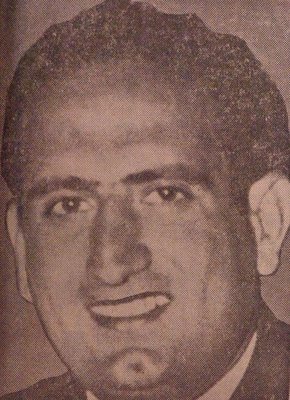
Paul Volpe, a 56-year-old Italian-Canadian man, was a prominent Toronto organized-crime figure whose life ended in a carefully executed killing on November 13, 1983. Known in underworld circles as “The Fox,” Volpe had spent years building influence in gambling, loansharking, construction-related rackets and other criminal enterprises in southern Ontario, while maintaining connections to organized-crime figures in both Canada and the United States.
By the early 1980s, however, he had accumulated a long list of enemies, and police already knew that at least one serious murder plot had been directed at him.
Volpe was last seen leaving the La Sem café in Woodbridge with his longtime driver and associate, Pietro “Peter” Scarcella. Investigators later learned that Volpe had reportedly told his wife that he was expecting to meet someone connected to Buffalo or elsewhere in the United States. Approximately 25 minutes after he was last seen, investigators believed he was killed. When he failed to return or telephone his wife, concern grew and his lawyer ultimately reported him missing.
On November 14, 1983, Volpe's body was discovered curled in a fetal position inside the trunk of his wife's BMW in a parking garage at Toronto International Airport, now Toronto Pearson International Airport. He had been shot several times in the head at close range. Accounts of the case describe the weapon as a small-calibre firearm, although Peel homicide investigators later declined to publicly identify the precise weapon and confirmed that the murder weapon was never recovered.
Detectives did not believe Volpe had been killed inside the trunk. The interior was comparatively clean for a shooting scene, and investigators concluded that he had been shot somewhere else, placed in the vehicle and then transported to the airport. Organic material recovered from the trunk suggested to investigators that the shooting may have occurred in an open outdoor area, but they were never able to connect that evidence to a specific murder scene. Police came tantalizingly close to obtaining another potential lead from airport parking records, where attendants recorded the licence plates of only a portion of vehicles entering or leaving. Volpe's BMW was among the vehicles whose plate had not been recorded, preventing detectives from identifying who brought the car into the garage.
The killing occurred against the backdrop of an earlier, documented contract on Volpe's life. In 1981, former Satan's Choice member and hitman Cecil Kirby was offered $20,000 to kill Volpe and, at one stage, Volpe's driver Scarcella. Kirby was secretly cooperating with the Royal Canadian Mounted Police. Authorities informed Volpe of the contract and enlisted his cooperation in an elaborate operation in which his death was temporarily staged. Volpe and his wife were hidden while Kirby told those who had hired him that Volpe had been killed, even producing Volpe's wallet as supposed proof.
That undercover investigation resulted in arrests and convictions involving members of the Commisso organization. Rocco Remo Commisso and Cosimo Commisso were convicted on serious charges arising from the murder plots and Kirby's evidence, including conspiracy-related offenses, while Michele Commisso was also convicted in connection with the wider conspiracy investigation. Those proceedings concerned the earlier attempted contract killing and other criminal plots; they did not establish who murdered Volpe in November 1983. Nevertheless, the case demonstrated that people within Toronto's organized-crime world had been actively trying to have Volpe killed well before his death.
Investigators examined several possible motives. One involved Volpe's dealings with the Commisso organization. Published accounts state that Volpe became involved with the group in real-estate transactions and was accused of cheating them, creating a bitter dispute. Another possibility centered on control of Toronto gambling and other underworld businesses. Police believed that Volpe's death created an opportunity for rival figures to expand their influence over operations that he had previously controlled.
Scarcella became an important figure in the homicide investigation because he was among the last people known to have been with Volpe. Former Toronto police intelligence official Ron Sandelli later described Scarcella as his principal suspect and believed he possessed information that could have unlocked the case. Another former investigator, Dan Parkinson, similarly said police considered Scarcella potentially crucial to determining what happened. Neither the suspicion surrounding Scarcella nor his proximity to Volpe before the killing resulted in a murder charge.
Enio “Pegleg” Mora, an organized-crime associate who had worked with Volpe, was also regarded by police as a possible participant. Investigators suspected that Mora may at least have helped lure Volpe into the circumstances that allowed his killers to reach him. Hamilton mob figure Johnny Papalia was another person repeatedly linked by investigators and organized-crime researchers to the killing. Montreal hitman Réal Simard has likewise been associated with theories surrounding the murder. None of those men was charged with killing Volpe.
A separate investigative theory led police south of the border. Volpe had become involved in real-estate ventures around Atlantic City, New Jersey, at a time when the Philadelphia Mafia exercised substantial criminal influence in the area. Former Peel homicide investigator Parkinson believed Volpe's Atlantic City dealings could have been the key to his murder. Police investigated whether Philadelphia crime boss Nicodemo “Little Nicky” Scarfo might have ordered Volpe killed because of disputes over Volpe's activities and money in Atlantic City. Informant Marvin Elkind later made a similar allegation. Investigators travelled to New York, Philadelphia and Atlantic City pursuing the American connection but were unable to develop evidence sufficient for charges.
The location where Volpe's body was abandoned also attracted attention. Investigators and organized-crime sources considered it possible that leaving his corpse at an international airport was intentional, potentially signaling that the motive involved business or enemies outside Canada. Other investigators believed the explanation might have been much closer to home, pointing to Volpe's numerous disputes, unpaid debts, questionable business dealings and conflicts within Toronto's criminal underworld. The sheer number of people who had reasons to resent him made narrowing the investigation particularly difficult.
Despite years of investigation, interviews and examination of competing theories, no one was arrested, tried or convicted for Paul Volpe's actual murder. The earlier Commisso conspiracy produced prosecutions, but the November 1983 killing remained a separate unsolved homicide. Investigators continued to preserve evidence and hoped that someone with direct knowledge of the execution or the events leading to it would eventually come forward. Volpe's murder consequently remained one of the Toronto area's longest-running organized-crime cold cases, with numerous suspected participants and possible motives but no proven killer.