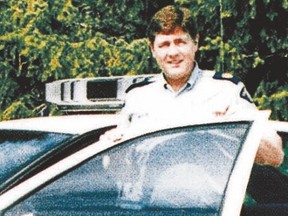
Gordon Edwin Sanderson was a 26-year-old Indigenous man from Manitoba who had been living in Edmonton before his death. Born on October 22, 1950, Sanderson and his siblings were separated from their family during the Sixties Scoop, and he was placed in foster care when he was nine. By the 1970s, he was living in Edmonton, and the last information his family had about his plans was that he intended to visit his brother in Calgary.
His exact date of death has never been firmly established, although investigators regard the case as a 1977 homicide.
On April 13, 1977, a local couple went to an abandoned rural property in the Lindbrook area, west of Tofield, hoping to recover a pump from an old septic tank. When they opened the tank, they noticed what appeared to be part of a human leg in the contents. The Tofield RCMP were contacted, and officers began the difficult process of emptying the approximately six-foot-deep tank. Sanderson's badly decomposed remains were eventually recovered. His body had been wrapped in a yellow bedsheet, secured with nylon rope and deposited headfirst into the tank. Quicklime had also been placed with the remains, apparently in an attempt to accelerate their destruction.
The examination of the remains revealed an exceptionally violent killing. Sanderson had been beaten and restrained before his death. Evidence indicated that he had been deliberately burned with cigarettes and a small butane torch, with burns also visible on portions of his clothing. He had suffered severe mutilation with a sharp instrument. Investigators believed the nature and extent of the injuries showed that he had been tortured before being killed. His fatal injuries included gunshot wounds to the head and chest. Reports concerning the investigation indicated that the shots were fired with a small-caliber firearm, described in some accounts as a. 32-caliber weapon.
Investigators believed the septic tank was probably a disposal site rather than the location where the killing occurred. The isolated property and the manner in which the body had been concealed suggested that whoever disposed of Sanderson knew the area or was at least familiar enough with the abandoned farm to believe the remains would remain undiscovered. Police also believed the extraordinary violence inflicted on him made it likely that his killers knew him and that the attack was personal rather than a random encounter.
For decades, however, investigators did not know the victim's identity. The case became widely known by the nickname "Septic Tank Sam." Police interviewed potential witnesses, pursued numerous leads and circulated dental information in an effort to identify him. His remains were exhumed more than once so forensic specialists could study them and create facial reconstructions. A reconstruction was produced in 1979, and another examination and reconstruction took place years later, but none of those efforts produced a confirmed identification.
The breakthrough came through forensic genetic genealogy. After conventional DNA searches failed to identify him, the Alberta RCMP Missing Person Unit and the Office of the Chief Medical Examiner worked with Othram, a Texas laboratory, to develop a more complete genetic profile from the degraded remains. Genealogical research produced possible relatives, and investigators subsequently obtained familial DNA samples. By October 2020, testing had confirmed a family relationship, and investigators ultimately established that the long-unidentified victim was Gordon Edwin Sanderson. The RCMP publicly announced his identity on June 30, 2021, more than four decades after his body was recovered.
Identifying Sanderson gave homicide investigators an opportunity to reconstruct his final months and revisit people connected to him in Edmonton. Police have said they believe he may have been killed by associates who were involved in criminal activity in the Edmonton area. Authorities have not publicly named a specific person as the killer, and they have acknowledged that because so much time has passed, whoever was responsible may already be dead. Investigators have continued seeking people who knew Sanderson or had contact with him shortly before his disappearance and death.
No arrest, criminal charge, trial or conviction has been publicly reported in connection with Sanderson's killing. Although solving his identity transformed the investigation and gave police new avenues to explore, the homicide itself remains unsolved. The Alberta RCMP Historical Homicide Unit has continued asking anyone with information about Sanderson's final days, his associates or the circumstances of his death to come forward in hopes of determining who tortured, killed and concealed him more than four decades ago.