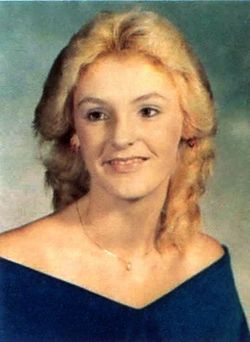
Teresa Ann Carmichael Hall was a 25-year-old white woman living in Cypress, a small community in Jackson County, Florida, when she and her five-year-old daughter, Tiffany Hall, were killed in December 1991. Online accounts place the killings during the night of December 9, after mother and daughter had returned home from a Christmas parade in nearby Marianna. By the following morning, both were found dead inside their residence. Some records list Teresa's death date as December 10, apparently reflecting the date the bodies were discovered, while accounts of the crime identify December 9 as the date of the murders.
The scene suggested a sudden and extremely violent attack inside the Hall home. Published accounts state that someone forced entry through the front door and that a wooden table was broken apart during the assault. Teresa and Tiffany were reportedly bludgeoned, with investigators believing a leg from the broken table was used as a weapon. The location of the house near railroad tracks eventually became an important feature of the investigation because it raised the possibility that a transient offender moving along rail routes could have been responsible.
For years, investigators were unable to identify anyone they could charge with the murders. One major lead eventually centered on Ángel Maturino Reséndiz, the serial killer widely known as the "Railroad Killer." Reséndiz traveled extensively by freight train and committed murders in communities near railroad lines, making the setting of the Hall home significant to investigators. Authorities questioned him about the Florida killings, and he was publicly identified as a suspect, but the investigation did not produce charges against him for Teresa and Tiffany Hall's deaths.
Another notorious serial killer, Tommy Lynn Sells, later became linked to the case. Sells was arrested in Texas in January 2000 after attacking two girls in Del Rio, killing 13-year-old Kaylene Harris and severely injuring 10-year-old Krystal Surles. Surles survived and helped authorities identify him. After his arrest, Sells confessed to numerous killings around the country, although law-enforcement officials determined that some of his claims were difficult or impossible to corroborate.
Sells reportedly confessed to killing Teresa and Tiffany Hall. Accounts attributing the crime to him say he claimed responsibility for entering the home and bludgeoning the mother and daughter with a wooden table leg. The confession caused investigators to reconsider the long-unsolved Cypress murders and shifted attention away from Reséndiz as the only prominent serial-killer suspect. At the same time, Sells had a documented history of making numerous confessions, some of which investigators believed could have been false or exaggerated, so his admission did not by itself establish that he committed the Hall murders.
Sells was never arrested, charged, tried, or convicted for the deaths of Teresa or Tiffany Hall. His convictions involved other crimes, including the murder of Kaylene Harris and another Texas murder, and he ultimately received a death sentence in Texas. He was executed by lethal injection on April 3, 2014. Reséndiz likewise was never charged in the Hall case; he was convicted of an unrelated Texas murder and executed in 2006.
Despite investigators having examined both Reséndiz and Sells, available online accounts continue to describe the killings of Teresa and Tiffany Hall as unsolved. No person has been convicted of their murders, and no publicly documented prosecution conclusively established either serial killer as the perpetrator. The case therefore remains one in which investigators developed significant suspects and obtained at least one reported confession, but never secured the evidence necessary to bring anyone to trial for the deaths of Teresa and her daughter.