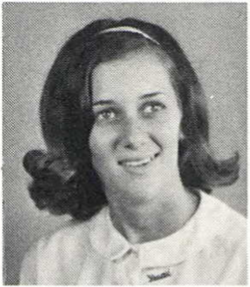
Elyse Rapp, whose surname has sometimes been rendered in later records as Napp, was a 21-year-old white Jewish woman from New York who had come to South Florida in June 1975 for temporary work. Contemporary accounts described her as quiet and shy. She was living in Hallandale, working as a secretary through Kelly Girl Services in Broward County, and reportedly intended to return to her home in Flushing, New York, later that year.
On the evening of July 30, 1975, she left her apartment to go shopping. When she did not return, her landlady became concerned and contacted police as well as her family.
The following morning, July 31, a worker grading a dirt road discovered her body floating in the Graham Canal in northwest Dade County. The location was especially disturbing to investigators because it was only a short distance from where Ronnie Sue Gorlin had been found dead about a week earlier. Rapp had been stripped of her clothing except for a necklace bearing the Hebrew symbol for “life.” The canal water was roughly 10 to 12 feet deep in the area where she was recovered. Investigators determined that she had been sexually assaulted before death and had suffered a significant blow to the head that was capable of causing a concussion. The medical examination established drowning as the cause of death. Historical accounts also describe severe sexual injuries, although surviving summaries differ somewhat on the precise extent of those wounds.
Police quickly found another connection to the Gorlin homicide. Rapp's rented yellow Chevrolet Vega had been left in a shopping-center parking lot with a deflated tire. Gorlin's rental vehicle had also been discovered with a damaged or flat tire before her body was recovered from the same canal. Those similarities led detectives to believe the same assailant had encountered both victims after deliberately disabling their vehicles. Investigators theorized that the killer damaged a tire while the victim was away from the car, waited for her to return, and then approached pretending to be a helpful stranger. By offering assistance or transportation, he could gain enough trust to get the victim away from the public parking area. This suspected method eventually produced the name by which the series became known: the Flat-Tire Murders.
Within a day of Rapp's discovery, Dade County authorities publicly stated that they were looking for a single perpetrator in the Rapp and Gorlin killings. Investigators also began comparing the two murders with other recent deaths in Dade and Broward counties. On August 29, 1975, deputy chief medical examiner Dr. Ronald Wright said he believed five killings were probably the work of the same assailant: those of Rapp, Gorlin, Barbara Stephens, Barbara Schreiber and Belinda Zetterower. Investigators developed a behavioral picture of a young, physically capable, well-presented and intelligent man who could appear trustworthy enough to approach strangers without immediately alarming them. Because the victims apparently had no previous relationship with their attacker, detectives faced the particularly difficult problem of identifying a stranger who may have selected his targets opportunistically in public places.
The investigation briefly expanded far beyond South Florida. Dade homicide detective Charles Mussoline and Sonoma County, California, Sgt. Erwin Carlstedt examined whether the Rapp and Gorlin murders could be part of a trail of similar killings extending through several western states. Authorities compared the Florida crimes with dozens of attacks in California, Washington and Utah. Ted Bundy consequently became the subject of speculation because he was responsible for numerous attacks on young victims elsewhere and was known to have experimented with ways of disabling vehicles so he could approach potential victims. Bundy was arrested in Utah in August 1975, but investigators never established evidence tying him to Rapp's murder. Florida investigators ultimately moved away from the theory that he was the Flat-Tire killer, and Bundy never confessed to Rapp's homicide before his execution. He was never charged or tried for her death.
Later developments in other cases once grouped with the Flat-Tire Murders have not produced a resolution in Rapp's case. DNA testing eventually identified Robert Clark Keebler and Lawrence Stein as the suspected perpetrators in the 1975 murders of Barbara Schreiber and Darlene Zetterower. Both men were already dead by the time investigators reached those conclusions. More importantly, Broward cold-case investigators have said they do not believe Keebler and Stein were responsible for the broader Flat-Tire series because the circumstances and method of the Schreiber-Zetterower killings differed from the other cases. Their identification therefore did not amount to an arrest, charge or solution in Rapp's homicide.
Despite the intensive investigation, comparisons with killings across the country and decades of renewed interest in the South Florida canal murders, no person has been arrested, charged, tried or convicted for killing Elyse Rapp. Her murder remains unsolved. The strongest conclusion reached by the original Dade investigators was that the person who killed her was also responsible for Ronnie Gorlin's death and had probably used the victims' disabled automobiles as the opportunity to approach them. Rapp's disappearance on July 30 and the recovery of her body on July 31, 1975, rather than July 1, place her killing at the center of the series of crimes that frightened South Florida during the summer of 1975 and left investigators searching for an unidentified killer who was never brought to justice.