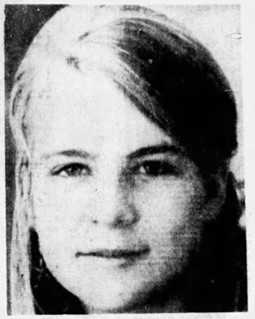
In the waning days of November 1972, a chill settled over Boston, a cold that had little to do with the approaching winter. Damaris Synge Gillispie, a 22-year-old White/Caucasian female, was a senior honors student at Boston University, poised on the brink of a future in art therapy. On the evening of November 29th, she left her Cambridge apartment, intending to hitchhike to her job as a cocktail waitress at The Jazz Workshop, a common practice for her. It was the last time she was seen alive.
Her failure to return home sparked a frantic search initiated by her roommates and family, who blanketed the city with over 20,000 posters and established a 24-hour hotline in the desperate hope of finding her.
The city was already on edge, gripped by a series of slayings that targeted young women and had been dubbed the "Hitchhike Murders." A mysterious man began calling the hotline set up for Gillispie, revealing details about her personal belongings that only her abductor could have known, deepening the sense of dread. The calls abruptly stopped after they were reported in the newspapers. For months, there was no sign of Damaris. The agonizing wait for her family ended in the most tragic way possible on February 3, 1973, when two children discovered her nude body in a snow-covered wooded area in Billerica, about 20 miles from Boston. An autopsy confirmed she had been strangled to death around the time of her disappearance.
The breakthrough in the series of terrifying crimes came on a December night in 1972. Police, already on high alert, pursued a man in a dark Cadillac, leading to a high-speed chase and a shootout. The driver, Anthony Jackson, also known as the 'Hitchhiker Murderer,' was apprehended. The investigation into Jackson unraveled a web of evidence connecting him to the string of killings that had terrorized the greater Boston area. He had told a prostitute that he had murdered a woman and was driving around with her body in the trunk of his car on the night Gillispie vanished. A search uncovered the victim's fur-lined coat, rings, and bloody shoes, which Jackson had given to the woman. Police also recovered a metal box Jackson had ordered to be thrown into the Charles River; it contained hundreds of photos of nude women, including images of Damaris Synge Gillispie.
Anthony Jackson was subsequently indicted for the murder of Damaris Synge Gillispie and several other young women. His trials were marked by delays and histrionic behavior, but the evidence against him was overwhelming. He was ultimately convicted for the murders of Gillispie, Ruth Hamilton, and Ellen Reich, receiving three consecutive life sentences. The convictions brought an end to a reign of terror and delivered a measure of justice for the victims and their families, though the brutal slayings left an indelible scar on the city of Boston.