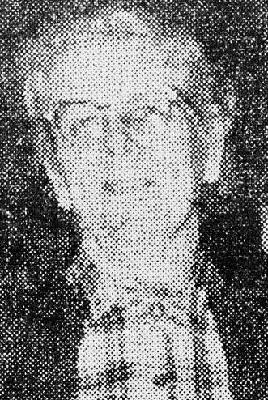
Ray Burgess, a White/Caucasian man reported to be about 50 years old, vanished near Plainfield, Wisconsin, on November 1, 1952, under circumstances that have never been satisfactorily explained. Although that date is sometimes treated as his presumed date of death, available missing-person records do not establish that Burgess died that day. In fact, investigators were never even able to confirm that “Ray Burgess” was his true name.
He was described as a short, heavyset stranger, approximately 5 feet 6 inches tall and around 250 pounds, with a round or “baby-faced” appearance and one or more noticeable gold teeth. He variously suggested that he lived in Milwaukee or Madison and claimed to be an executive for a chain store.
Burgess entered the story only about a week before his disappearance. On October 25, 1952, he met Victor Harold “Bunk” Travis at a tavern in Big Flats, Wisconsin. Burgess attracted attention because he was carrying a conspicuous roll of money and freely buying drinks for people in the establishment, paying with large-denomination bills. Travis became acquainted with him and reportedly considered bringing the stranger to his mother's home, but his mother was uneasy about Burgess and warned her son about associating with someone they knew so little about. Despite those concerns, Travis and Burgess continued spending time together and made plans to hunt.
On November 1, Travis and Burgess returned to the Big Flats tavern and told people they intended to go squirrel hunting on property belonging to farmer Lars Thomsen in the Plainfield area. Travis left his own automobile behind and rode with Burgess in a 1950 Oldsmobile. At approximately 4:00 that afternoon, the men arrived at a Plainfield tavern, where they remained for roughly three hours. At about 7:00 p.m., they left together, reportedly saying they were headed back toward the Thomsen property. That was the last confirmed sighting of either man. Neither Burgess nor Travis was ever seen again.
The disappearance quickly became more troubling because items belonging to Travis remained behind. His hunting rifle, clothing and hunting dog were subsequently located on the property where the men had been hunting. Burgess's identity also began to unravel when investigators examined the automobile information. Thomsen's wife had written down the license plate number from Burgess's Oldsmobile. Authorities discovered that the plate had been issued in the name of a Milwaukee man who had already died. The automobile itself was traced through previous ownership to a dealer in Chippewa Falls and a farmer in Stanley, Wisconsin, but neither man was named Ray Burgess or matched the stranger's description. These discoveries left investigators with the possibility that Burgess had been traveling under an assumed identity.
Years later, the mystery took another turn when investigators reportedly explored a possible organized-crime connection. Reporting concerning a renewed investigation in 1961 said that a witness had tentatively identified the man calling himself Ray Burgess as someone associated with the Chicago crime syndicate and described as an enforcer. That theory raised the possibility that Burgess's sudden appearance in Victor Travis's life, his large amount of cash, the questionable identity connected to his automobile and the subsequent disappearance were not coincidental. Under that scenario, Burgess himself could conceivably have been involved in whatever happened to Travis rather than simply being another victim. The theory was never proved, however, and Burgess's true identity has remained uncertain.
Another name inevitably became associated with the mystery: Edward Gein. The Thomsen hunting property was adjacent to or near Gein's Plainfield farm, and after Gein's crimes were uncovered in November 1957, authorities reconsidered several unexplained disappearances from the surrounding area. Human remains discovered in connection with searches around Gein's property intensified speculation about missing people from earlier years. Burgess and Travis were consequently mentioned among cases potentially connected to Gein, but investigators never developed evidence proving that Gein killed either man. Gein denied responsibility for their disappearance, and no remains were conclusively identified as belonging to Burgess or Travis.
Gein was arrested in 1957 after the disappearance and murder of Plainfield hardware-store owner Bernice Worden. He was ultimately tried in 1968; the court determined that he had killed Worden, but he was adjudged not guilty by reason of insanity and remained confined in a state institution. He also admitted killing tavern owner Mary Hogan. Despite the proximity of his property and the later suspicion surrounding the two missing hunters, Gein was never arrested, charged, tried or convicted in connection with Burgess's or Travis's disappearance.
More than seven decades later, there is still no verified account of what became of the man known as Ray Burgess. No body has been conclusively identified as his, no homicide conviction has been obtained, and there is no definitive evidence establishing that November 1, 1952, was actually the date of his death. The case instead remains intertwined with the unsolved disappearance of Victor Travis, an unidentified stranger using questionable credentials, an abandoned trail of hunting belongings, competing theories involving organized crime and Ed Gein, and the unanswered question of whether “Ray Burgess” ever existed under that name at all.