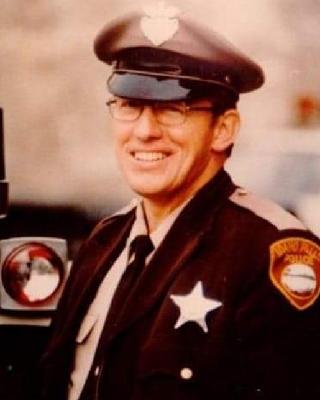
On the night of April 7, 1979, Illinois State Police Trooper Michael Keith McCarter—a 32-year-old white male and U.S. Marine veteran who had served in Vietnam—pulled alongside a small convoy on Interstate 57 just south of Paxton. Riding with the trooper was his brother-in-law, Donald Vice, as he worked an unmarked state car and called for help from Paxton Patrolman William Caisse.
What began as speeding stops quickly turned volatile: one of the targeted cars, a red-and-silver Ford Thunderbird carrying two of the Lampkin brothers, refused to remain at the original stop near the Route 9 overpass. McCarter gave chase toward the Route 17 overpass, radioing urgently that he had “a subject giving me a hard time,” and moments later that he had been shot. Gunfire erupted from the embankment near the overpass as officers and civilians converged on the scene. Trooper Michael Keith McCarter, a decorated Vietnam veteran, was struck multiple times by gunfire and mortally wounded.
The chaos on the shoulder and the slope above it drew in everyone who had been stopped—officers, drivers, passengers. Witnesses described muzzle flashes from the west side of the road and the trooper returning fire up the embankment. Forensic work later documented. 38-caliber casings and cartridges on the grassy hill; a matching handgun was never recovered. The trooper’s autopsy showed fatal wounds to the neck among others, and investigators traced key bullets to a. 38-caliber weapon. Patrolman Caisse was also fatally shot while trying to pull the wounded trooper to safety; Vice fell near the rear passenger door of the unmarked car; Paxton Officer Larry Hale survived after being hit and returning fire. Trooper Michael Keith McCarter, a Vietnam veteran who had served his country before joining the Illinois State Police, was one of three people killed that night, along with Caisse and Vice.
The men who clashed with police were the Lampkin brothers—Monroe, Cleveland, David, and Clyde—traveling south that evening. During the exchange, Cleveland Lampkin was shot by the trooper and later died, and David Lampkin was killed when Officer Hale returned fire. Clyde Lampkin was taken into custody on weapons charges in the immediate aftermath, while the remaining suspect, Monroe Lampkin, fled the scene and was arrested roughly 26 hours later north of Paxton with a gunshot wound to his wrist. The arrests and rapid investigative work refocused the case onto Monroe Lampkin as the surviving principal suspect in the killings of Trooper McCarter, Patrolman Caisse, and Donald Vice.
Prosecutors initially won convictions against Monroe Lampkin, including a death sentence, but the legal story stretched over years. In 1983, the Illinois Supreme Court reversed and remanded for a new trial after finding prejudicial errors, including the use of an old threat and undisclosed serology that undermined a key prosecution theory about whose blood and shells were found on the embankment. A second conviction followed, then another reversal in 1990 over hypnotically influenced testimony. In January 1991, a third jury again found Monroe Lampkin guilty of murdering Trooper Michael Keith McCarter, Patrolman Caisse, and Donald Vice; this time the Appellate Court affirmed the verdict and the case closed with concurrent life sentences. Decades later, news reports confirmed that Monroe Lampkin died in prison in 2021 while serving those terms.
In the years since, the community has marked the place where Trooper McCarter fell. The overpass at I-57 was officially dedicated in 2018 as the McCarter-Caisse-Vice-Hale Memorial Overpass, a roadside reminder of a night when a routine stop unraveled into sudden violence. The Illinois State Police memorial rolls and officer tributes continue to bear McCarter’s name and service dates, honoring not only his sacrifice in law enforcement but also his earlier service to the nation in Vietnam.