

Why Crime Database Analysis Matters for Justice

Crime database analysis is the systematic examination of criminal data to uncover patterns, trends, and insights that enable more effective policing and justice responses. For researchers and advocates, understanding why crime database analysis matters is the starting point for any serious effort to improve public safety outcomes. The national homicide clearance rate sits at roughly 59%, while nonfatal shooting clearance falls to around 20% and property crime clearance drops below 15%. Those numbers reveal a justice system that urgently needs better data practices. Crimesolverscentral maintains a national database of over 264,913 cases, demonstrating the scale at which organized crime data can support investigators and advocates alike.
Why crime database analysis matters for law enforcement operations
Crime database analysis gives law enforcement the ability to move from reactive to proactive policing. Without structured data examination, officers respond to incidents as they occur. With it, they can predict where and when crimes are most likely to happen and deploy resources accordingly.
Place-based crime analysis identifies high-frequency crimes at specific times and locations, making geography the central variable in prevention strategy. A patrol commander who knows that knife assaults spike on Friday evenings near a particular transit hub can station officers there before an incident occurs, not after. This shift from response to prevention is the core operational benefit of crime analytics.

West Midlands Police demonstrated this concretely. Their Project Guardian initiative used geospatial and temporal hotspot analysis to achieve a 16% reduction in knife crime. That result came directly from mapping crime data to specific streets and time windows, then targeting patrols accordingly.
Crime analysts operate at two levels that serve different planning horizons:
- Tactical analysis addresses immediate operational needs, such as identifying active offenders, linking crimes in a series, and supporting ongoing investigations.
- Strategic analysis examines long-term trends across months or years to inform staffing decisions, budget allocations, and community intervention programs.
- Administrative analysis produces performance reports that help agency leadership evaluate whether current strategies are working.
- Investigative analysis links suspects, victims, and locations across multiple cases to surface connections that individual detectives might miss.
Pro Tip: When requesting crime data for advocacy work, always ask whether the dataset distinguishes between tactical and strategic analysis outputs. The two serve different purposes and mixing them produces misleading conclusions.
What are the biggest challenges in crime data management?
Raw crime data is rarely ready for analysis. Duplicates, incomplete records, and administrative noise contaminate datasets before a single query runs. Manual data cleaning is not optional. It is the prerequisite for any analysis that will hold up to scrutiny.
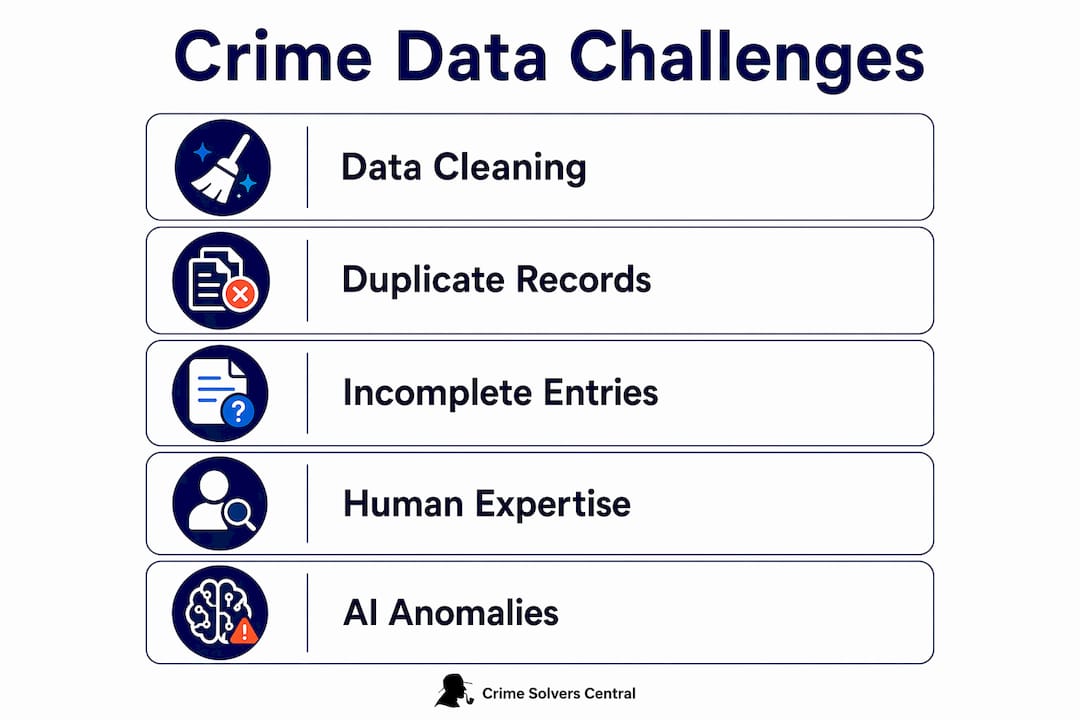
One underappreciated problem is the presence of administrative location data inside crime records. Hospital addresses, custody facility coordinates, and police station locations can appear as incident sites when data is exported from case management systems. Filtering these artifacts before mapping is essential. Skipping this step creates false hotspots that send patrols to the wrong places.
Database fragmentation compounds the problem. Many agencies still operate across multiple disconnected systems, forcing officers and dispatchers to run sequential queries across separate terminals. The operational cost is significant:
- Extended query times force dispatchers to keep officers waiting during active calls, creating safety risks in time-sensitive situations.
- Inconsistent data formats across systems mean the same person or address may appear under different spellings, making cross-database matching unreliable.
- Siloed records prevent analysts from seeing connections between cases that span jurisdictions or offense categories.
- Legacy terminal setups require specialized training for each system, increasing onboarding time and reducing analyst capacity.
- Audit trail gaps in fragmented environments make it harder to document the chain of analysis for court proceedings.
“Multi-database fragmentation forces officers to juggle multiple systems, causing inefficiencies and safety risks. Integrated interfaces that consolidate queries under a secure architecture improve both dispatcher workflow and officer safety in ways that individual system upgrades cannot replicate.”
The human expertise problem is equally serious. AI tools can process large datasets quickly, but they produce anomalies that require expert correction. An algorithm that flags a cluster of incidents as a hotspot may be detecting a reporting artifact rather than a genuine crime concentration. Only a trained analyst with local knowledge can tell the difference.
How is technology changing crime database analysis in 2026?
The most significant technological shift in crime data analysis is the move toward unified database access. Consolidating queries across systems like NCIC and NLETS reduces investigative query time from 30–45 minutes to under 5 minutes. That reduction is not just an efficiency gain. It directly affects officer safety by eliminating the wait time during active field situations.
Real-time dashboards now allow analysts to visualize crime patterns as incidents are reported rather than reviewing static weekly summaries. This shift gives tactical commanders the ability to adjust patrol assignments within hours of a pattern emerging. The difference between a weekly briefing and a live dashboard is the difference between reacting to last week’s crime and preventing tonight’s.
AI plays a growing but carefully bounded role in this environment. The technology automates repetitive classification tasks, flags potential case linkages, and generates preliminary pattern reports. What it cannot do is replace the contextual judgment that experienced analysts bring to interpretation.
| Capability | Traditional approach | Technology-assisted approach |
|---|---|---|
| Query time across databases | 30–45 minutes per query | Under 5 minutes with unified access |
| Hotspot identification | Manual map review | Automated geospatial clustering |
| Case linkage | Individual detective review | AI-flagged similarity scoring with analyst review |
| Pattern reporting | Weekly static summaries | Real-time dashboard updates |
| Data cleaning | Fully manual | Semi-automated with mandatory human audit |
Crime mapping software now integrates temporal filters, allowing analysts to isolate incidents by hour, day of week, and season simultaneously. This granularity matters because a neighborhood that appears safe on aggregate data may have a concentrated problem on Tuesday evenings that aggregate statistics obscure.
Pro Tip: When evaluating crime mapping outputs for advocacy purposes, always request the temporal breakdown alongside the geographic view. A map without time filters can misrepresent the actual risk profile of a location.
How does crime data analysis shape criminal justice policy?
Crime database analysis is the foundation of evidence-based policy. Without it, policy decisions rest on anecdote, political pressure, or outdated assumptions. With it, researchers and advocates can evaluate whether specific interventions actually reduce crime for specific populations.
Access to individual criminal records data remains underutilized for policy evaluation. Researchers frequently struggle to obtain the granular data needed to assess what works for whom, limiting the rigor of program evaluations and weakening the evidence base for reform. Opening structured access to this data, under appropriate privacy protections, would significantly improve the quality of criminal justice research.
The importance of crime analysis for advocacy extends beyond academic research. Advocates use crime trend data to:
- Identify communities where specific offense types are concentrated and direct resources accordingly.
- Document disparities in clearance rates across offense types or geographic areas to support reform arguments.
- Evaluate whether post-intervention crime rates changed in ways consistent with program goals.
- Build public-facing narratives grounded in verified data rather than perception.
- Support grant applications with quantitative evidence of community need.
The role of criminal databases in policing extends directly into policy because the same data that guides patrol decisions also reveals systemic patterns. A database showing that property crime clearance rates remain below 15% is not just an operational problem. It is a policy argument for increased investigative resources and improved data-sharing protocols between agencies.
Understanding crime trends at the individual record level also helps researchers distinguish between programs that reduce crime overall and those that simply displace it to adjacent areas. That distinction is critical for honest policy evaluation and for advocates who want to recommend interventions that genuinely improve community safety rather than shift the problem.
Key Takeaways
Crime database analysis directly improves public safety outcomes when data is clean, unified, and interpreted by trained analysts working alongside technology.
| Point | Details |
|---|---|
| Clearance rates reveal the stakes | Homicide clearance at 59% and property crime below 15% show how much room exists for data-driven improvement. |
| Geospatial analysis produces results | West Midlands Police cut knife crime by 16% using hotspot mapping and targeted patrol deployment. |
| Data quality precedes analysis | Removing administrative noise and duplicates before mapping prevents false hotspots and flawed conclusions. |
| Unified access saves critical time | Consolidating database queries cuts investigative time from 30–45 minutes to under 5 minutes per query. |
| Policy needs individual record access | Researchers require granular criminal record data to evaluate what interventions work for specific populations. |
The uncomfortable truth about crime data and justice
The field talks a great deal about the promise of data-driven policing and evidence-based policy. What gets discussed less honestly is how often the data itself is the problem. I have seen analysts produce authoritative-looking hotspot maps built on datasets that still contained hospital addresses and custody facility locations as incident sites. The maps looked credible. The conclusions were wrong.
The balance between AI tools and human expertise is not a philosophical debate. It is a practical daily reality for anyone working with crime databases. Automated systems accelerate the work, but they do not understand context. An algorithm does not know that a spike in reported incidents near a particular address reflects a new community reporting program, not an actual increase in crime. A trained analyst does.
My strongest conviction is that open access to crime data for researchers and advocates is not a risk to manage. It is a resource to develop. The communities most affected by crime are also the communities most underserved by opaque data systems. When advocates cannot access the numbers, they cannot make the arguments. When researchers cannot access individual records, they cannot build the evidence. The result is policy made on assumption rather than fact, and communities that continue to wait for justice.
Crimesolverscentral exists precisely because that gap is real and consequential. Over 264,913 cases in a single searchable database represents what organized, accessible crime data can look like when the goal is justice rather than institutional convenience.
— Crime
Crimesolverscentral and the case for accessible crime data
Researchers and advocates who understand the significance of crime database analysis need more than theory. They need access to real case data organized in a way that supports investigation and advocacy work. Crimesolverscentral provides exactly that through its cold case database by state, which catalogs over 264,913 missing persons and unsolved homicide cases across the country. Each case is categorized by state and situation, making it possible to identify patterns, support ongoing investigations, and build evidence for community safety initiatives. For anyone working to close the gap between crime data and justice outcomes, this database is a concrete starting point.
FAQ
What is crime database analysis?
Crime database analysis is the systematic examination of criminal data to identify patterns, trends, and connections that support law enforcement decisions and policy evaluation. It draws on sources including NCIC, NLETS, and local records management systems.
How does crime data analysis improve public safety?
Structured crime analysis allows agencies to identify hotspots, allocate patrol resources to high-risk times and locations, and link cases across jurisdictions. West Midlands Police reduced knife crime by 16% using geospatial hotspot analysis.
Why are clearance rates relevant to crime database analysis?
Clearance rates measure how often crimes result in an arrest or closure. With homicide clearance at 59% and property crime below 15%, they reveal where analytical improvements could produce the most significant justice gains.
What role does AI play in analyzing crime data?
AI automates repetitive classification and pattern-flagging tasks, but requires expert human review to catch anomalies and interpret results accurately. It accelerates analysis without replacing the judgment of trained analysts.
How can researchers access crime data for policy work?
Access to individual criminal records remains limited for most researchers, which constrains policy evaluation rigor. Platforms like Crimesolverscentral offer structured access to cold case data organized by state, providing a practical resource for advocates and researchers working on justice outcomes.