

Why Amateur Investigators Aid Law Enforcement in 2026

Amateur investigators are defined as civilian volunteers who apply research, open-source intelligence, and community knowledge to assist official law enforcement agencies in solving crimes. The reason why amateur investigators aid law enforcement is straightforward: police departments across the United States operate under severe resource constraints that leave thousands of cases unresolved. National clearance rates tell the story bluntly. Homicide clearance sits at 59%, nonfatal shootings at roughly 20%, and property crime below 15%. Those numbers mean the majority of crimes go unsolved, and civilian investigators fill part of that gap. Platforms like Crimesolverscentral, which catalogs over 264,913 missing persons and unsolved homicide cases, exist precisely because official capacity alone is not enough.
Why amateur investigators aid law enforcement: the core case
The most direct reason citizen detectives help police is resource supplementation. Detectives carry heavy caseloads. Cold cases sit in filing cabinets for years because no active investigator has time to revisit them. Amateur crime investigators step into that vacuum with something professional agencies rarely have: unlimited time.

Structured volunteer organizations demonstrate this most clearly. The Doe Network, a nonprofit dedicated to unidentified remains and missing persons, has helped resolve at least 113 cases by vetting potential matches before notifying police. That number represents 113 families who received answers partly because volunteers spent evenings cross-referencing databases. The Doe Network’s model works because it is systematic, not spontaneous.
Fresh perspective is the second major contribution. Detectives who worked a case for years develop tunnel vision. An amateur reviewing the same autopsy report and witness statements with no prior assumptions often spots inconsistencies a seasoned investigator overlooked. Law enforcement agencies have acknowledged this value, with academic fellowships and volunteer programs now formally supplementing cold case units in several states.
The third contribution is 24/7 availability. Civilian groups can dedicate full-time monitoring to specific targets or case types that official agencies cannot prioritize continuously. That sustained attention produces leads that would otherwise never surface.
- Resource gap filling: Volunteers review cold case files that active detectives cannot revisit.
- Fresh analytical perspective: Amateurs bring no prior assumptions to old evidence.
- Extended time commitment: Civilian investigators work cases for months or years without caseload pressure.
- Niche expertise: Veterans using OSINT (open-source intelligence) techniques bring specialized skills to missing persons searches.
Pro Tip: When submitting findings to police, write a structured intelligence report with source citations, timestamps, and a clear summary. Raw screenshots and chat logs without context are far less useful and may be ignored or rejected.
What challenges and risks come with amateur involvement?
Amateur involvement carries real legal and procedural risks that can destroy a case before it reaches a courtroom. The most common failure point is evidence handling. Chain of custody procedures require that every piece of evidence be documented, preserved, and transferred in a legally defensible way. Most civilians have no training in this. Screenshots taken without metadata preservation, chat logs copied without authentication, and physical items moved without documentation all become inadmissible in court.
Independent sting operations present an even sharper risk. Civilian groups that confront suspected child predators on camera and post the footage online often believe they are helping. In practice, these confrontations frequently jeopardize prosecutions by alerting suspects, contaminating evidence, and creating legal complications that prosecutors cannot overcome. Charges get dismissed. Suspects walk free.
“Quick amateur confrontations can compromise long-term, carefully built investigations involving undercover and federal partners. A single social media post can end months of official work in minutes.”
The risks extend beyond evidence problems. Ego-driven investigations create a separate category of harm. When amateur sleuths prioritize social media attention over investigative accuracy, they risk ignoring exculpatory evidence and publicly naming innocent people. That causes real harm to real individuals and can result in judicial suppression of evidence tied to the amateur’s actions.
- Evidence admissibility failures: Civilian-collected materials often lack the documentation courts require.
- Tipping off suspects: Public confrontations or social media posts warn targets before police can act.
- Killing active investigations: Amateurs who contact suspects directly can destroy undercover operations.
- Public shaming of innocents: Bias-driven conclusions lead to false accusations with lasting consequences.
Pro Tip: Contact your local law enforcement agency before conducting any field research. Establish that relationship early. If you discover something significant, report it and step back. Let the professionals handle the confrontation.
Structured volunteer groups vs. independent amateur investigators
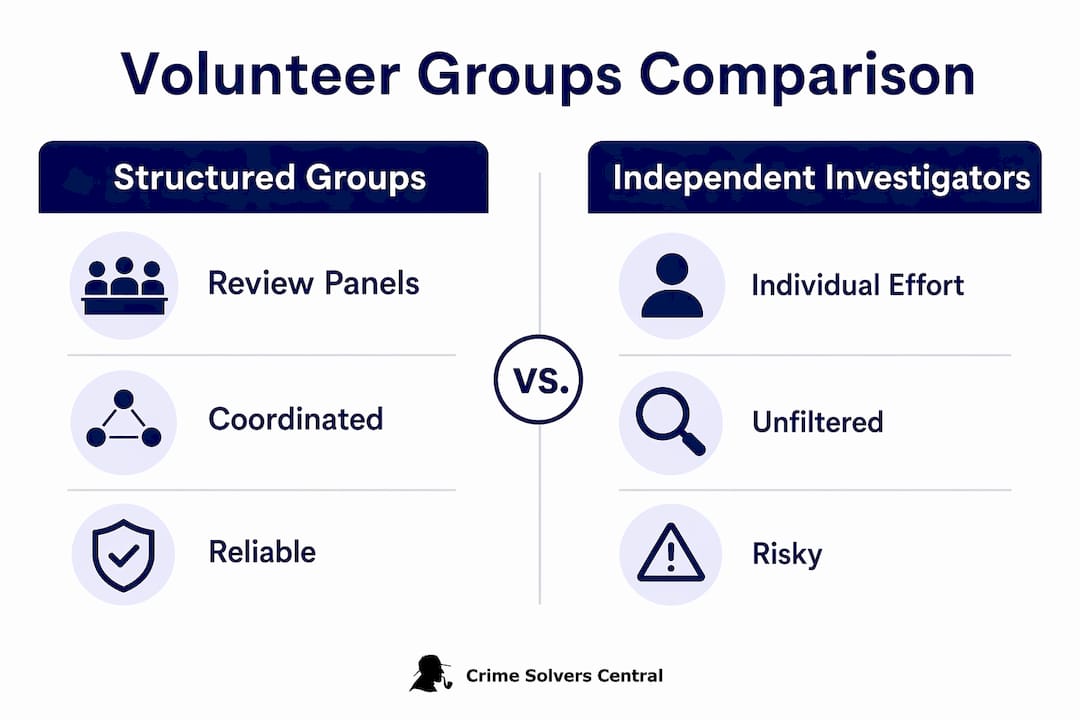
The difference between structured volunteer organizations and independent amateur investigators is the difference between a useful tool and an unpredictable one. Both groups want to help. Their methods and outcomes diverge significantly.
| Characteristic | Structured volunteer organizations | Independent amateur investigators |
|---|---|---|
| Review process | Formal evaluation panels vet submissions | No standardized review before action |
| Police coordination | Regular, established communication channels | Sporadic or nonexistent contact |
| Evidence handling | Trained in documentation standards | Typically untrained |
| Public exposure | Controlled, case-sensitive | Often public and social media driven |
| Case outcomes | Higher rate of actionable leads | Higher rate of compromised investigations |
| Example | Doe Network | Civilian predator sting groups |
The Doe Network operates with an administrative panel that reviews every user-submitted match before it reaches police. That vetting step filters out false positives, protects investigators from wasted effort, and builds credibility with law enforcement over time. Police agencies that receive a Doe Network referral know it has already passed internal scrutiny.
Independent groups lack that filter. A single motivated individual with a social media following can launch an investigation, name a suspect publicly, and film a confrontation within 48 hours. The speed feels productive. The legal consequences are often catastrophic. Cases that could have resulted in conviction instead collapse because the amateur moved faster than the evidence could support.
The lesson from comparing these two models is clear. Structure produces results. Coordination with law enforcement multiplies those results. Independence without oversight multiplies risk.
How amateurs can effectively support law enforcement
Effective amateur investigators follow a specific discipline that separates useful contributions from harmful interference. The approach is methodical, not impulsive.
-
Build a relationship with local law enforcement first. Introduce yourself to the detective assigned to the case or to the department’s tip line coordinator. Establish trust before you start working. Agencies that know you are operating in good faith are far more likely to act on your findings.
-
Understand chain of custody before collecting anything. Every screenshot, photograph, or document you gather must be timestamped, sourced, and preserved in its original format. Learn the basics of digital forensics documentation before you start.
-
Focus on gaps, not duplicated effort. Review what investigators have already pursued. Effective amateur efforts target unsearched leads and unexplored angles, not territory the official investigation already covered. Redundant work wastes everyone’s time.
-
Submit intelligence reports, not raw data. Compile your findings into a clear, structured document. Include sources, dates, and a plain-language summary of what you found and why it matters. Police investigators receive hundreds of tips. A well-organized report gets read. A folder of screenshots does not.
-
Practice patience. Investigations take months or years. Resist the urge to post updates, share theories publicly, or pressure detectives for responses. Patience protects the case.
Pro Tip: Avoid the ego trap. If your goal is recognition rather than resolution, your bias will show up in your work. Focus on finding evidence that could exonerate as readily as evidence that could implicate. Courts and detectives notice the difference.
For a practical look at crowdsourcing tips effectively, the Crimesolverscentral resource library covers submission standards and community protocols in detail.
Key Takeaways
Amateur investigators provide the most value to law enforcement when they operate within structured frameworks, submit verified intelligence reports, and coordinate with police before taking any independent action.
| Point | Details |
|---|---|
| Resource supplementation | Volunteers fill gaps left by underfunded, understaffed departments with limited clearance rates. |
| Structured beats independent | Organizations like the Doe Network produce reliable leads through formal vetting before police contact. |
| Evidence handling is critical | Civilian-collected evidence must meet chain of custody standards or it becomes inadmissible in court. |
| Coordination prevents harm | Early law enforcement contact stops amateurs from tipping off suspects or killing active investigations. |
| Intelligence reports, not raw data | Structured, sourced summaries are far more useful to detectives than unorganized screenshots or tips. |
The uncomfortable truth about amateur investigations in 2026
Amateur investigations are now a genuine cultural force. YouTube channels with millions of subscribers cover cold cases. Podcasts reconstruct murders in granular detail. Online communities spend thousands of collective hours analyzing evidence. This is not a fringe activity anymore.
I find the enthusiasm genuinely encouraging. The public’s appetite for justice, especially for victims whose cases have sat cold for decades, is a powerful thing. Crimesolverscentral’s database of over 264,913 cases exists because that appetite is real and because families deserve more than a filing cabinet.
What concerns me is the gap between enthusiasm and discipline. The cases where amateur involvement helped, like the Doe Network’s 113 resolved identifications, share a common thread: structure, patience, and deference to official process. The cases where amateur involvement caused harm share a different thread: speed, ego, and public performance.
The cultural moment we are in right now could go either way. Amateur investigators who understand missing persons search protocols and learn from past mistakes will become genuine assets to law enforcement. Those who treat investigations as content will continue to compromise cases and harm innocent people.
The solution is not less public involvement. It is better-educated public involvement. Formal cooperation between amateur communities and police agencies, supported by platforms that provide vetted cases and clear guidelines, is the model that actually produces justice.
— Crime
Crimesolverscentral: a resource for responsible citizen investigators
Crimesolverscentral gives amateur investigators a structured starting point rather than a blank page. The platform’s cold case database by state catalogs over 264,913 missing persons and unsolved homicide cases, organized for accessibility. Readers can search by state, case type, and situation to find gaps where community attention is most needed. The platform also connects community members with health and safety initiatives and provides resources that support lawful, coordinated participation. For those who want to contribute meaningfully without compromising investigations, victim advocacy resources like those at Schizophrenic.NYC show how structured community support translates into real outcomes for affected families.
FAQ
Why do amateur investigators help solve cold cases?
Cold cases go unsolved primarily because detectives lack time for intensive review. Amateur investigators provide the dedicated hours that busy departments cannot, often spotting overlooked leads in old files.
What is the biggest risk of amateur crime investigation?
The biggest risk is compromising evidence admissibility. Civilian-collected materials frequently fail chain of custody requirements, making them unusable in court and potentially damaging the prosecution’s case.
How does the Doe Network contribute to law enforcement?
The Doe Network uses formal evaluation panels to vet potential matches between missing persons and unidentified remains before notifying police. This structured process has contributed to resolving at least 113 cases.
Can amateur investigators legally conduct their own stings?
Independent sting operations, particularly those targeting child predators, frequently result in dismissed charges because civilian confrontations compromise evidence and alert suspects before police can act legally.
What is the most effective way for amateurs to submit findings to police?
Submit a structured intelligence report with clear source citations, timestamps, and a plain-language summary. Organized reports are far more likely to be acted on than raw screenshots or unverified tips.