

Unsolved Cases by State: Where to Find Them

The fastest way to find unsolved cases by state is to search NamUs, the federally supported national repository for missing persons and unidentified remains, then cross-reference your state’s official cold-case unit page, and use Crimesolverscentral’s state-by-state cold-case database for a single searchable index covering over 264,913 cases. The FBI UCR provides aggregate clearance statistics but not individual case profiles. According to a National Policing Institute policy analysis, roughly 250,000 unsolved murders have accumulated nationally, with a substantial number of new cases added annually.
Fastest starting points by reader type:
- Researcher or analyst: Start with NamUs filters and the FBI UCR for aggregate counts, then triangulate with state agency data.
- Family member of a victim: Go directly to NamUs to file or search a case, then contact your state’s cold-case unit.
- Community tipster: Use Crimesolverscentral’s state index to locate the case, then follow the tip submission pathway to the listed agency contact.
Quick links to bookmark:
- NamUs national search
- FBI UCR clearance data
- Crimesolverscentral state database
- Wikipedia category: “Unsolved murders in the United States by state” (useful as a quick index, not a primary source)
- Your state attorney general’s website (search “[State] cold case unit”)
Pro Tip: If you know the county, search the county sheriff’s office website directly. Many counties maintain their own cold-case pages that never make it into national databases.
Key Takeaways
The most reliable path to finding unsolved cases by state is to start with NamUs for individual profiles, use the FBI UCR for aggregate statistics, and use Crimesolverscentral’s state index for a single searchable database covering all 50 states.
| Point | Details |
|---|---|
| Start with NamUs | Filter by state, county, and case type for individual missing or unidentified-remains profiles. |
| FBI UCR for statistics | Use UCR data for state clearance rates and aggregate homicide counts, not individual case files. |
| Scale of the problem | Roughly 250,000 unsolved murders have accumulated nationally, with about 6,000 added each year. |
| Verify before sharing | Cross-reference any case detail against the originating agency’s press release before republishing. |
| Crimesolverscentral | Search over 264,913 cases by state at crimesolverscentral.com; members access full files and tip tools. |
Table of Contents
- What are the main national databases for unsolved cases by state?
- How do you find unsolved cases by state?
- What does a state-level case profile typically include?
- How does the FBI count unsolved cases, and what is “exceptional means”?
- How do you submit a tip or add a case to a public database?
- Why curated case spotlights move investigations forward
- How Crimesolverscentral’s state-by-state database works
- Resources for families and community members
- How to verify whether a database is current and reliable
- Navigating legal and privacy restrictions on case records
- How state-national partnerships shape case reporting
- The databases are only as useful as the people who use them
- Crimesolverscentral gives you the state-by-state depth other databases skip
- Sources
- FAQ
What are the main national databases for unsolved cases by state?
Three national-level resources cover the bulk of publicly accessible unsolved-case data. Each has a different scope, and knowing what each one does well saves you from chasing the wrong source.
NamUs is the most searchable public database for individual case profiles. Run by the National Institute of Justice, it covers missing persons, unidentified remains, and unclaimed persons. Families and law enforcement can both submit cases. Filters include state, county, age, race, and case status, making it the go-to tool for locating a specific person or geographic cluster of cases.
FBI UCR publishes aggregate crime and clearance statistics, not individual case files. Its value is in the numbers: how many homicides were reported in a given state, what percentage were cleared, and how those figures compare year over year. The UCR portal is the authoritative source for those counts, but you will not find a victim’s name or case narrative there.
Wikipedia’s “Unsolved murders in the United States by state” category functions as a crowd-maintained index of notable cases with their own Wikipedia articles. It is genuinely useful as a quick entry point for famous cold cases, but it skews heavily toward high-profile victims and should never be treated as a complete count.
| Source | Case types covered | Individual profiles? | Best use |
|---|---|---|---|
| NamUs | Missing persons, unidentified/unclaimed remains | Yes, searchable by state | Finding or submitting a specific case |
| FBI UCR | All reported crimes, homicide clearances | No (aggregate only) | State-level statistics and clearance rates |
| Wikipedia category | Notable unsolved murders | Yes, but selective | Quick index of famous cold cases |
| Crimesolverscentral | Missing persons, unsolved homicides, unidentified remains | Yes, 264,913+ cases by state | Comprehensive state-by-state search with member tools |
| Project Cold Case | Unsolved homicides, primarily Southeast U.S. | Yes | Regional deep dives and family advocacy |
| Uncovered (Unsolved Murders By State) | Unsolved homicides, national | Yes | State-organized browsing and community engagement |
For a deeper guide on leveraging national database cold cases, including how to use ViCAP alongside NamUs, Crimesolverscentral’s resource library covers the workflow step by step.
How do you find unsolved cases by state?
Getting to a specific state’s list takes about five minutes if you know the right sequence. Here is the most reliable path.
- Open NamUs and set the state filter. Go to namus.nij.ojp.gov, select “Missing Persons” or “Unidentified Persons,” and apply the state dropdown. You can add county, age range, and date range to narrow results quickly.
- Search your state attorney general’s site. Type
[State name] cold case unitinto Google. Most states maintain a dedicated page, often under the attorney general or state police. Examples: the California Department of Justice’s Unresolved Cases database and the Texas Rangers Cold Case Unit. - Use Crimesolverscentral’s state index. The platform’s state filter covers all 50 states and organizes cases by type (missing, homicide, unidentified). Members get full case files; free users see summary profiles.
- Run a targeted Google query for local coverage. Try
site:namus.nij.ojp.gov "cold case" "[State]"or"[County name]" unsolved homicide cold case site:.govto surface official pages that do not rank well organically. - Check Wikipedia’s category page as a secondary index. Search Wikipedia for “Unsolved murders in [State]” to find notable cases that have their own articles. Cross-reference any name you find against NamUs or official press releases before treating it as confirmed.
Pro Tip: For archived local media coverage, try Google News with the search string "[City or county]" "cold case" before:2020 to surface older newspaper investigations. Local TV stations in mid-size markets often publish annual cold-case roundups that include cases never entered into national databases.
A few caveats on state-specific searches: reporting lag is real. UNLV’s homicide clearance analysis recommends using multi-year windows and cross-referencing local agency reports rather than relying on any single source. A case that appears “cleared” in one database may still be listed as open in another because agencies update on different schedules.
What does a state-level case profile typically include?
Case profiles vary by source, but a complete entry from a well-maintained database should contain most of the following fields.
- Victim information: Full name (or “Jane/John Doe” for unidentified), date of birth or estimated age, sex, race/ethnicity, and physical description.
- Incident details: Date of death or disappearance, city and county, cause of death (if known), and case number.
- Case status: Open, inactive, cleared by arrest, or cleared by exceptional means.
- Evidence summary: A brief narrative of known circumstances, physical evidence types (DNA, fingerprints, ballistics), and any forensic updates.
- Media and images: Case flyers, composite sketches, or photographs where legally permitted.
- Contact for tips: The assigned detective’s name and phone number, or a tip line number.
What is frequently missing or redacted is just as important to understand. Juvenile victim identities are protected under state law in most jurisdictions. Ongoing-investigation details, autopsy specifics, and witness statements are routinely withheld. Medical examiner records are often exempt from public records requests while a case is active.
Pro Tip: When a profile lists only a case number and no narrative, call the agency’s records division and request the public-facing press release for that case number. Press releases are almost always releasable and often contain more detail than the database entry.
Status labels can be confusing. “Inactive” does not mean closed; it typically means no detective is actively working the case at that moment. “Cleared” means an arrest was made or exceptional means were applied, but it does not mean anyone was convicted.
How does the FBI count unsolved cases, and what is “exceptional means”?
The FBI UCR defines a cleared offense as one resolved either by arrest or by “exceptional means.” Arrest clearance requires that a person is taken into custody, charged, and turned over for prosecution. Exceptional means applies when law enforcement has identified the offender, gathered enough evidence to support an arrest, and knows the offender’s location, but some circumstance outside law enforcement control prevents an arrest.
The four conditions the UCR requires for exceptional clearance are:
- The offender has died (suicide, killed by police, or other causes).
- The offender is in custody for another crime and extradition has been denied.
- The victim refuses to cooperate with prosecution after the offender is identified.
- Prosecution is declined by the prosecutor (in some jurisdictions).
A cleared case is not a solved case in the public’s sense of the word. No conviction is required. That distinction matters when reading clearance statistics because a jurisdiction can report a high clearance rate while still having many cases where no one was prosecuted.
The national picture is stark. A National Policing Institute analysis estimates roughly 250,000 unsolved murders have accumulated in the U.S., with a substantial number of new unresolved homicides added each year. Since 1965, a very large number of homicides went unsolved nationally.
State variation is wide. A UNLV analysis of homicide clearance rates from 1990 to 2019 found a national an average solve rate near two-thirds nationally, with wide variation by state. NBC News’s interactive analysis shows that solved-murder rates have fallen nationally and differ significantly by location and by victim race, with some jurisdictions solving far fewer homicides than others. For a deeper look at how to read crime statistics as a cold-case investigator, Crimesolverscentral’s guide breaks down the data sources and their limits.
How do you submit a tip or add a case to a public database?
Submitting a tip or requesting case information follows different pathways depending on your goal.
- Contact the assigned agency directly. Every case profile should list a detective or tip line. Call or email that contact first. Local agencies have the most authority to act on new information.
- Submit through your state’s cold-case unit. Most state attorneys general and state police agencies accept tips via web form or phone. Search “[State] cold case tip” to find the current form.
- Report to NamUs. Families can submit a missing person or unidentified remains case directly through the NamUs portal. The system notifies the relevant medical examiner and law enforcement agency automatically.
- Submit through Crimesolverscentral. Members can add tips, upload supporting documents, and flag cases for community review through the platform’s tip submission workflow.
For a complete walkthrough of each channel, Crimesolverscentral’s guide on how to report information about a cold case covers what to include and what to leave out.
What information is typically accepted:
- Witness accounts with approximate dates and locations
- Photographs, video, or audio files
- Documents (receipts, records, correspondence)
- Physical evidence descriptions (do not mail physical evidence without law enforcement guidance)
Pro Tip: Submit anonymously through Crime Stoppers (1-800-222-TIPS) or your local Crime Stoppers chapter if you have information but fear retaliation. Crime Stoppers does not record caller ID and does not share identifying information with law enforcement. Never post specific tip details publicly on social media before contacting the agency, since doing so can compromise an investigation.
For public records requests, most states allow citizens to request investigative reports on closed cases under state freedom of information laws. Active cases are typically exempt. File your request with the agency’s records custodian in writing, citing your state’s specific open records statute by name.
Why curated case spotlights move investigations forward
A raw database entry tells you a case exists. A curated spotlight tells you why it matters and what kind of help is needed. That difference is what generates new tips.
When a case gets a detailed public spotlight, including a timeline, key evidence images, a description of what investigators are still looking for, and a clear tip contact, witnesses who had forgotten about it or assumed someone else had already called often come forward. The NIJ has documented that resolving one cold case can reveal links to other crimes, since serial offenders repeat patterns. A spotlight that draws attention to one case can surface connections to several others.
What a strong case spotlight includes: a verified timeline of known events, photographs or composite sketches cleared for public release, a specific description of what evidence or witness accounts are still needed, and a direct tip contact with a case number. The more specific the ask, the more useful the responses tend to be.
Verification is non-negotiable before sharing a spotlight. Confirm details against official press releases, NamUs records, or police statements before republishing. Errors in victim names, dates, or locations can misdirect tips and cause real harm to families. Crimesolverscentral’s guide on amplifying overlooked cold-case victims covers the verification workflow in detail.
How Crimesolverscentral’s state-by-state database works
Crimesolverscentral provides a searchable index of over 264,913 cases organized by state and case type, covering missing persons, unsolved homicides, and unidentified or unclaimed remains. It is designed to complement NamUs and FBI data rather than replace them, with features built specifically for community investigators, family members, and advocates.
Core features:
- State and case-type filters across all 50 states
- Downloadable case flyers for community distribution
- Member-only evidence boards with source links, videos, and digital case files
- Tip submission workflow connected to the relevant agency contact
- Volunteer coordination tools and community forums
- AI image tools and a flyer builder for outreach campaigns
Three steps to get started:
- Go to Crimesolverscentral and select your state from the database index.
- Open a case profile, review the summary, and cross-reference the NamUs or agency case number to verify the record.
- Submit a tip through the profile’s contact pathway, or join the case’s community team as a member to access full files and the evidence board.
Pro Tip: Use Crimesolverscentral’s member forums to connect with others researching the same geographic area. Regional clusters of cases often share investigative threads that only become visible when multiple researchers compare notes.
Case lists are compiled from NamUs records, FBI UCR data, state agency releases, and verified media reports. Profiles are reviewed and updated as new information becomes available, and members can flag outdated entries for editorial review.
Resources for families and community members
Families of victims and community members have more structured support available than most people realize. The challenge is knowing where to look.
National advocacy and support organizations include the National Center for Missing and Exploited Children (NCMEC), which maintains a 24-hour hotline at 1-800-THE-LOST (1-800-843-5678) and assists with both missing children and adult cases. The Office for Victims of Crime (OVC), part of the U.S. Department of Justice, funds victim assistance programs in every state and maintains a directory at ovc.ojp.gov.
State-level resources vary considerably. Most states have a victim services division within the attorney general’s office that can connect families to case advocates, grief counselors, and legal aid. Search “[State] victim services cold case” to find the current contact.
Community involvement takes several forms beyond tip submission. Volunteer cold-case organizations operate in most regions and often work alongside law enforcement on case reviews. Crimesolverscentral’s guide on how to collaborate with communities on unsolved crimes outlines how these partnerships typically work and how to get involved without interfering with active investigations.
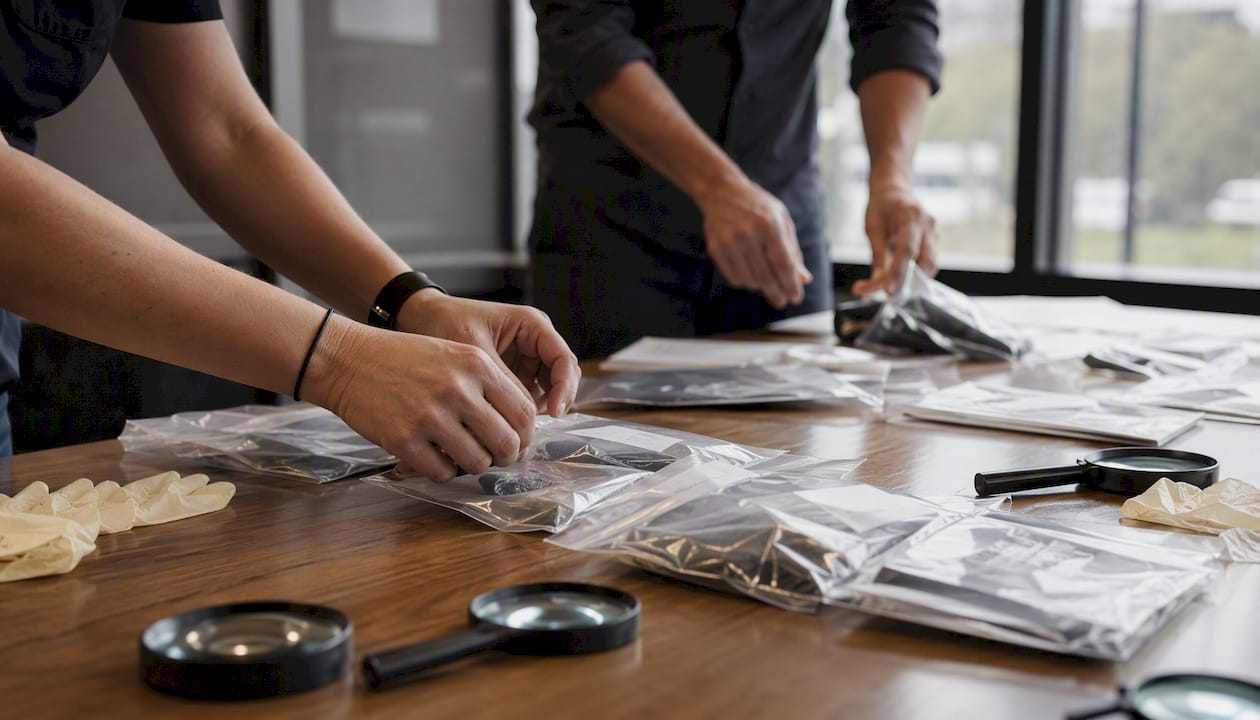
For families specifically, connecting with a victim advocate before contacting media or posting publicly about a case can prevent missteps that complicate investigations.
How to verify whether a database is current and reliable
Not every cold-case database is maintained with the same rigor, and an outdated entry can send a researcher in the wrong direction. A few quick checks tell you a lot.
Look for a “last updated” timestamp on individual case profiles. NamUs displays this prominently. If a database shows no update dates at all, treat its information as potentially stale and cross-reference against the agency’s own press releases.
Check who runs the database. Government-operated systems (NamUs, state AG pages) are authoritative but sometimes slow to update. Independent databases can be more current on media developments but may carry unverified information. The UNLV clearance analysis recommends using multi-year windows and cross-referencing local agency reports when comparing state-level data, because each source has different reporting coverage and lag times.
A useful triangulation: check the same case across NamUs, the originating agency’s press release archive, and Crimesolverscentral. If all three agree on the core facts, the record is reliable. If they conflict, the agency’s own press release takes precedence.
Navigating legal and privacy restrictions on case records
Access to case records sits at the intersection of public interest and legal protection, and the rules differ by state and case status.
Active investigations are almost universally exempt from public records disclosure. Most state freedom of information laws explicitly carve out records that would interfere with an ongoing investigation, identify a confidential informant, or endanger a witness. Requesting those records is legal, but the agency can lawfully deny them.
For closed or cold cases, the picture is more open. Autopsy reports, arrest records, and court documents are generally public in most states once a case is no longer active. File your request with the specific agency in writing, cite your state’s open records statute by name, and specify the case number. Many agencies have a standard form on their website.
Juvenile victim records are protected regardless of case status in most jurisdictions. Victim addresses, next-of-kin contact information, and witness identities are routinely redacted even from released records.
When researching online, be careful about republishing personal information about living individuals connected to a case. Sharing unverified suspect names publicly can expose you to defamation liability and can destroy an investigation. Stick to information already in official press releases.
How state-national partnerships shape case reporting
The relationship between state agencies and national organizations directly affects what appears in public databases and how quickly tips reach investigators.
NamUs operates through a network of regional system administrators who work with state medical examiners and law enforcement to enter and verify cases. States that have formal data-sharing agreements with NamUs tend to have more complete and current records in the national system. States without those agreements often have significant gaps.
The FBI’s National Crime Information Center (NCIC) and ViCAP (Violent Criminal Apprehension Program) are law enforcement-only systems, but they feed indirectly into what gets publicly reported. When a state agency enters a case into ViCAP, it becomes searchable by other agencies nationally, which can surface cross-state patterns. That information sometimes makes its way into public databases when agencies issue press releases about linked cases.
The National Policing Institute’s analysis of cold-case prioritization notes that a systematic, solvability-based review process, including multidisciplinary monthly case reviews, helps jurisdictions work more effectively with national partners. Agencies that participate in those structured reviews tend to update national databases more consistently.
For tip submitters, this means the channel you use matters. A tip submitted directly to a local agency may or may not reach the NamUs record. A tip submitted through NamUs is routed to the agency of record automatically.
The databases are only as useful as the people who use them
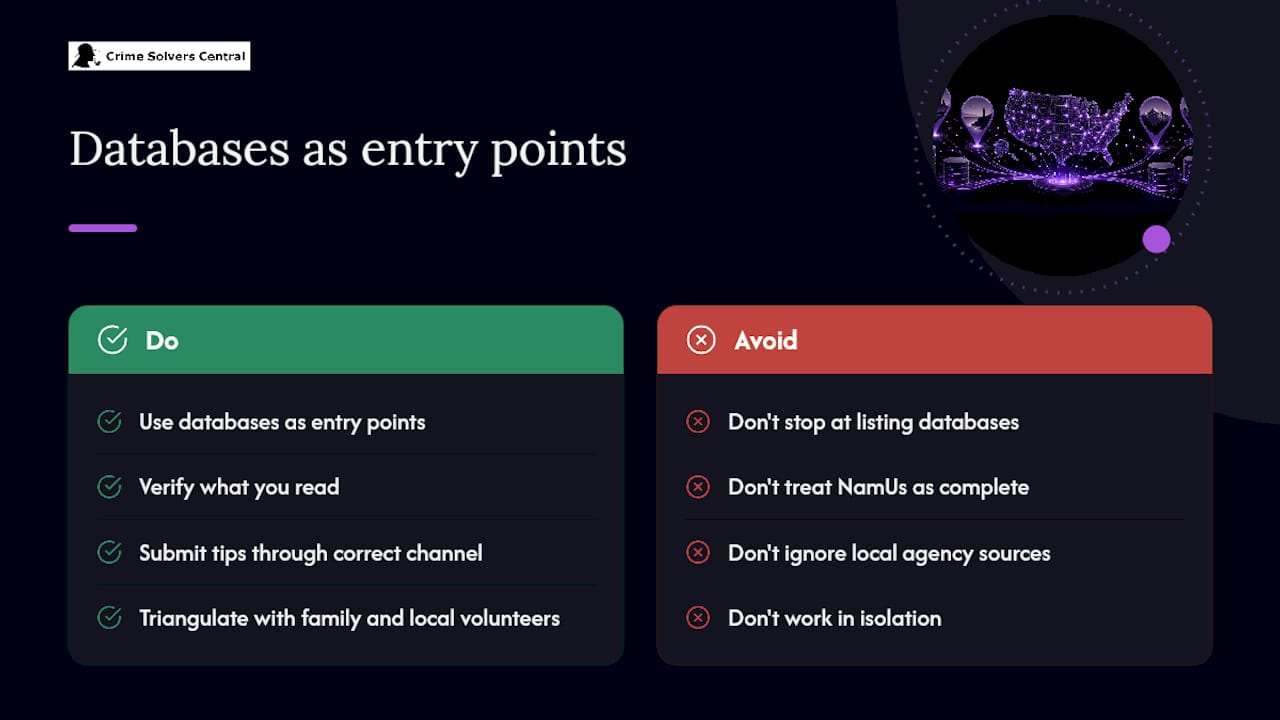
Most guides on finding unsolved cases by state stop at listing the databases. That is the wrong place to stop.
The real bottleneck in cold-case research is not access to information. NamUs is free and searchable. The FBI UCR is public. State cold-case pages exist for most jurisdictions. The bottleneck is what happens after someone finds a case: whether they know how to verify what they are reading, whether they submit tips through the right channel, and whether they connect with others working the same geographic area.
The conventional advice to “just search NamUs” misses something important. NamUs is authoritative for missing persons and unidentified remains, but its homicide coverage depends entirely on whether the originating agency entered the case. States without formal NamUs data-sharing agreements have real gaps. A researcher who treats NamUs as complete will miss cases that only appear in local agency databases or in platforms like Crimesolverscentral that aggregate from multiple sources.
The other thing most guides understate is the value of community triangulation. A family member who has been following a case for years often holds contextual knowledge that no database captures. When that person connects with a researcher who knows how to read clearance statistics and a community volunteer who knows the local geography, the combination is genuinely more powerful than any single database. That is not a feel-good observation. The NIJ’s documentation of serial killer connections through cold cases shows that case links are often identified by people who are not the primary investigators, precisely because they are looking across cases rather than down into one.
Use the databases as entry points, not endpoints.
Crimesolverscentral gives you the state-by-state depth other databases skip
Most national databases give you a case number and a status field. Crimesolverscentral gives you the full picture: over 264,913 cases organized by state and type, with member access to source documents, evidence boards, video files, and a tip submission workflow that routes directly to the agency of record. Free users can search and browse state summaries. Members unlock complete case files, community forums, a flyer builder, and volunteer coordination tools built for people who want to do more than read a summary.
If you are a family member, a researcher, or a community advocate who has hit the wall with public databases, the next step is to search your state at Crimesolverscentral and see what the full case file contains.
Sources
- NamUs
- Serial killer connections through cold cases | NIJ
- Prioritizing Cold-Case Murders: What Law Enforcement Executives Can Do - National Policing Institute
- Homicide Clearance Rates, 1990 - 2019
- Interactive: What solved murder data says about homicides in the U.S. | NBC News
Always check the “last updated” date on any database entry and compare against local agency press releases for the most current status.
FAQ
What state has the most unsolved homicide cases?
No single authoritative ranking exists for total unsolved homicide counts by state, but the UNLV clearance analysis found that states with the lowest solve rates over 1990–2019 include several high-population states where volume and resource constraints both contribute to accumulating backlogs.
How many unsolved murders are there in the United States?
A National Policing Institute analysis estimates roughly 250,000 unsolved murders have accumulated nationally, with a substantial number of new unresolved homicides added each year.
What U.S. city has the highest rate of unsolved murders?
NBC News’s interactive analysis shows that several large cities solve fewer than half their homicides, with solve rates varying significantly by location and victim demographics. No single city holds a permanent ranking, as rates shift year to year.
Where can I search unsolved cases organized by state?
NamUs covers missing persons and unidentified remains with state filters; Crimesolverscentral’s database at crimesolverscentral.com covers over 264,913 cases across all 50 states, including unsolved homicides, with member access to full case files.
Is a “cleared” homicide the same as a solved one?
No. The FBI UCR defines clearance as either an arrest or exceptional means (such as the suspect dying before arrest), and no conviction is required. A case can be cleared without anyone being prosecuted.