

Search Cold Cases Faster With NamUs Advanced Searches and FOIA Triage

Start with three sources: NamUs for missing and unidentified persons, your state’s public cold-case list for local homicides, and the National Archives for historic or federal records, including the Civil Rights Cold Case Records portal. Run a NamUs search or check your state’s law enforcement page first. File a Freedom of Information Act (FOIA) request only after you’ve confirmed the records aren’t already public.
TL;DR:
- Searching NamUs is most effective for missing persons and unidentified remains, especially when case details include dental, DNA, or fingerprint verification.
- Filing a FOIA request is appropriate only after confirming the case is not already publicly available in the National Archives Catalog to avoid unnecessary delays.
- State police and Department of Public Safety websites often hide cold-case lists in obscure tabs, but including specific details like names or locations can help move cases forward.
- Historic newspapers and genealogical records can provide crucial context for unresolved cases, especially when government files are incomplete or unavailable.
- Collaborative research platforms like Crime Solvers Central offer organized tools for tracking leads, but patience and teamwork remain essential for solving cold cases.
Table of Contents
- How to Search Cold Cases Using Official Databases
- How Do You Run an Effective NamUs Search?
- When Should You File a FOIA Request?
- Finding State and Local Cold Case Lists
- Where Else Should You Look for Records?
- What Are the Ethics of Researching a Cold Case?
- What Crime Solvers Central Offers Researchers
- A Note on Patience and Persistence
- How Crime Solvers Central Fits Into Your Search
- Sources
- FAQ
How to Search Cold Cases Using Official Databases
Each database exists for a different kind of case, and picking the wrong one wastes hours. NamUs is the country’s no-cost repository for missing, unidentified, and unclaimed person cases, and it works best when a Regional System Administrator (RSA) has verified the entry against dental, DNA, or fingerprint records. If you’re searching for a missing family member or trying to match an unidentified body to a name, this is where to begin.
The National Archives holds a different tier of material: digitized federal investigations, historic case files, and now the Civil Rights Cold Case Records Collection, which releases documents from decades-old racially motivated killings on a rolling basis.
- Missing person or unidentified remains: search NamUs first.
- Historic civil-rights era homicide: check the Civil Rights Cold Case Records portal.
- Federal investigation (FBI, DOJ, interstate crime): search the National Archives Catalog before anything else.
Knowing which bucket your case falls into cuts your research time dramatically.
How Do You Run an Effective NamUs Search?
NamUs rewards patience more than luck. Basic searches find obvious matches; advanced searches find the cases everyone else missed.
- Register for a free account. Public users can browse case summaries, but registration unlocks advanced fields and saved searches. Registration matters most for family members entering a case, since NamUs generally recommends waiting until 180 days have passed unless the person is at imminent risk.
- Use the advanced-search fields. Typeahead menus, Boolean operators, and filters let you combine age range, last-known location, distinguishing marks, and date windows in one query.
- Watch the dynamic result count. As you tighten filters, NamUs shows how many possible matches remain, so you know whether to loosen or narrow further.
- Export to CSV. Once you have a workable result set, export it so you can cross-reference against newspaper archives or genealogy records offline.
Pro Tip: Run the same search twice with alternate name spellings and nicknames. A single transposed letter in an old police report can hide a match for years.
For a full procedural walkthrough, our step-by-step NamUs guide breaks down each field in more detail.
When Should You File a FOIA Request?
Search before you request. Many FBI and DOJ files are already digitized and sitting in the National Archives Catalog, and filing FOIA for something already public just adds months to your timeline.
- Search the National Archives Catalog and submit a research inquiry if you’re unsure whether a file has been released.
- File FOIA when a federal case file exists but hasn’t been published. Expect possible exemptions (ongoing investigations, privacy protections for living relatives) and, occasionally, processing fees.
- Narrow your request. Include the investigative agency’s case number, approximate dates, and the office that likely handled it. A vague request (“all files related to my uncle’s disappearance”) gets deprioritized; a specific one gets processed faster.
Finding State and Local Cold Case Lists
Most state police and Department of Public Safety (DPS) agencies publish their own cold-case rosters, often buried a few clicks deep in an “investigations” or “unsolved crimes” tab. City police departments frequently keep separate lists for cases inside their jurisdiction.
- Search “[state name] cold case list” plus “police” or “DPS” to surface the official page directly.
- An actionable tip includes a name, date, location, or physical detail investigators can verify. Vague suspicions rarely move a case forward; specifics do.
- Attach corroborating documents when you can. Old photos, letters, or timestamped social media posts give investigators something to check against existing files.
- Many departments accept anonymous tips through Crime Stoppers-style hotlines, and some cases benefit from routing sensitive information through a family advocate instead of a stranger’s phone call.
Where Else Should You Look for Records?
Official databases rarely tell the whole story. Historic newspapers help you rebuild a timeline, identify witnesses named in original coverage, or spot a follow-up article that never made it into any government file.
- Search digitized newspaper archives and local library collections for coverage from the week the case broke and the following months.
- For federal court dockets, PACER provides online access for a small per-page fee, though older records sometimes require contacting a regional archive directly.
- Genealogy databases and cemetery or grave indexes can confirm identity in unidentified-remains cases, especially when combined with a NamUs entry that lists distinctive physical features.
If a case involves someone who may have been incarcerated at any point, The Bail Network’s guide to free inmate searches walks through locating custody records that rarely show up in a standard database search.
What Are the Ethics of Researching a Cold Case?
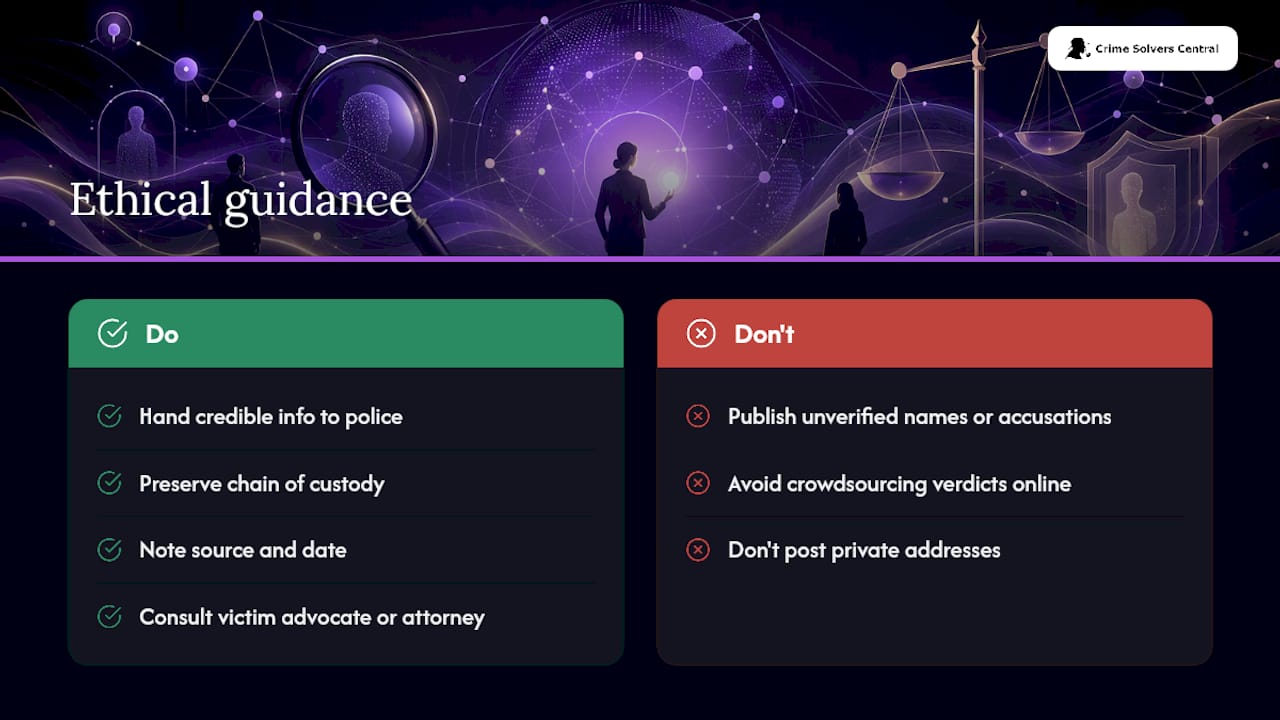
Publishing a name, address, or accusation you haven’t verified can derail an active investigation and devastate an innocent family. Keep unverified information out of public posts, and hand anything credible to law enforcement rather than crowdsourcing a verdict online.
Preserve the chain of custody on any physical document or photo you find, and note where and when you got it. When emotions run high, especially in your own family’s case, a victim advocate or attorney can help you decide what to share and with whom.
What Crime Solvers Central Offers Researchers
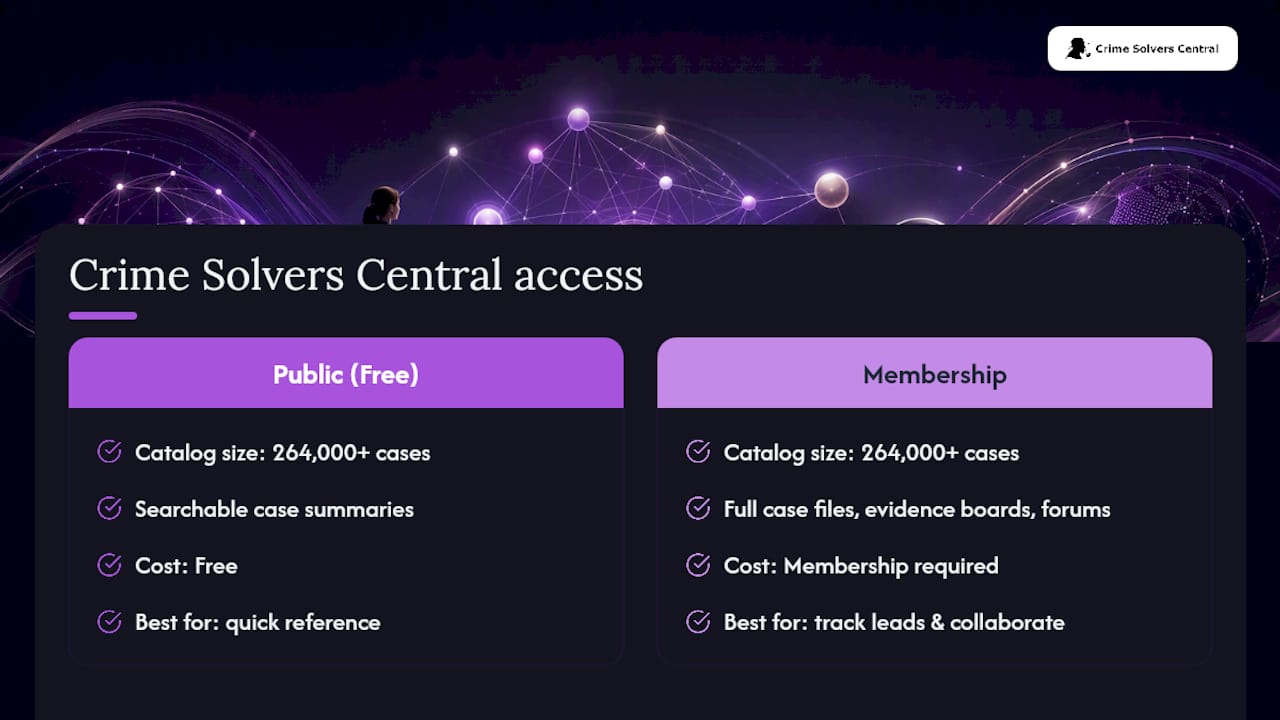
Crime Solvers Central catalogs over 264,000 cases by state and status, giving researchers a single place to cross-reference what NamUs, state police, and news archives each turn up separately. Free summaries cover the basics of most listings. Full case files, digital evidence boards, and community forums require membership, which suits family members and citizen detectives who want to coordinate research rather than start from scratch every time. If you’ve exhausted the free public databases and need a organized workspace to track leads, that’s when membership starts to make sense.
A Note on Patience and Persistence
Cold cases move slowly, and no single database solves one alone. The strongest results come from teams: family members, investigators, and researchers comparing notes. Forensic tools keep improving, and some cases previously thought unsolvable have been solved with new techniques.
— Crime
How Crime Solvers Central Fits Into Your Search
Crime Solvers Central works alongside NamUs and state lists, not instead of them; it’s the layer that keeps your research organized once you’ve pulled cases from those official sources. Instead of tracking spreadsheets across five browser tabs, members get digital evidence boards, AI image tools, and a forum of other researchers working the same category of case. The Jr. Detective plan starts at $3.97 a month, with Sr. Detective and True Crime Influencer tiers unlocking deeper case access and community features for researchers who want to go further. Browse the national case database by state for free first, then check the pricing page if you decide full case files and collaborative tools would speed up your search. For a broader look at working through a large dataset, the cold case search engine playbook is worth a read before you dive in.
Sources
- NamUs fiscal year 2024 annual report
- NamUs advanced searching user guide
- National Archives press release: Civil Rights Cold Case Records release
FAQ
Are Cold Cases Open to the Public?
Most cold cases have some public-facing summary through NamUs, state police lists, or National Archives holdings, though full investigative files are usually restricted while a case remains open. Historic and civil-rights era cases are increasingly digitized and released through the Civil Rights Cold Case Records Collection.
Is There a Cold Case Database?
Yes. NamUs is the primary free federal database for missing, unidentified, and unclaimed persons, and Crime Solvers Central maintains a searchable national database of over 264,000 cases organized by state and status.
Can You Give Me a List of Unsolved Cases?
State police and DPS agencies publish their own cold-case rosters, and NamUs lets you filter by state, age, and case type to build a working list. Crime Solvers Central’s database organizes cases the same way, with free summaries and member-only full files.
Do Cold Cases Ever Get Reopened?
Regularly. New DNA technology, modern investigative methods, and multidisciplinary review teams recommended by NIJ often surface leads that were unusable at the time of the original investigation, prompting agencies to reopen cases years or decades later.