

FindAGrave.com Alternatives for Cold-Case Researchers
For cold-case and missing-person research in the United States, the most useful FindAGrave alternatives are not cemetery platforms at all. They are forensic databases, newspaper archives, and investigative tools built specifically for identifying remains and tracking unsolved cases.
Here is the shortlist:
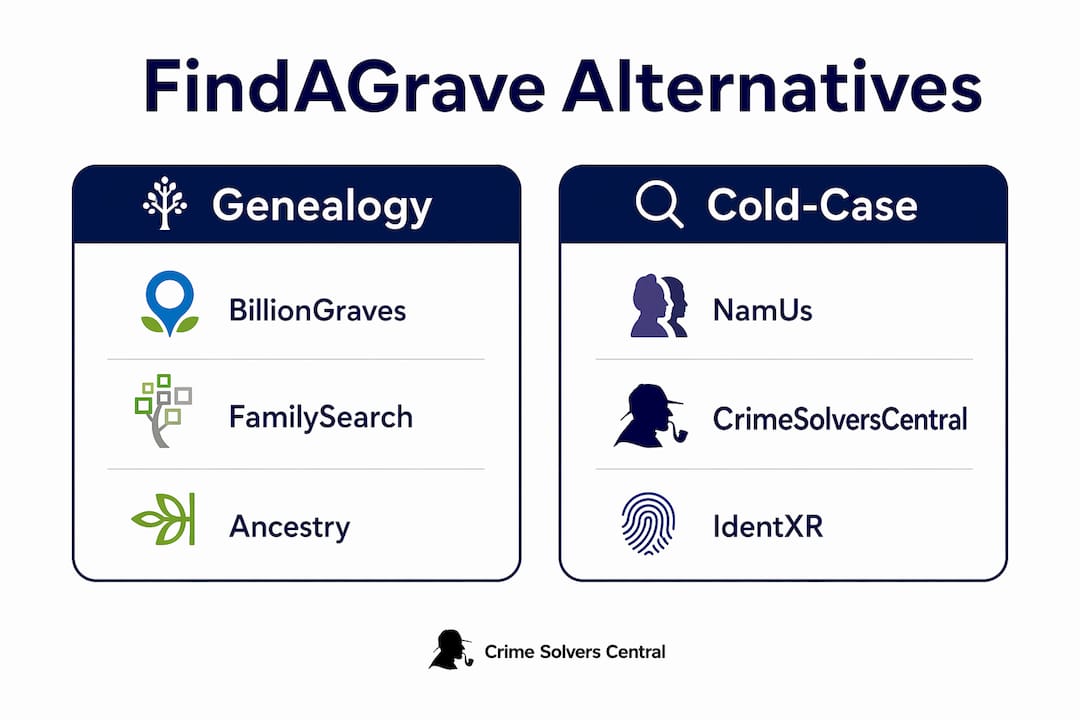
- Crimesolverscentral — Recommended central database. A large number of cases organized by state, with member tools including a flyer builder, AI image tools, and volunteer coordination forums. Best for deep case files and community-driven investigation.
- NamUs — The official national repository, administered by the National Institute of Justice. Free forensic services (odontology, fingerprints, DNA) and cross-jurisdictional matching. Best for forensic identification and law-enforcement linkage.
- IdentXR — An analytical cross-referencing tool that scores potential matches between missing-person and unidentified-remains datasets. Best for analysts who need pattern detection across large datasets.
- The Doe Network — Volunteer-run case summaries for missing and unidentified persons. Best for publicity-focused searches and locating community-curated profiles.
- BillionGraves — GPS-tagged headstone photographs and burial transcriptions. Best when burial location or gravestone data is the specific gap.
- Ancestry.com — Indexed genealogical records, obituaries, and cemetery links. Best for historical family linkage and vital records.
- FamilySearch — Free genealogy platform with community-submitted cemetery transcriptions. Best for corroborating burial data without a paid subscription.
- Chronicling America (Library of Congress) — Free digitized historical newspapers. Best for narrative context: witness accounts, trial coverage, and local detail.
- State medical examiner/coroner offices — Primary-source forensic records and official cause-of-death determinations. Best for autopsy reports and formal case documentation.
Access at a glance: NamUs, FamilySearch, Chronicling America, and The Doe Network are free. Crimesolverscentral offers free public summaries with full case files behind a membership. Ancestry.com requires a paid subscription. IdentXR is currently in beta with free public cross-reference functionality and a Pro tier for deeper analysis.
Table of Contents
- What are the best FindAGrave alternatives for cold-case research?
- How does each alternative actually work for investigators?
- How to search, cross-check, and escalate a cold-case lead
- Crimesolverscentral: a purpose-built database for cold-case work
- FAQ
- Key Takeaways
What are the best FindAGrave alternatives for cold-case research?
| Platform | Primary Focus | Geographic Scope | Access Level | Search Fields & Filters | LE / Official Status | Community Features | Best Use Case |
|---|---|---|---|---|---|---|---|
| Crimesolverscentral | Cold cases: missing persons, homicides, unidentified remains | National (U.S., state-organized) | Free summaries / paid membership | Name, state, case type, status | Community + LE collaboration | Forums, flyer builder, AI tools, volunteer coordination | Single-stop cold-case research hub |
| NamUs | Missing, unidentified, unclaimed persons | National (U.S.) | Free (registration for full access) | Name, aliases, date, location, physical descriptors, dental/forensic, DNA | Official NIJ-administered system | LE/ME submission portal | Forensic matching and official case filing |
| The Doe Network | Missing and unidentified persons | U.S., Canada, Europe | Free | Name, location, date, physical description | None (volunteer-run) | Volunteer case tracking | Awareness and community-curated leads |
| IdentXR | Cross-referencing missing/unidentified datasets | National (U.S.) | Free (beta) / Pro tier | Sex, race, age, geography, timeline scoring | None (analytical tool) | — | Pattern detection and scored candidate matches |
| BillionGraves | Cemetery and burial records | International | Free / paid features | Name, location, date, headstone image | None | Community photo uploads | Burial location and gravestone data |
| Ancestry.com | Genealogy, vital records, obituaries | International | Paid subscription | Name, date, location, family relationships | None | Member trees | Historical family linkage and obituaries |
| FamilySearch | Genealogy and cemetery indexes | International | Free | Name, date, location, family relationships | None | Community transcriptions | Free vital records and burial corroboration |
| Chronicling America | Historical newspaper archives | U.S. (pre-1963) | Free | Keyword, date, state, publication | Library of Congress | — | Narrative context and trial coverage |
| State ME/Coroner offices | Forensic autopsy and death records | State/county | Varies (FOIA/open records) | Case-specific (name, date, manner of death) | Official state/county authority | — | Autopsy reports and official determinations |
Coverage gaps to expect: Chronicling America covers newspapers through 1963; for more recent decades, paid archives like Newspapers.com fill the gap (many public libraries provide free access). State ME/coroner records vary widely by jurisdiction and may require a formal public-records request.
How does each alternative actually work for investigators?
Crimesolverscentral
Crimesolverscentral organizes its 264,913+ case database by state and case type, which means you can filter down to a specific region before you ever run a name search. Free visitors see case summaries; members unlock full case files, source documents, video evidence, digital evidence boards, and the forum where volunteers coordinate. The flyer builder and AI image tools are genuinely useful for generating age-progression visuals or shareable missing-person materials. For anyone doing sustained cold-case work, the member tools justify the subscription.

NamUs
NamUs is the only platform on this list with official NIJ administration and free forensic services, including odontology, fingerprint examination, forensic anthropology, and DNA analysis. Family DNA collection kits are provided at no cost. Law enforcement and medical examiners can submit cases directly, and the system cross-references missing-person records against unidentified remains across jurisdictional lines. If you find a potential match anywhere else, NamUs is where you escalate it.
IdentXR
Rather than a case directory, IdentXR is an analytical layer on top of existing datasets. It scores candidate matches by sex, race, age, geography, and timeline, and surfaces geographic patterns or demographic gaps that manual review misses. The free beta includes public cross-reference functionality; the Pro tier adds serial-pattern overlays, unlimited cross-reference, maps, and data export. Serious volunteer analysts and professional investigators will find the Pro tier worth the cost for high-volume work.
The Doe Network
The Doe Network is volunteer-curated and publicity-focused. Profiles are community-submitted and not forensically verified, so treat it as a lead-generation tool rather than a primary source. It is most useful for locating a case summary quickly or finding whether a specific unidentified person has already been profiled publicly.
BillionGraves, FamilySearch, and Ancestry.com
These three are the closest true find-a-grave substitutes on this list. BillionGraves provides GPS-tagged headstone photographs and transcribed burial data. FamilySearch offers extensive free records and community-submitted cemetery transcriptions, useful for corroborating a burial date or location without a subscription. Ancestry.com adds indexed obituaries and vital records, but requires a paid membership. For cold-case work, these platforms matter most when you need to confirm a burial, establish a family connection, or verify that a missing person was never officially recorded as deceased.
Chronicling America and newspaper archives
Newspaper archives are often the fastest starting point for researching old murders because they supply narrative context that condensed police reports omit: witness accounts, trial testimony, sentencing outcomes, and neighborhood detail. Chronicling America covers U.S. newspapers through 1963 for free. For cases after that cutoff, Newspapers.com and NewspaperArchive fill the gap.
Pro Tip: Cross-reference a victim’s name in Chronicling America against the forensic descriptor fields in NamUs. A newspaper account may name a witness or describe a distinctive physical feature that matches an unidentified-remains profile, creating a lead neither database would surface alone.
State medical examiner and coroner offices
County clerks and local law-enforcement records divisions often hold more complete case files than any online portal. State online dockets are frequently bare-bones; the clerk maintains the physical or scanned originals. Access varies by state and local policy, but most jurisdictions respond to formal public-records requests under state open-records laws.
How to search, cross-check, and escalate a cold-case lead
Start by assembling your identifiers before you open any database. The single most important is the full legal name combined with an approximate date and the specific city or county. Physical descriptors (height, weight, hair color, distinguishing marks) and any known case numbers come next. Specific identifiers streamline requests to courts, police, and coroners far more than a name alone.
- Run NamUs and IdentXR first. NamUs cross-references missing persons against unidentified remains nationally. IdentXR adds scored pattern analysis. Together they surface forensic matches that no single-database search would catch.
- Search Crimesolverscentral. Use the state filter to narrow the case index, then check whether a full case file is available under membership. The national database cold cases guide on the site walks through cross-jurisdictional search sequences.
- Pull newspaper archives. Search Chronicling America by name, date range, and state. For post-1963 cases, check your public library’s database access for Newspapers.com.
- Check cemetery and burial databases. BillionGraves and FamilySearch confirm whether a person was buried and recorded. A missing person with no burial record is a meaningful data point.
- Request official records. Contact the state ME/coroner office and the county clerk directly. A short records-request email works well: “I am requesting any publicly available records related to [full name], [approximate date], [city/county], under [state] open-records law. Please advise on the applicable form and fee.” Most offices respond within 10–20 business days; some states mandate a response within 5–10 days.
When you find a credible lead, document every source with the URL, database name, and date accessed before sharing anything. Submit tips to NamUs through its investigative support portal, or contact the original investigating agency directly. Do not post unverified identifying information about living individuals publicly.
Pro Tip: Keep a running log in a spreadsheet: one row per search, with columns for database, search terms, date, result, and source URL. Provenance matters if a lead ever reaches a detective or prosecutor.
Crimesolverscentral: a purpose-built database for cold-case work
Most FindAGrave alternatives on this list serve genealogists first and investigators second. Crimesolverscentral is built the other way around. Its searchable national database covers 264,913+ missing-person and unsolved-homicide cases organized by state, with member access to full case files, source documents, video evidence, digital evidence boards, and community forums where volunteers coordinate active searches.
Free visitors can browse public case summaries and read investigative guides. A membership unlocks the full file for any case, the flyer builder, AI image tools, and forum participation. For family members, amateur sleuths, or nonprofit investigators who need more than a summary, the membership is the difference between reading a headline and reading the file. Browse the public index or sign up at Crimesolverscentral.
FAQ
What is the best free alternative to FindAGrave for missing-person research?
NamUs is the strongest free option: it is the official national repository with free forensic services and cross-jurisdictional matching. FamilySearch and Chronicling America are also free and useful for burial records and historical newspaper context.
How does IdentXR differ from NamUs?
NamUs is an official case repository where law enforcement and medical examiners file records. IdentXR is an analytical tool that cross-references existing datasets to score potential matches and surface geographic patterns, currently in beta with a free public tier and a Pro tier for deeper analysis.
Can I use these databases to find unidentified remains cases?
Yes. NamUs maintains a dedicated unidentified-persons database with forensic descriptors, and the FBI’s ViCAP program also catalogs unidentified remains from major violent crimes. Crimesolverscentral includes unidentified and unclaimed remains in its national case index.
How do I submit a tip or correction to these platforms?
NamUs accepts tips and case submissions through its investigative support portal. The Doe Network accepts volunteer-submitted profiles. For Crimesolverscentral, members can contribute through the forum and evidence boards. State ME/coroner offices accept corrections through direct contact or formal records-amendment requests.
Are grave record websites useful for cold-case research?
Occasionally. BillionGraves and FamilySearch can confirm whether a missing person was ever officially buried and recorded, which is a meaningful negative data point when no burial exists. For active forensic identification or unsolved homicides, forensic databases like NamUs and analytical tools like IdentXR are far more productive.
Key Takeaways
For cold-case and missing-person research in the U.S., NamUs and Crimesolverscentral cover the most ground, but combining them with IdentXR, newspaper archives, and direct records requests produces the strongest leads.
| Point | Details |
|---|---|
| Start with identifiers | Full legal name, approximate date, and city/county are the identifiers that speed every database search and records request. |
| NamUs is the official anchor | Administered by the NIJ, NamUs provides free forensic services and cross-jurisdictional matching unavailable on any other free platform. |
| IdentXR adds analytical depth | Its scored cross-referencing and pattern-detection tools surface matches that manual database searches miss, with a free beta and a Pro tier. |
| Newspaper archives fill narrative gaps | Chronicling America (free, pre-1963) and paid archives supply witness accounts and trial detail that police dockets omit. |
| Crimesolverscentral for deep case files | Its 264,913+ case database, state-organized index, and member tools make it the recommended single-stop resource for sustained cold-case research. |