

Endangered Missing Persons: How Alerts Work and What to Do
An endangered missing person alert is a public notice that law enforcement requests when someone is missing under circumstances that suggest danger, and the case does not fit an AMBER Alert. If someone you love is missing, call 9-1-1 first. Police, not the family, decide whether an alert is warranted. If you see a person from an alert, call 9-1-1 and do not approach. This guide explains how the system works, who qualifies, and what you can do while the official process runs.
TL;DR
- An endangered missing advisory is a formal action plan for missing children who do not meet AMBER Alert criteria and for missing adults with no other recovery plan in place.
- Families report to local law enforcement by dialing 9-1-1. Police verify the criteria and request the alert from the state or tribal alerting authority.
- Rules differ by state. Texas, Idaho, Illinois, Florida, California and South Dakota each run their own version, so check your state’s public-safety website.
- If you spot the person, call 9-1-1 and report location, direction of travel and any vehicle details.
- An alert is one tool. Families can also build a case file, share verified information and use a searchable case database.
Table of Contents
- What an endangered missing person alert is
- Who qualifies, and why states differ
- How an alert differs from AMBER, Silver and Ashanti Alerts
- A new federal alert code for missing and endangered persons
- If someone is missing: the first steps
- What the public should do if they see the person
- Where to find current alerts and report a tip
- Perspective
- Keeping a case alive after the alert ends
- Using Crime Solvers Central
- FAQ
- Sources
What an endangered missing person alert is
Most people know the AMBER Alert, which is built for abducted children in danger. Many missing-person cases do not meet that bar. The federal guide for states describes an Endangered Missing Advisory (EMA) as a formal action plan to help safely recover missing children who fall outside AMBER criteria and missing adults for whom no systematic recovery plan exists. It is built for a rapid response and for notifying the public.
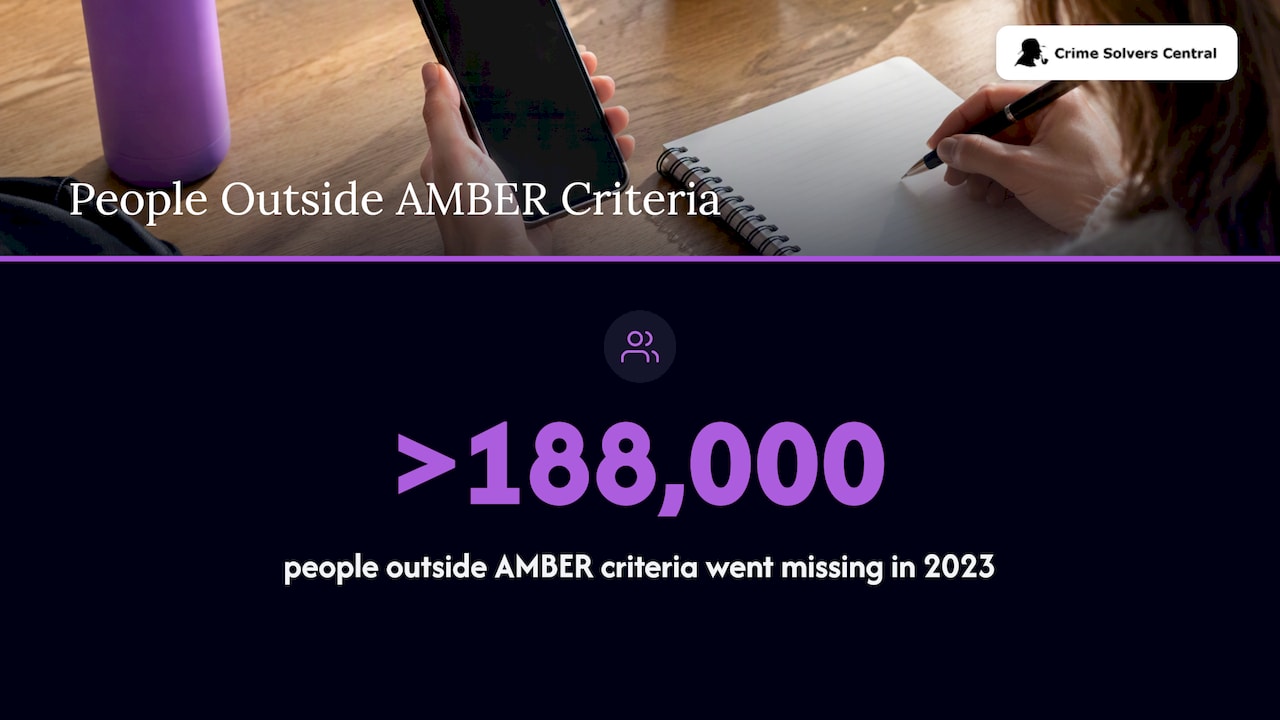
The scale of that gap is large. According to the FCC, in 2023 more than 188,000 people who fell outside AMBER Alert criteria went missing in the United States. That figure is the reason states built broader advisory programs.
The name varies. You may see “Endangered Missing Advisory,” “Endangered Persons Advisory,” “Missing Endangered Persons Information” or “Endangered Missing Persons Alert.” The idea is the same: enlist the public, broadcasters and other agencies in a voluntary partnership. Illinois describes its version as a formal action plan that brings law enforcement, broadcasters and others together to rapidly disseminate information about an at-risk missing person.
Who qualifies, and why states differ
There is no single national rulebook. Each state or tribal authority sets its own criteria, which is why the same case can lead to an alert in one place and not in another. The National Ashanti Alert Network says states have different policies and criteria and tells people to consult local public-safety websites.
Three examples show the range.
Idaho: any age, with an endangerment condition
Under Idaho Code 67-2922, a person of any age may qualify if they are reported missing, are or are believed to be an Idaho resident, are at a location unknown to someone familiar with them, and meet at least one statutory endangerment condition. Those conditions include unexplained, involuntary or suspicious circumstances.
Texas: a focus on intellectual and developmental disabilities
Texas created its Endangered Missing Persons Alert in 2011. The Texas Department of Public Safety explains that it was named to avoid confusion with AMBER Alerts and that its criteria center on a diagnosed intellectual disability or developmental disorder, with a written diagnosis from a physician required for an intellectual disability. If you are a caregiver in Texas, read the criteria before you need them.
California: a request through the Highway Patrol
In California, law enforcement asks the California Highway Patrol to activate an Endangered Missing Advisory. The CHP page on the program is the place to see how the advisory works and what to do if you receive one.
Why not every case gets an alert
It can feel unfair when an alert is not issued. There is a reason for restraint. The Ashanti Alert Network notes that if an alert went out in every case, the public could become overwhelmed and begin ignoring alerts or turning off notifications. Strict criteria keep alerts meaningful. Your job is to give police every fact that could show the case meets them.
How an alert differs from AMBER, Silver and Ashanti Alerts
The programs overlap, and the labels matter less than the circumstances. All of them are, in the Ashanti Network’s words, intended to send notifications to a larger geographic area under unique circumstances, to raise public awareness and help the person return safely.
| Alert | Typically for | Key point |
|---|---|---|
| AMBER Alert | Abducted children believed to be in danger of serious harm | Narrow, strict criteria |
| Endangered Missing Advisory | Missing children outside AMBER criteria and missing adults, any age in some states | Broader, set by each state |
| Silver Alert | Older adults, commonly age 60 and up in some states | Often tied to dementia or cognitive decline |
| Ashanti Alert | Missing adults who are endangered, abducted or have special needs | Covers adults who do not fit other criteria |
An endangered advisory can also take pressure off investigators. The federal implementation guide notes that an EMA can reduce pressure on police to issue an AMBER Alert in cases that do not fit its criteria. That keeps AMBER Alerts credible while still giving other cases a public channel.
A new federal alert code for missing and endangered persons
In August 2024, the FCC established a Missing and Endangered Persons (MEP) event code to allow wider dissemination of these alerts over the Emergency Alert System and Wireless Emergency Alerts. The agency says the code supports state and tribal initiatives and helps coordinate responses across jurisdictions. Its requirements take effect 12 months after the order was published in the Federal Register, so check the FCC page for current status.
The FCC’s data also shows who is most affected. In 2023, 202,097 missing Black persons were reported to NCIC, roughly 35% of total missing-person entries, while Black people made up approximately 12% of the U.S. population. Wider alert channels are meant to help close that attention gap.
For caregivers, a phone alert only helps if someone is checking in before a person goes missing. A routine of daily check-ins and missed-check-in notices makes a wandering or missing episode visible sooner. Tools for family emergency alerts for caregivers can be tested quickly and fit alongside, not in place of, a 9-1-1 call.
If someone is missing: the first steps
- Call 9-1-1 right away. Both the federal guide and Illinois’s fact sheet say to report immediately by dialing 9-1-1. You do not have to wait a set number of hours.
- Tell the officer why the person may be in danger. Mention medical conditions, medications, cognitive or developmental needs, threats, unusual behavior, and whether the absence is out of character. Police verify whether the criteria are met, so these details matter.
- Ask whether an alert can be requested. An investigation must be opened by law enforcement, which then requests the alert from the state or tribal alerting authority.
- Prepare a recent photo and description. Clothing, height, distinguishing marks, phone number, vehicle and likely destinations all help.
- Write everything down. Keep a timeline of calls, names and case numbers.
Our guide on what a missing persons report is walks through what officers will ask. If you are organizing details yourself, how to build a missing person case file shows a clean structure.
Tribal communities
Tribal governments have their own route. The Department of Justice notes that FEMA’s IPAWS is a free, internet-based tool tribal officials can use to issue public alerts such as missing-person alerts. Families should ask tribal law enforcement how their alerting process works.
How long an alert lasts
An alert is not open-ended. In Idaho, the State Police must end it when the person or suspect is located, the incident is otherwise resolved, or the alert is no longer an effective tool for locating the person. Families should ask the investigating agency how it will tell them when an alert is closed or renewed.
What the public should do if they see the person
An alert works because ordinary people notice something. If you think you have seen the person in an alert, call 9-1-1 immediately. Note the location, the direction of travel and, if you can, the make, model, color and license plate of any vehicle. Even a small detail may lead to a successful recovery.
A few practical rules:
- Do not confront or follow the person. Their circumstances may be unsafe or unclear.
- Do not post a sighting online before calling. Call first, then share only what police have released.
- Compare the description and photo in the alert with what you saw, then report what you actually observed rather than a guess.
Watching for the same alert again is fine, but mind the source. Our piece on recent missing persons cases and verifying before you share explains how to check that a post is current, because old or false posts can send people looking for someone already found.
Where to find current alerts and report a tip
For alerts specific to your state, use your state’s public-safety website. The Ashanti Network says to consult the state public-safety site and to report information by calling 9-1-1 or contacting local law enforcement directly. Some states publish a standing page. Florida’s Missing Endangered Persons Information Center has staff available 365 days a year and lets residents sign up for alerts. South Dakota, Texas and Idaho also run dedicated state pages.
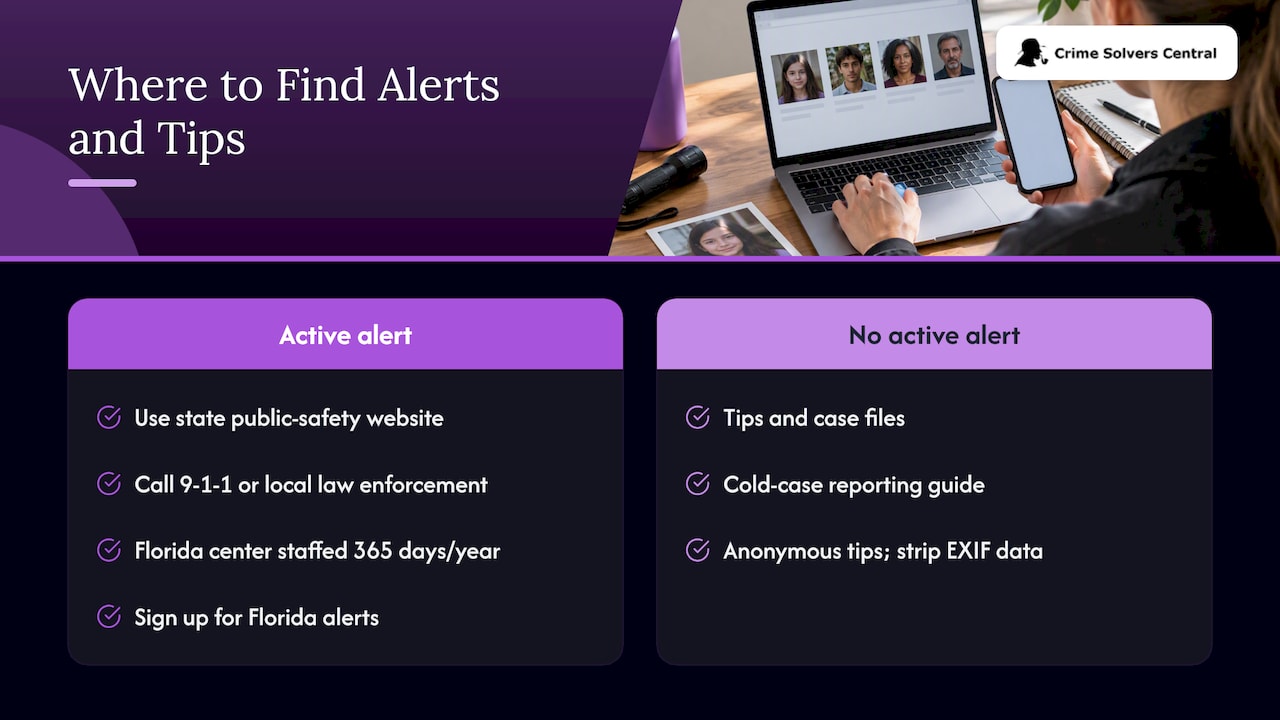
When the person has been missing a long time and no alert is active, the route changes to tips and case files. Our guide on how to report information about a cold case explains what to include, and anonymous tips and stripping EXIF data covers sending photos without exposing location data.
Perspective
We built Crime Solvers Central around a simple observation: an alert is a spotlight, and a spotlight has to be kept on. Alerts are issued by police for a limited time under strict criteria. The families we hear from need something that continues after the broadcast ends.
That is why we keep a searchable national database of more than 264,000 cases, sorted by state and situation, covering missing persons, unsolved homicides and unidentified remains. A family in one state can see how similar cases are described in another. A volunteer can learn how a case file is organized. A student can see how patterns look across regions.
We also think community effort should be structured, not chaotic. Our tools are designed for that: digital evidence boards, volunteer coordination, a flyer builder and forums where members can compare notes. Used well, they complement the official process. They never replace the investigators or the 9-1-1 call.
Our testimonials show what that can look like in practice: families reconnected and leads passed along to law enforcement. We believe the more organized and informed the public is, the more likely a quiet case is to move again.
Crime
Keeping a case alive after the alert ends
Many families describe the same moment: the alert expires and the phone stops ringing. This is when preparation counts.
- Keep one current file. Photos, medical details, dental records, last known contacts and a dated timeline. Update it when anything changes.
- Know common pitfalls. Our list of common mistakes in missing persons searches covers things like spreading unverified rumors or contaminating a lead.
- Use federal resources. Three federal resources and what families can share explains where to turn after the first days.
- Share responsibly. Use only details released by the investigating agency, and tag the case number where possible.
- Keep in touch with the detective. A short, regular check-in keeps the case on their desk. Our tips for families and investigators offer a script.
For a broader walk-through, see how to find missing persons: a practical U.S. guide.
Using Crime Solvers Central
Anyone can browse our cold case database by state for case summaries. Members unlock full case details, sources, videos, forums, digital evidence boards, the flyer builder and volunteer coordination. Plans on our pricing page are Jr. Detective at $3.97 per month or $39 per year, Sr. Detective at $9.97 per month or $99 per year, and True Crime Influencer at $39.97 per month or $399 per year. You can read more about our mission on the About Us page.
FAQ
Do I have to wait 24 hours to report someone missing?
No. Official guidance says to report immediately by dialing 9-1-1. Early reports give police and the public the most time to act.
Can a family request an endangered missing person alert directly?
Not usually. Law enforcement must open an investigation and then ask the state or tribal alerting authority to issue the alert. Families can help by giving officers the facts that show the person may be in danger.
Is an endangered missing person alert the same as an AMBER Alert?
No. AMBER Alerts are for abducted children believed to be in danger. An endangered advisory is built for missing children outside AMBER criteria and missing adults where no other recovery plan exists. Criteria for the latter vary by state.
What if the person is an adult who left voluntarily?
Adults have the right to leave, and police will weigh whether there are signs of danger. In Idaho, for example, the statute looks for unexplained, involuntary or suspicious circumstances, among other conditions. Tell officers about any health risk or threat that makes the absence unsafe.
Where do I see active alerts in my state?
Start with your state’s public-safety or state police website, which is where state-specific alert information is posted. Report any sighting to 9-1-1 or local law enforcement.
Sources
- Guide for Implementing or Enhancing an Endangered Missing Advisory (OJJDP)
- Endangered Missing Person Advisory Act fact sheet (Illinois)
- Idaho Code 67-2922
- FAQs, National Ashanti Alert Network
- Endangered Missing Persons Alert, Texas DPS
- Endangered Missing Advisory, California Highway Patrol
- FCC order 24-83 (text)
- FCC order 24-83 (PDF)
- FCC Missing and Endangered Persons EAS code
- Tribal Justice and Safety resource basket, U.S. Department of Justice