

Crime Solvers Central: What the Cold Case Database Offers

Crime Solvers Central is a searchable national database of cold cases: missing persons, unsolved homicides, and unidentified and unclaimed remains. Our catalog lists more than 264,000 cases, sorted by state and by case type, with a case forum attached to each profile. Free summaries are open to everyone. Full case files, sources, media and community tools sit behind a monthly or yearly membership starting at $3.97 a month.
This guide explains what you will find on the site, who it serves, what each plan costs, and how to use it next to the official channels that handle every missing-person case: local law enforcement and NamUs.
TL;DR
- Crime Solvers Central catalogs missing persons, unsolved homicides, and unidentified and unclaimed remains, organized by state and case type.
- Plans run from $3.97 a month (Jr. Detective) to $39.97 a month (True Crime Influencer), with yearly options at $39, $99 and $399.
- The site supports the official process. It does not replace a police report or a NamUs entry.
- Treat forum posts as leads to pass to investigators, not as confirmed facts.
- Volunteers help most by documenting carefully and sending information to the investigating agency.
Table of Contents
- What Crime Solvers Central is
- The kinds of cases we list
- Free access versus membership
- Plans and prices
- How to use the site alongside official resources
- If someone is missing: first steps
- Reading case pages and forums carefully
- How volunteers can help without causing harm
- Submitting a tip
- Ready to start
- FAQ
- Sources
What Crime Solvers Central is
We built Crime Solvers Central as a hub for people who refuse to let cold cases go quiet. The audience is wide: families of missing persons looking for answers, community volunteers, students of criminology and sociology, advocates working on justice reform, and law enforcement agencies that want public tips on an open investigation.
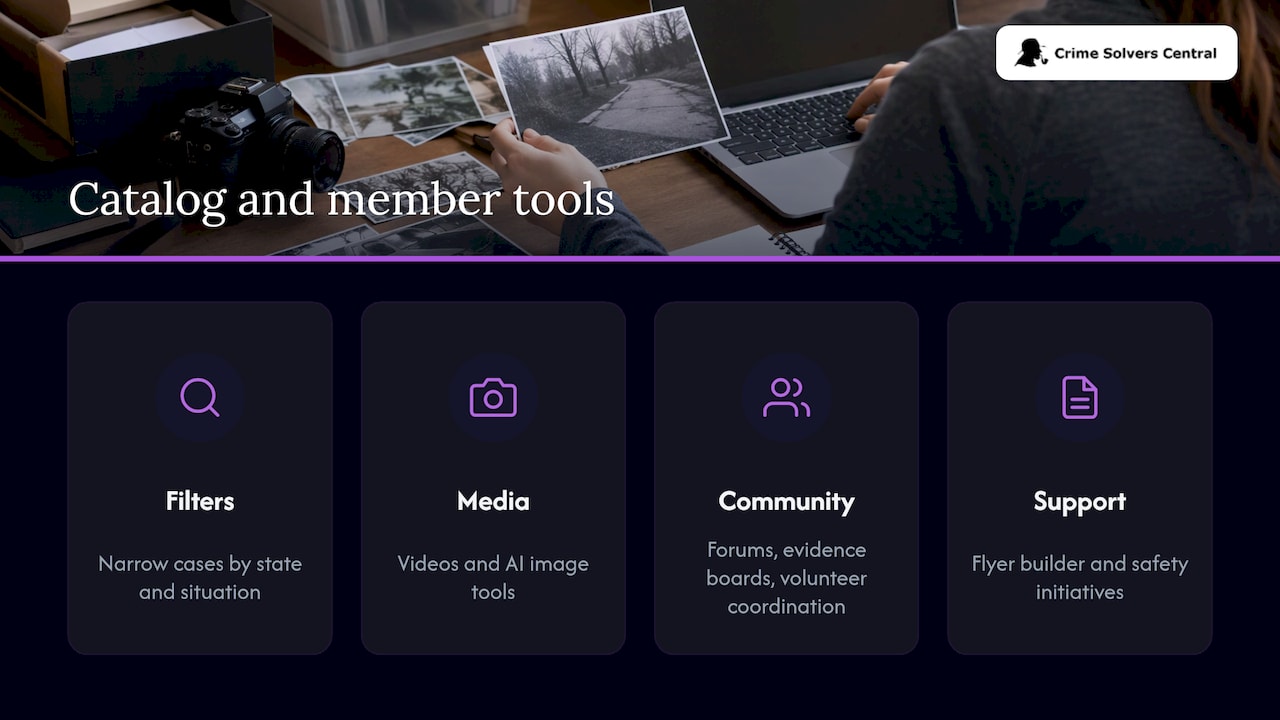
The core is the case catalog. Each profile belongs to a state and a situation, so a reader in Ohio looking for an unidentified person can narrow to that state and that case type instead of scrolling through a national list. Beyond the catalog, the site hosts member tools: videos, forums, digital evidence boards, a flyer builder, AI image tools, volunteer coordination and safety initiatives.
Testimonials on the site describe members who used these resources to reconnect with family or to move an investigation forward. Those are the experiences of individual members, and every case is different.
The kinds of cases we list
The catalog is organized around four situations that families and investigators run into again and again:
- Missing persons: adults and children whose whereabouts are unknown.
- Unsolved homicides: cases where a death was ruled a homicide and no one has been held responsible.
- Unidentified remains: people who have been found but not yet named.
- Unclaimed persons: people who have been identified but whose next of kin have not been located or have not claimed them.
Each case type has its own forum. The forum pages are what many searchers land on first, and each one is built around a single case profile with a thread of community posts under a short rules notice asking for respectful conduct. Our guide to the missing and murdered database walks through how these categories relate to each other.
Free access versus membership
Summaries and guides are free to read. That includes the articles on this site about databases, evidence and tips, which are written for families who are at the start of the process and want a clear map.
Membership unlocks the deeper material: complete case details, sources, videos, forums, evidence boards and the working tools. We designed the tiers so a family member who needs one flyer and one case file does not pay the same as a volunteer who runs an online research group.
Plans and prices
Prices below are as published on our pricing page. Check that page for the current list before you subscribe.
| Plan | Monthly | Yearly |
|---|---|---|
| Jr. Detective | $3.97 | $39 |
| Sr. Detective | $9.97 | $99 |
| True Crime Influencer | $39.97 | $399 |
The yearly Jr. Detective plan works out to $3.25 a month if you divide $39 by twelve, and the Sr. Detective yearly plan to $8.25. Choose the yearly option if you expect to follow a case for more than a few months, which is usual: cold cases move slowly.
How to use the site alongside official resources
A database like ours is a companion to the official process. Two official systems sit at the center of it.
NamUs
The National Institute of Justice describes NamUs as a national database and support program for law enforcement, medical examiners, coroners, investigators and families dealing with missing, unclaimed and unidentified-person cases. Public users, including family members, volunteers and advocacy staff, can enter cases, track cases and view publicly visible information once entries have been vetted with the investigating agency.
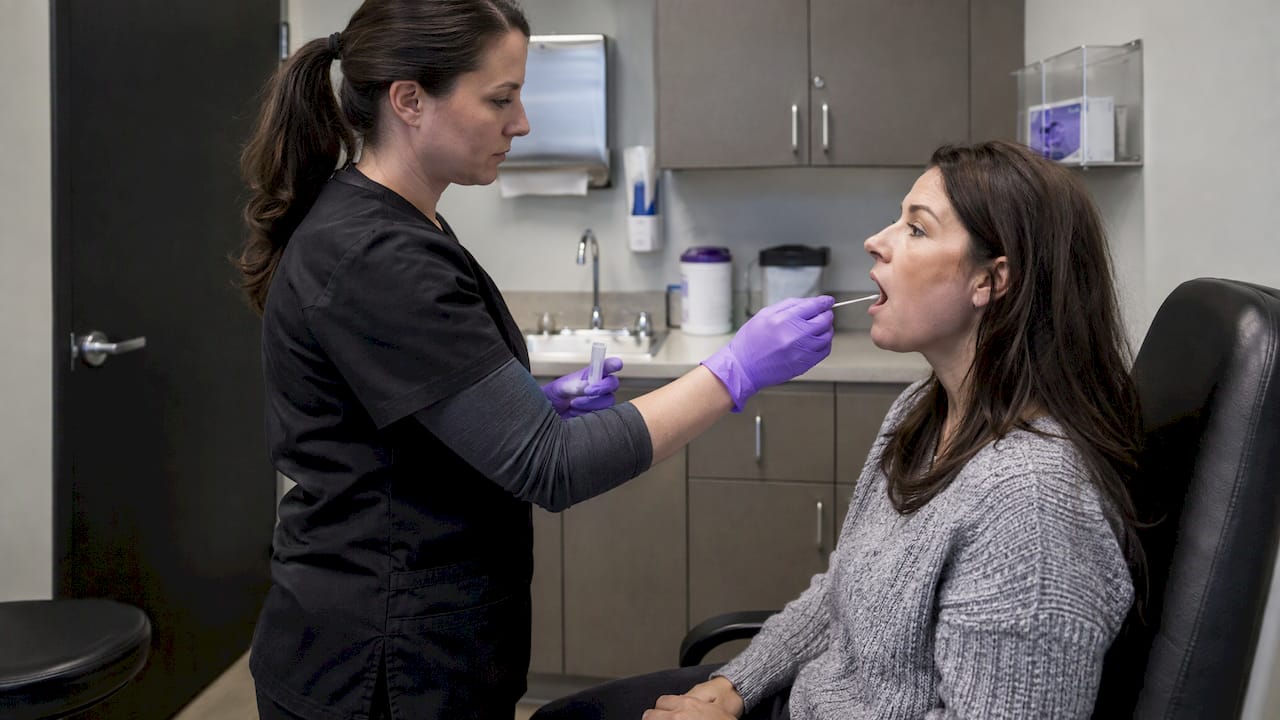
NamUs also connects families and law enforcement partners for family-reference DNA collection and for DNA from the missing person’s belongings. Its services page says cold-case advisors provide case consultations, help collect biometric information and facilitate forensic services.
If you have not registered a case there, start with our step-by-step NamUs search guide. Then come back to our catalog to widen the search. Our guide to searching for unidentified persons beyond NamUs explains why a family should look in more than one place.
Law enforcement
Every missing-person case begins with a report. The Department of Justice’s report and identify page says that when a child is missing, the public should call local law enforcement first and then the National Center for Missing & Exploited Children at 800-THE-LOST (800-843-5678). It also lists AMBER Alert, FBI missing-person investigations, NCMEC and NamUs as federal resources.
The Model State Missing Persons Statute says agencies should accept missing-person reports. They should not refuse solely because the person is an adult, the disappearance is recent, foul play is not indicated, or the person may not have been in that agency’s jurisdiction. If someone tells you to wait, that is worth raising with the agency again.
For a broader view of the federal options, see our overview of three federal resources and what families can share.
If someone is missing: first steps
These steps come from state and federal guides. Use them as a checklist, and follow the instructions of the officers on your case.
- Call law enforcement right away. Virginia’s family resource guide advises calling immediately without waiting, and giving the person’s description, clothing, vehicle, companions, health issues, disabilities, impairments and medication needs.
- Write down the details. The Colorado Bureau of Investigation’s missing persons checklist asks for as many circumstantial and descriptive details as possible, including why you believe the absence is not voluntary.
- Get the case numbers. CBI recommends getting the reporting officer’s contact information and the agency case number, and confirming the case was entered into the FBI’s National Crime Information Center. Virginia’s guide adds asking for the NCIC file number, a law-enforcement liaison and a backup contact.
- Keep a log. Virginia’s guide recommends a case log or journal of every call and update.
- Protect belongings. Secure the person’s room and belongings, and do not go through their devices or social media accounts before asking investigators. CBI gives the same warning about searching a residence or accounts on your own.
- Preserve what could help identify them. CBI lists frequently worn clothing, mail, toothbrushes and hairbrushes. If you are unsure whether an item matters, ask the investigators. Our guide to preserving evidence at home covers this in more detail.
When you are ready to spread the word, our flyer builder lets you print missing-person flyers. Check the details with the investigators first so the flyer matches what the agency wants public.
Reading case pages and forums carefully
A forum thread is a conversation, and conversations contain guesses. The most useful habit a reader can build is separating three layers of information.
- Confirmed: facts released by the investigating agency, a medical examiner or coroner, or an official database entry.
- Reported: facts from news coverage or family statements that an agency has not confirmed.
- Speculation: theories and hunches posted by community members.
A good rule is to confirm any outcome with the agency before you repeat it. Naming a suspect or declaring a case solved on the strength of a post can hurt a family and derail an investigation. A University of Dayton law school article on volunteer investigation groups says volunteer organizations should require detailed documentation and peer review, and should reject conclusions that lack supporting documentation, to reduce inaccurate accusations.
Our forums carry a rules notice asking for respectful posts, and we recommend you hold your own posts to a stricter standard: say what you know, say where it came from, and label the rest as a question.
How volunteers can help without causing harm
Volunteering on cold cases is meaningful work, and it works best when it feeds the official investigation instead of running beside it. CBI tells families to stay in communication with investigators, share additional information, and ask how they can assist rather than carrying out independent investigative activity. The same logic applies to volunteers who are not family.
In practice:
- Document everything. Note the source, date and exact wording of every item you collect. Careful record-keeping and peer review are what make a volunteer group’s work usable by others, and they matter just as much when you recruit and organize helpers.
- Send, don’t confront. Pass information to the investigating agency. Do not contact witnesses, suspects or relatives to test a theory.
- Respect privacy. Share only what the family or the agency has already made public.
- Use evidence boards for organizing, not accusing. A digital evidence board is a place to lay out timelines and sources so you can see gaps. It is not a place to name culprits.
If you want to find other families facing similar situations, our guide on registering with NamUs first and then connecting with advocate-vetted families explains the order that protects everyone involved.
Submitting a tip
If you have information, send it to law enforcement. For an emergency or a crime in progress, call 911; the Sayreville, New Jersey police tip page says the same.
A strong tip is specific. Sayreville Police’s tip guidance asks for dates and times, physical descriptions and distinguishing characteristics, vehicle make, model and plate information, and any photos or videos. The Model State Missing Persons Statute lists further details that help in a missing-person report: aliases, date of birth, identifying marks, clothing, possessions, electronic communications, reasons for concern, health-risk circumstances, transportation, possible companions and last contact.
Separate what you saw from what you think. “A blue sedan with a partial plate seen at 9 p.m. on the corner” is a tip. “I believe the neighbor did it” is an opinion, and the agency will decide what to do with it. Our tips guide for families and investigators has more examples.
Our perspective
Cold cases stall for a simple reason: the people who hold the missing piece rarely know which case it belongs to. A woman remembers a car, a nurse remembers a patient, a cousin remembers a phone call. None of them knows that a profile in another state is waiting for exactly that detail.
That is why we built the catalog around state and case type, and why we kept it large. More than 264,000 cases in one place means a reader can compare, cross-check and connect what used to sit in separate silos. Our members work on those connections every day with evidence boards, flyers and AI image progression tools, and they tell us it keeps families from feeling alone.
We believe the membership model is the honest way to fund this. Free summaries keep the door open to everyone. Paid tiers pay for the depth, the tools and the people who keep case files current. A Jr. Detective plan at $3.97 a month puts that depth within reach of a family on a tight budget.
Our rule for every member is the same: work with law enforcement, never around it.
Crime
Ready to start
If you are following a case, researching one, or helping a family, pick a membership plan and open the full case files for your state. Our about page explains the mission, and our missing persons database explained and database guide for families are good places to begin before you subscribe.
FAQ
What is crimesolverscentral.com?
It is a national cold case database covering missing persons, unsolved homicides, and unidentified and unclaimed remains. Cases are organized by state and type, and each one has a forum. Members get full case files, media, evidence boards and community tools.
How much does a membership cost?
Jr. Detective is $3.97 a month or $39 a year. Sr. Detective is $9.97 a month or $99 a year. True Crime Influencer is $39.97 a month or $399 a year. The pricing page always shows the current plans.
Should I use Crime Solvers Central instead of NamUs?
Use both, and start with a police report. NamUs is the federal database that law enforcement, medical examiners and families use for missing, unidentified and unclaimed cases. Our catalog adds community tools, forums and resources around those cases.
Can I trust what I read in the forums?
Treat forum posts as leads, not confirmed facts. Confirmed information comes from the investigating agency, a medical examiner or coroner, or an official database entry. If a post gives you something useful, pass it to the agency on the case.
How do I submit a tip about a case?
Contact the law enforcement agency handling it, and call 911 if it is an emergency. Include dates, times, descriptions, vehicle details and any photos or video. Keep facts apart from opinions.
Sources
- National Missing and Unidentified Persons System, National Institute of Justice
- Services, NamUs
- Report and Identify Missing Persons, U.S. Department of Justice
- Model State Missing Persons Statute, Office of Justice Programs
- Virginia Missing Person Family Resource Guide
- Missing Persons Checklist, Colorado Bureau of Investigation
- Police Tips, Sayreville Police
- University of Dayton law school article on volunteer investigation groups