

How to Collaborate With Communities on Unsolved Crimes

The fastest useful action you can take on an unsolved case is to submit a verified tip through an official law-enforcement portal or a vetted nonprofit intake form. Right now, that means contacting your local agency’s tip line, the FBI’s online tip portal, or submitting case information through Crimesolverscentral, which maintains a large searchable national database of cold cases organized by state and case type. The National Institute of Justice (NIJ) and the Office of Justice Programs (OJP) both recognize structured community tip submission as a legitimate and valuable part of cold-case investigation.
Start here:
- Submit a tip through your local agency’s official tip portal, the FBI Tips line, or Crimesolverscentral’s intake form.
- Preserve what you know by documenting dates, locations, and any digital evidence (screenshots, photos, messages) before sharing it anywhere.
- Contact a victim advocate if you are a family member. The OJP’s survivor services network can connect you with support before you engage law enforcement directly.
Cold cases are rarely solved by a single viral tip. Sustainable progress comes from methodical evidence audits and updated technology applied consistently over time. That is the context for everything that follows.
Table of Contents
- How do vetted cold-case nonprofits work, and how do you submit a case?
- What support can families expect, and what should they ask?
- How do you use public cold-case databases responsibly?
- How do you run an awareness campaign without harming the investigation?
- What are the legal and safety limits for community collaborators?
- What do timelines and costs actually look like?
- What does law enforcement actually want from community partners?
- Key Takeaways
- Why ethics and patience are the two things this work actually demands
- Crimesolverscentral gives families and volunteers a real starting point
- Useful sources for families and volunteers
- FAQ
How do vetted cold-case nonprofits work, and how do you submit a case?
Nonprofits that work cold cases typically do four things: case intake and documentation, family advocacy, fundraising for forensic costs, and volunteer coordination. What they do not do is conduct independent investigations without law-enforcement cooperation. That distinction matters.
Civil investigators and volunteer groups succeed when they demonstrate professionalism and cooperate with law enforcement rather than working around it. Trust is the most significant barrier to productive cooperation, and it is earned through consistent, boundary-respecting behavior.
Nonprofit submission steps:
- Gather the case number, jurisdiction, and the name of the assigned detective or cold-case unit if known.
- Compile any existing documentation: police reports (if accessible), news coverage, family statements, and a timeline of known events.
- Contact the nonprofit through its official intake form or email. Never submit sensitive case details through social media.
- Ask specifically whether the organization has a formal law-enforcement partnership or memorandum of understanding with the relevant agency.
Trust checklist before working with any organization:
- Verifiable law-enforcement partnerships or formal cooperation agreements
- Secure, encrypted intake forms (look for HTTPS and a privacy policy)
- Published case spotlights or testimonials from named families
- Clear communication about what the organization can and cannot do
- No upfront fees for case intake
Successful cold-case task forces share one common trait: they formalize the relationship between volunteers, nonprofits, and the agency before any case work begins.
What support can families expect, and what should they ask?
Families of unsolved-homicide victims are often left without a clear point of contact, a communication schedule, or any sense of whether the case is still active. That silence is not neutral. It causes harm.
The OJP guide on serving survivors recommends written cold-case protocols, regular contact schedules with families (at minimum annually, ideally biannually), and survivor academies to set realistic expectations. The National Sheriffs’ Association protocol guide reinforces this: periodic contact, honored appointments, and making families feel the case has not been forgotten are baseline professional standards, not extras.
Questions every family should ask when contacting law enforcement or a nonprofit:
- Who is the primary contact for this case, and what is the best way to reach them?
- How often will we receive updates, and in what format (phone, letter, in-person)?
- Has the physical evidence been audited recently? Has any been submitted for updated forensic testing?
- Is there a victim advocate assigned to our family, and what services are available to us?
- What is the process if we want to request an internal case review?
- Will we be notified before any public announcements about the case?
Support resources to request:
- A dedicated victim advocate through your state’s victim services office or the OJP’s Office for Victims of Crime
- Grief counseling through local nonprofits or the National Organization for Victim Assistance (NOVA)
- Crime Victims Compensation through your state’s program (covers some costs related to the crime)
- A written summary of the case’s current status and the evidence inventory
Requesting a case audit does not compromise an investigation. Understanding how cold-case reviews are initiated can help families frame that request in a way investigators will take seriously. Ask for it in writing, reference the case number, and specify what you are asking to be reviewed.
The SAKI brief on communicating with those impacted by cold-case violent crimes also recommends that agencies include advocates in all major communications and notify families before any public announcement. If your agency is not doing this, you can cite these standards directly when making your request.
How do you use public cold-case databases responsibly?
Public cold-case databases vary widely in what they offer. Some provide only basic identifying information. Others, like Crimesolverscentral, give members access to full case files, source documents, videos, digital evidence boards, and investigative tools including a flyer builder and AI image tools.
Key public resources and what they offer:
- NamUs (National Missing and Unidentified Persons System): Searchable by state, case type, demographics, and circumstance. Free public access. Managed by the NIJ.
- FBI Missing Persons database: Searchable by name and state. Useful for cross-referencing federal involvement.
- State-level law-enforcement portals: Many state agencies maintain their own cold-case pages, often with contact information for the assigned unit.
- Crimesolverscentral: Over 264,913 cases searchable by state and case type. Free summaries are publicly accessible; full case files, forums, digital evidence boards, and investigative tools require a membership.
Search tips:
- Use Boolean operators when a database supports them: “Jane Doe” AND “Chicago” AND “1998” narrows results faster than browsing.
- Search by case type AND state, not just name. Many cases involve unidentified remains where no name is available.
- Save your search results with timestamps. If you find a match or a discrepancy, that documentation becomes part of your tip.
Pro Tip: When packaging database findings for an investigator, write a one-page brief: case number, the database you used, the specific field or record that raised the flag, and a screenshot with the URL and date. Investigators can act on a brief like that immediately. A three-page narrative with your analysis is harder to use.
Why public databases aid law enforcement explains how agencies actually ingest community-sourced database findings and what format makes them most useful.
How do you run an awareness campaign without harming the investigation?
Awareness campaigns work when they generate new tips from people who genuinely have information. They backfire when they alert suspects, contaminate witness memories, or release details the agency has not cleared.
Campaign checklist:
- Get written approval from the family before publishing any case details, photos, or identifying information.
- Coordinate with the agency’s public information officer (PIO) before any press release or major social media push.
- Identify what information is safe to share publicly. Typically: name, photo, date and general location of disappearance or incident, and a tip line number.
- Set a specific call to action: “Call [tip line] if you were in [location] on [date]” outperforms generic “share if you care” posts.
- Time the campaign. Anniversaries, local events, and news cycles can amplify reach. Coordinate timing with the PIO.
- Monitor responses and route all tips to the official tip line, not to a personal inbox.
What to keep off social media:
- Details about evidence or forensic findings
- Names of witnesses or persons of interest
- Speculation about motive or suspects
- Information the agency has explicitly asked to withhold
For fundraising tied to investigative costs, be transparent about where money goes. Forensic genealogy testing, lab fees, and travel for family members to attend hearings are all legitimate uses. Vague “investigation fund” language erodes trust quickly. Amplifying overlooked cold-case victims covers the ethical framework for awareness work in more detail.
Sustainable results come from institutionalized processes rather than expecting a single viral campaign to break a case. Use awareness campaigns to build a sustained tip pipeline, not to manufacture a moment.
What are the legal and safety limits for community collaborators?
Community involvement in cold cases carries real legal and personal safety risks. Most people do not realize how quickly well-intentioned actions can cross into obstruction of justice or defamation.
Legal risks to know:
- Defamation: Publicly naming someone as a suspect without evidence is actionable. Even framing it as a question (“Did [name] do it?”) can create liability.
- Obstruction of justice: Contacting witnesses before investigators do, or sharing case details that compromise a prosecution, can constitute obstruction.
- Privacy violations: Publishing personal information about victims, witnesses, or their families without consent can violate state privacy laws.
- Evidence tampering: Handling physical evidence, even to preserve it, without law-enforcement authorization can render it inadmissible.
Safety checklist for in-person activity:
- Never conduct an independent canvass or interview without notifying law enforcement first.
- Do not meet alone with anyone connected to the case.
- If you receive a threat or feel unsafe, contact law enforcement immediately and document everything.
- Do not publicize your own involvement in a case investigation.
Pro Tip: Document every interaction with investigators in writing. After a phone call, send a brief email summarizing what was discussed and agreed upon. This protects both you and the family if questions arise later about what was shared or promised.
Avoid releasing sensitive victim information, including addresses, medical records, or family details, under any circumstances. Doxxing anyone connected to a case, even a suspected perpetrator, is dangerous and potentially illegal. When in doubt about whether an action is appropriate, consult a victim-rights attorney before proceeding.
What do timelines and costs actually look like?
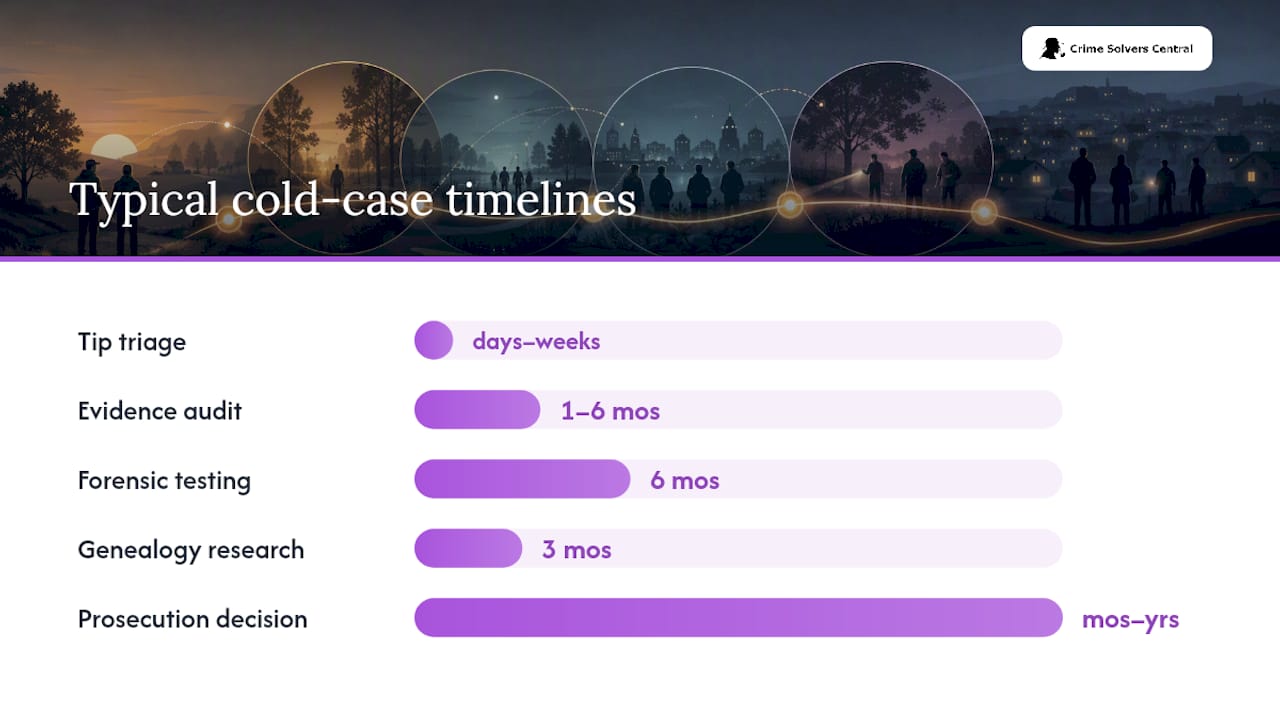
Cold-case collaboration is a long-term commitment. Families and volunteers who go in expecting a quick resolution usually burn out or cause harm. Here is what realistic timelines and costs look like.
| Stage | Realistic time range | Notes |
|---|---|---|
| Tip triage by agency | Days to several weeks | Depends on staffing and case priority |
| Evidence audit and inventory | 1–6 months | Longer for older cases with degraded records |
| Forensic lab testing (DNA, trace) | 6 months | Federal labs have significant backlogs |
| Genealogy research (if applicable) | 3 months | Depends on database matches and analyst availability |
| Prosecution decision | Months to years after lab results | Requires sufficient evidence for a charge |
Common investigative costs:
- Forensic DNA testing: several hundred to several thousand dollars per sample, depending on the lab and test type
- Investigative genetic genealogy: typically $3,000–$5,000 per case for a full analysis
- Public records and FOIA fees: usually $0–$50 per request, though some agencies charge for extensive searches
- Travel costs for families attending hearings or meetings: variable
Funding options:
- Nonprofit forensic funds (some cold-case nonprofits cover specific lab costs directly)
- Crowdfunding platforms with transparent cost breakdowns
- OJP’s Bureau of Justice Assistance grant programs for agencies
- State victim compensation programs for families
Why cold-case audits yield new leads explains how agencies prioritize which cases receive forensic resources and how community-funded testing fits into that process.
What does law enforcement actually want from community partners?
The NIJ’s national best practices for cold-case investigation are specific: agencies should maintain a public-facing list of unresolved cases, designate a media liaison, and create sanctioned pathways for community tip submission. Models that work include structured programs for retired officers, digital volunteers, and forensic genealogy partnerships.
What investigators want from volunteers and families:
- Tips submitted through official portals with full contact information
- Documented timelines built from public records, not speculation
- Database findings packaged as a one-page brief with source citations
- Awareness campaigns coordinated with the agency’s PIO
- Volunteers who have been vetted, trained, and are working within a supervised program
Effective police leadership in cold-case units depends on clear protocols for community engagement. Agencies that define those protocols upfront get better community contributions and fewer complications.
Why cold-case units are established covers the internal agency logic behind how these units prioritize cases and what triggers a formal review, which helps community partners time and frame their contributions effectively.
Key Takeaways
Effective community collaboration on unsolved crimes requires submitting verified tips through official channels, vetting every organization you work with, and maintaining victim-centered communication throughout.
| Point | Details |
|---|---|
| Submit tips through official channels | Use law-enforcement portals, the FBI tip line, or vetted nonprofit intake forms with full documentation. |
| Preserve digital evidence first | Save metadata-intact files before sharing; EXIF data and timestamps can be more useful than the image itself. |
| Vet every organization | Confirm law-enforcement partnerships, secure intake forms, and published case spotlights before engaging. |
| Families deserve regular contact | OJP and the National Sheriffs’ Association recommend at minimum annual contact with families, and biannual contact as the preferred standard. |
| Crimesolverscentral | Provides a searchable database of over 264,913 cases by state, with member access to full files, forums, and investigative tools. |
Why ethics and patience are the two things this work actually demands
Most people who want to help an unsolved case come in with urgency, and that urgency is completely understandable. But urgency without structure is one of the most common ways community involvement goes wrong.
The cases that move forward are rarely the ones that went viral. They are the ones where a family had a consistent advocate, a volunteer submitted a well-documented tip at the right moment, and an agency had the infrastructure to act on it. That is not a dramatic story. It is a slow, methodical one.
What concerns me most about the current true-crime moment is the gap between the energy people bring and the discipline the work actually requires. Submitting a tip is useful. Publishing your theory on a podcast is not. Organizing a case file for a detective is useful. Contacting a person of interest to “ask a few questions” is dangerous and potentially criminal. The line is not always obvious, which is exactly why the ethical frameworks from NIJ, OJP, and survivor-centered advocates exist.
The community’s role is to support investigators and families, not to replace them. That means doing the unglamorous work: digitizing records, distributing flyers, funding forensic tests, and staying in contact with families who need to know someone still cares. That kind of sustained, structured engagement is what actually moves cases forward.
Crimesolverscentral gives families and volunteers a real starting point
For families and volunteers who want to move from intention to action, Crimesolverscentral offers something most resources do not: a single, organized place to find case information, connect with others working the same issues, and access tools built specifically for this kind of work.
The free database covers a substantial number of cases searchable by state and case type, including missing persons, unsolved homicides, and unidentified remains. A membership unlocks full case files, source documents, videos, digital evidence boards, a flyer builder, AI image tools, forum access, and volunteer coordination features. Families can use the flyer builder to create shareable materials immediately. Volunteers can use the forums and evidence boards to organize findings in a format investigators can actually use.
Getting started is straightforward: browse the cold case database by state to find a case, review the free summary, and sign up for a membership when you are ready to access the full file and community tools. For families already in contact with law enforcement, the database provides a structured way to track what is publicly known and coordinate with other advocates working the case.
Useful sources for families and volunteers
- National best practices: Implementing and sustaining cold case investigation
- Serving survivors of homicide victims during cold case investigations: A guide for developing a law enforcement protocol | Office of Justice Programs
- Guide for developing a law enforcement protocol (National Sheriffs’ Association)
- Communicating With Individuals Impacted by Cold Case Violent Crimes: Strategies for Ongoing Engagement
- Crime Solvers Central
FAQ
Can you volunteer to help solve cold cases?
Yes. Structured volunteer roles include case-file digitization, timeline building, public records research, flyer distribution, and family liaison support. The key is working within a supervised program coordinated with law enforcement rather than independently.
What do law enforcement agencies find most useful from community partners?
Investigators want tips submitted through official portals with full documentation, database findings packaged as a concise brief, and awareness campaigns coordinated with the agency’s public information officer. Unstructured or unsolicited contact is harder to act on.
How can families stay informed about a cold case?
Families can request a named point of contact, a written case-status summary, and a regular update schedule. The OJP and National Sheriffs’ Association both recommend at minimum annual contact with families, while biannual contact is considered preferable. Families can cite these guidelines directly when making the request.
Where can you search a national cold-case database?
NamUs (managed by the NIJ) and Crimesolverscentral both offer searchable national databases. Crimesolverscentral covers over 264,913 cases by state and case type, with free public summaries and full case files available to members.
What are the legal risks of community involvement in cold cases?
The main risks are defamation (publicly naming a suspect without evidence), obstruction of justice (contacting witnesses before investigators), privacy violations, and evidence tampering. When in doubt about whether an action is appropriate, consult a victim-rights attorney before proceeding.