

File Faster: 30 Day NamUs Steps for Families With Oklahoma Cold Cases
If you’re trying to find official information on cold cases in Oklahoma, start with the Oklahoma Missing Persons Clearinghouse, the OSBI’s cold case pages, and NamUs. Your first concrete move is to contact local law enforcement to file or confirm a missing-person report, which triggers an NCIC and NamUs entry. Local contacts like Tulsa PD and Tulsa County Sheriff’s Office keep their own cold case lists and tip lines too.
TL;DR:
- Filing a missing-person report with local law enforcement immediately is critical to trigger NCIC and NamUs entries, improving case visibility.
- Local units like Tulsa PD and Tulsa County Sheriff’s Office maintain public cold case pages and accept tips directly from the public.
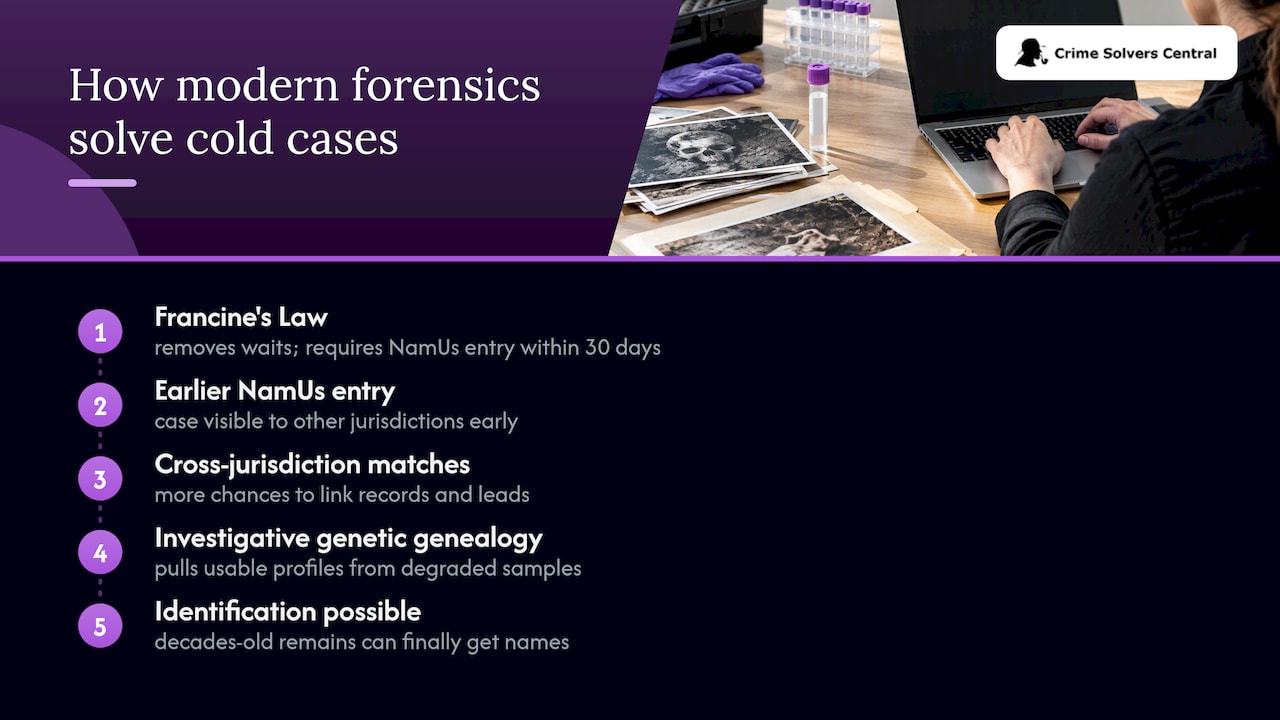
- Investigative genetic genealogy and NamUs’s quick inclusion within 30 days of a report increase the chances of solving decades-old unidentified remains.
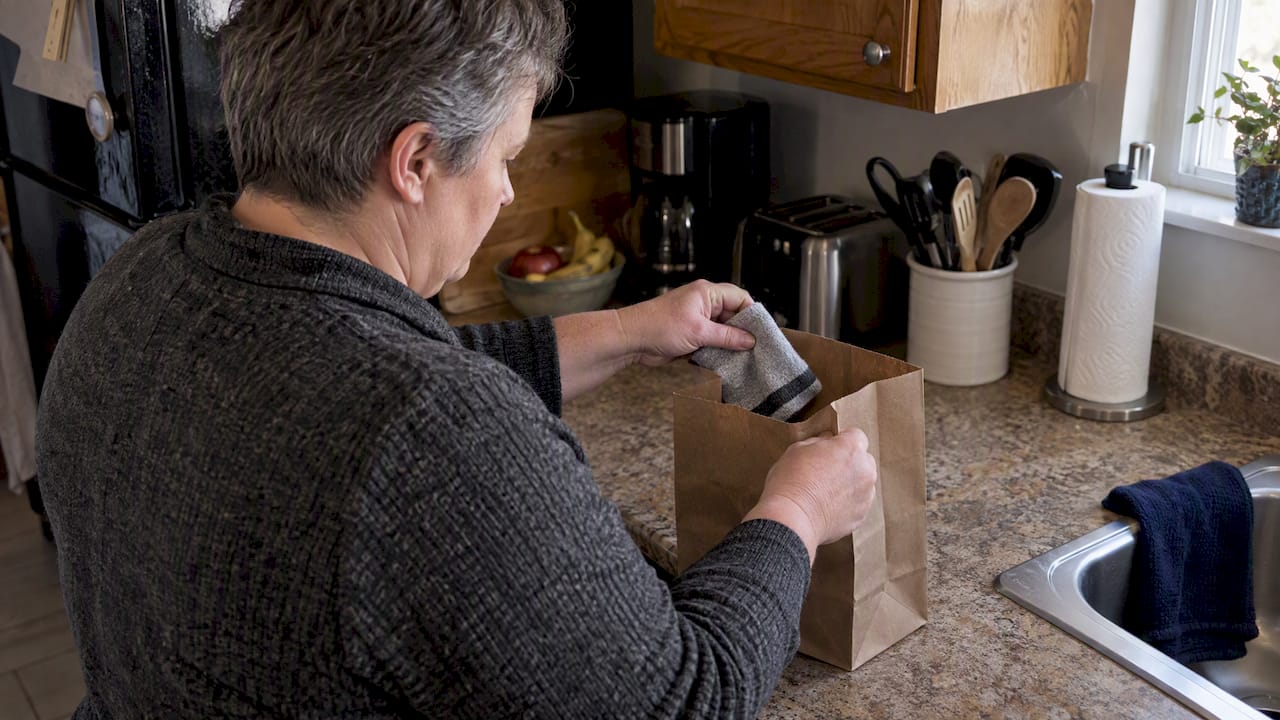
- Biological evidence should be stored properly in paper bags and minimally handled to preserve DNA for forensic analysis.
- Coordinated multi-agency efforts and advances in forensic technology now provide a clearer path to resolving older cases faster than in the past.
Table of Contents
- State and National Databases That Track Oklahoma Cold Cases
- Local Cold Case Units Worth Contacting Directly
- A Step-by-Step Checklist for Families Right Now
- How Modern Forensics Are Solving Older Cases
- Staying Informed and Getting Involved
- Why Some Investigations Move Slower Than Families Expect
- Why We Cover These Cases
- How Crime Solvers Central Supports Families and Researchers
- FAQ
- Sources
State and National Databases That Track Oklahoma Cold Cases
Several databases hold pieces of the puzzle, and knowing which one does what saves families time. The Oklahoma Missing Persons Clearinghouse is run by the OSBI and acts as the state’s coordination point, but entry starts with a local police report, which is what gets a case into the NCIC database in the first place.
NamUs, the National Missing and Unidentified Persons System, is a separate federal tool that the public can search directly, unlike NCIC, which is restricted to law enforcement. NamUs connects missing-person cases with unidentified remains across state lines, something a single state database can’t do on its own.
The Oklahoma Office of the Chief Medical Examiner handles unidentified remains directly and works with families to collect reference DNA.
- The OSBI clearinghouse coordinates state-level missing-person cases after a local report is filed.
- NamUs is publicly searchable and cross-references missing persons with unidentified remains nationwide.
- The OCME manages unidentified-remains cases and supports DNA collection for identification.
Local Cold Case Units Worth Contacting Directly
State databases matter, but local units are often where the actual casework happens. Tulsa Police Department and the Tulsa County Sheriff’s Office both maintain public cold case lists and accept tips through dedicated channels, which gives families a direct line to the detectives most familiar with a specific case.
- Tulsa PD posts its open cold cases publicly and accepts tips by phone or online form.
- The Tulsa County Sheriff’s Office keeps a parallel cold case page with its own open investigations.
- Local units coordinate with the OSBI Cold Case Unit when a case needs forensic re-testing or statewide resources.
Task forces generally reopen a review when new forensic technology becomes available, a credible tip surfaces, or a related case creates a fresh lead. These reviews often connect back to established multi-agency processes that prioritize cases with the clearest path to resolution. The OSBI’s Investigative Statewide Units page describes how its Cold Case Unit, established in 2018, works alongside the Forensic Science Center on exactly this kind of re-evaluation.
A Step-by-Step Checklist for Families Right Now
Families often feel powerless in the early days of a disappearance, but there are concrete steps that genuinely help investigators.
- File a missing-person report with local law enforcement immediately; this triggers NCIC entry and, under Francine’s Law, a mandated NamUs entry within 30 days.
- Preserve the person’s living space and any items that might carry DNA, such as a toothbrush or hairbrush, without cleaning or disturbing them.
- Gather recent photos, dental records, medical records, and fingerprints, since these are the materials investigators request first.
- Provide a family reference DNA sample and share any consumer genealogy test results with investigators, since these can sometimes be cross-referenced during an active case.
- Keep a written log of every investigator contact, including names, dates, and what was discussed, and lean on victim services staff when communication slows.
The OSBI’s family resource guide walks through this same checklist in more detail, including how to supply genealogy test company information when relevant.
Pro Tip: Store DNA-relevant items in a paper bag rather than plastic, and handle them as little as possible; plastic traps moisture and can degrade biological evidence before investigators ever see it.
How Modern Forensics Are Solving Older Cases
Investigative genetic genealogy has changed what’s possible for decades-old cases. The FBI’s case file on Molly Monette Hogan documents an Oklahoma identification made through IGG, showing how unidentified remains can finally get a name even years later.
Francine’s Law changed the front end of this process, removing waiting periods and requiring NamUs entry within 30 days of a report. That earlier visibility means a case has a better shot at cross-jurisdictional matches before leads go cold. Combined with IGG, which pulls usable profiles from degraded or limited samples, Oklahoma cases that once had no leads at all now have a real path forward.
Staying Informed and Getting Involved
Following a case closely and contributing real information are two different skills, and both matter. Checking OSBI and NamUs listings periodically, along with local department pages, keeps you current without overwhelming investigators with repeat calls.
- A credible tip includes specific dates, locations, names, and photos whenever possible, not vague recollections.
- Most departments, including Tulsa PD, accept anonymous tips by phone or online form.
- Volunteering at Missing Person Day events or supporting community-led advocacy campaigns gives you a direct way to help without interfering with active casework.
Why Some Investigations Move Slower Than Families Expect
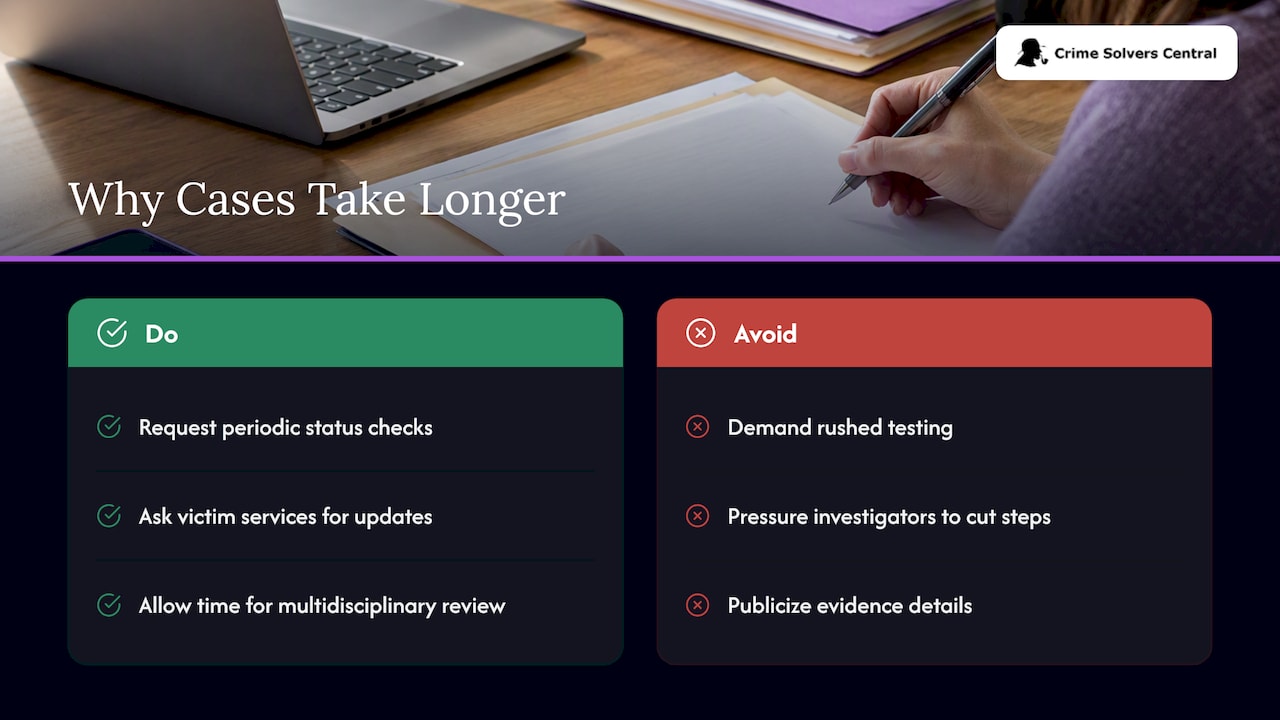
Chain-of-custody rules exist to protect future prosecutions, and they’re a big part of why public updates can feel sparse. Evidence re-testing, especially DNA work tied to investigative genetic genealogy, often requires coordination between state labs, federal partners, and outside genealogists, which takes real time.
A multidisciplinary review, pulling in forensic, legal, and investigative perspectives, simply can’t be rushed without risking the case itself. Families can still request periodic status checks through victim services or their assigned investigator, even when there’s no new public development to share.
Why We Cover These Cases
We publish on Oklahoma cold cases because families deserve accessible, accurate information, not silence. Our role is to point toward credible tools and official channels, never to speculate or spread rumor. A verified tip submitted through the right agency is worth more than a hundred shares of an unconfirmed theory.
— Crime
How Crime Solvers Central Supports Families and Researchers
We built a database to make Oklahoma’s cold cases, and cases nationwide, easier to find and follow. Free case summaries give anyone a starting point, while a membership unlocks resources for families and researchers who want to go deeper.
For families working with DNA evidence, it’s worth understanding the difference between consumer kits and court-admissible kinship testing before sharing results with investigators. If you’re ready for full access, our Jr. Detective, Sr. Detective, and True Crime Influencer plans start at $3.97 per month, with annual options available for each tier.
FAQ
How many cold cases are there in Oklahoma?
Exact statewide counts fluctuate as cases open and close, but NamUs reports consistently show Oklahoma among the states with hundreds of active missing-person records at any given time. The OSBI and NamUs databases are the most current sources for specific, up-to-date numbers.
What are some famous cold cases in Oklahoma?
Oklahoma’s cold case history includes both long-unsolved homicides and unidentified remains cases, many of which are listed directly on OSBI and local department pages. One recent example involved investigative genetic genealogy finally identifying remains years after the case went cold.
What are the recent murders in Oklahoma?
Recent homicide cases are tracked individually by local police departments and the OSBI rather than compiled into one running public list. Checking Tulsa Police Department’s cold case page or your local department’s site gives the most current, case-specific information.
How many people are missing in Oklahoma right now?
The real-time count changes constantly as reports are filed and cases resolve, so there’s no single fixed figure. NamUs and the Oklahoma Missing Persons Clearinghouse are the most reliable places to check current, searchable listings.