

Canadian Cold Cases: Notable Unsolved and Solved Files
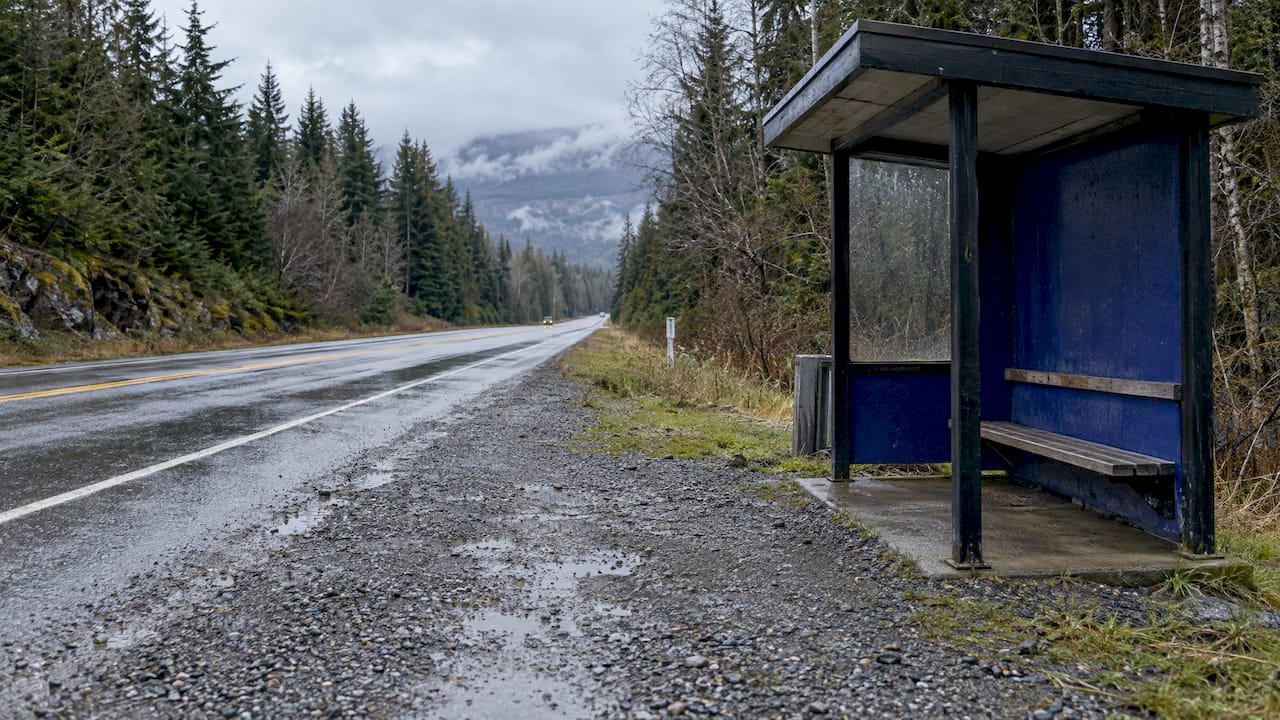
Canada’s cold cases are not frozen. The RCMP’s national missing-persons data shows 8,329 missing-person files from earlier years still open as of December 31, 2025, the oldest dating to 1919. Meanwhile, genetic genealogy is closing homicides that sat for 40 years or more. If you are a family member, a volunteer, a student or an advocate, the useful question is which Canadian files are still open, what investigators say they need, and how to organize your own effort. Crime Solvers Central’s searchable national database of cold cases, with case profiles sorted by state and type, is built for exactly that kind of organized work.
TL;DR
- As of December 31, 2025, the RCMP’s national data counted 8,329 open missing-person subjects from previous years, and 540 of the 68,349 people reported missing in 2025 were still missing at the February 2, 2026 data extraction.
- Notable open files include Tamara Chipman (Highway of Tears, B.C.), Margaret McDonald and Sharmini Anandavel (Toronto), Billy Hall (Ontario, 1967) and a Toronto John Doe unidentified since 1994.
- Recent solves, from Toronto, Windsor and Montreal, came from forensic genetic genealogy and re-examined evidence, not from new witnesses alone.
- Tips work best when they are specific, tied to a case number and sent to the investigating agency. Small details count.
- Crime Solvers Central membership starts at $3.97 per month and unlocks full case files, forums, evidence boards and a flyer builder.
Table of Contents
- How many Canadian cases are still open
- Notable unsolved Canadian cases
- Canadian cold cases that were solved
- What you can do with a Canadian cold case
- Why cross-border research matters
- Our perspective
- Membership and where to start
- FAQ
- Sources
How many Canadian cases are still open
Start with the scale, because it changes how you read every individual story. The RCMP’s National Centre for Missing Persons and Unidentified Remains publishes an annual fact sheet. The 2025 edition reports 68,349 missing-person subjects for the year, down 1% from 69,152 in 2024 and 8% below 2019. Of those, 540 (1%) were still missing when the data was pulled on February 2, 2026. The 8,329 older files are the long-term pool that most people mean by cold cases.
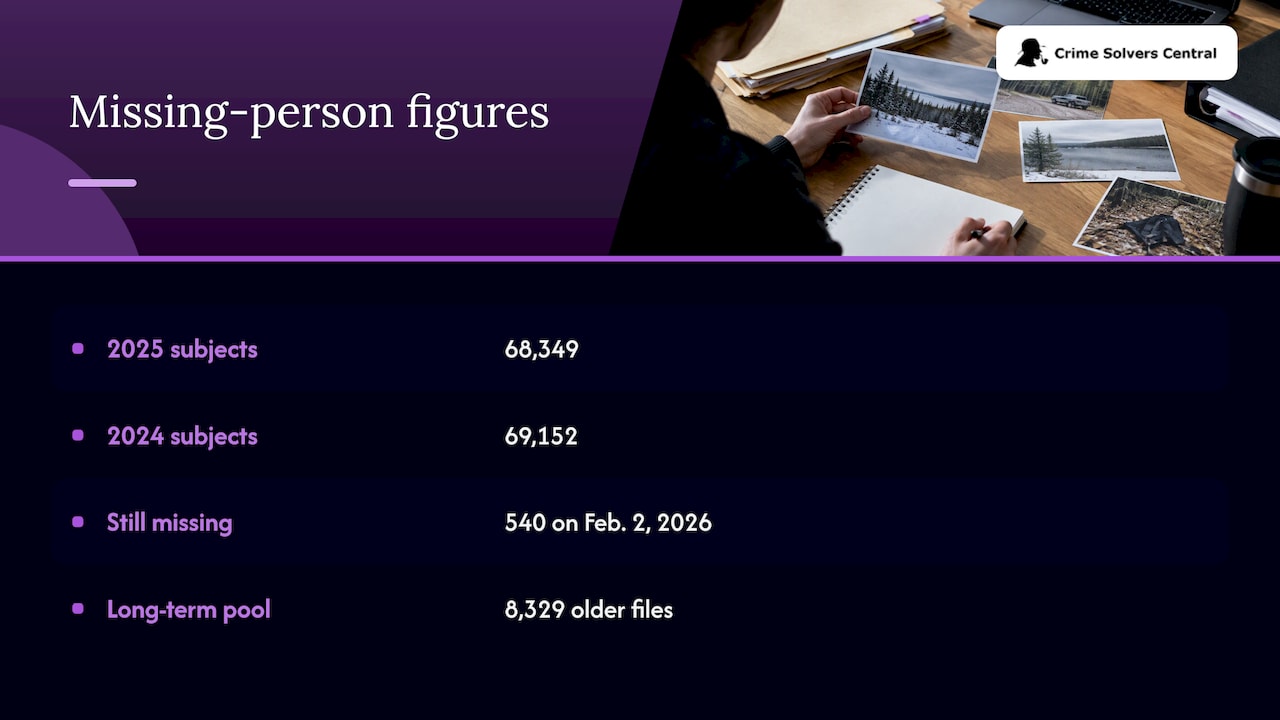
These figures are published for a period and refreshed each year, so check the live fact sheet for the latest edition before you quote a number.
Most missing people are found quickly. The Vancouver Police Department says its Missing Persons Unit handles more than 5,000 reports a year and locates the person in more than 99% of cases, with about 80% found or returning within 48 to 72 hours. The cold cases are the small remainder, which is why each one deserves sustained attention.
Notable unsolved Canadian cases
The cases below are public, active or officially listed. Each is described only as far as police or major news outlets have reported it.
Tamara Chipman and the Highway of Tears
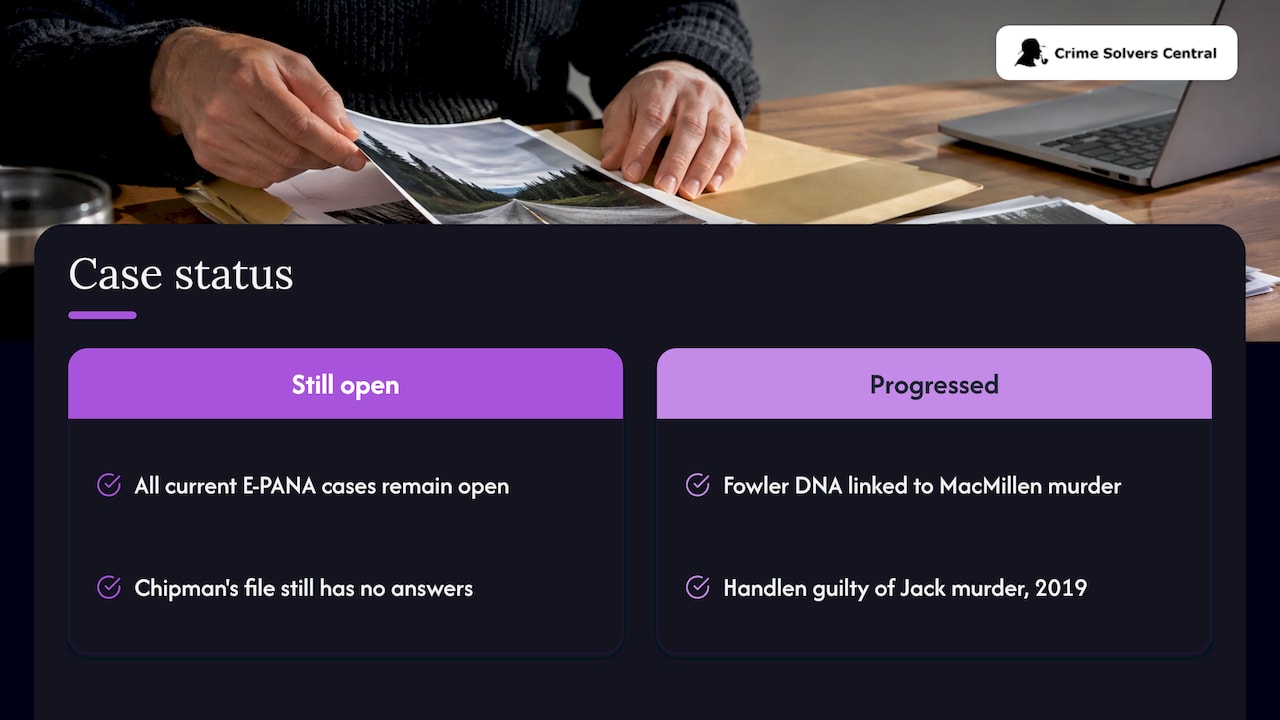
Tamara Chipman was 21 when she was last seen hitchhiking from Prince Rupert to Terrace, B.C., on September 21, 2005. CBC reports her file is one of 17 under RCMP Project E-PANA, and every current E-PANA case remains open. Her family has offered a $10,000 reward.
The Highway of Tears is the best-known cluster of Canadian cases. The Canadian Encyclopedia notes that the RCMP’s list covers 18 murders and disappearances between 1969 and 2006, ten involving Indigenous women and girls, while Indigenous groups argue the true number in northern B.C. exceeds 40. The same entry records that E-PANA has collected 750 DNA samples and conducted 2,500 interviews.
Some files have moved. DNA linked the American felon Bobby Jack Fowler to the 1974 murder of 16-year-old Colleen MacMillen, and Garry Taylor Handlen was found guilty in 2019 of murdering Monica Jack. Others, including Chipman’s, still have no answers.
Toronto homicides: Margaret McDonald and Sharmini Anandavel
CP24’s January 2026 roundup of Toronto’s notable cold cases includes Margaret McDonald, 80, who was killed in her home after an intruder ransacked it. Police hold a male DNA profile with no match in the National DNA Data Bank and describe the suspect as likely a white male with dark hair and lighter eyes, in his mid-to-late 40s.
The roundup also covers Sharmini Anandavel, a teenager whose body was found in a wooded area after she disappeared. A fake job application for the Metro Search Unit was found in her bedroom, and no charges have been laid.
Billy Hall, 1967
Sixteen-year-old Billy Hall was found near Pontypool, Ont., with a gunshot wound to the back of the head. CBC’s November 2026 reporting says the case was assigned to an OPP investigator under Project Millennium in 2015, the reward rose to $50,000 in 2016, and DNA and fingerprints were extracted from crime-scene evidence in 2017. A retired lawyer who has studied the file says genetic genealogy is probably the best prospect of solving it. A family advocate points out that the gap between when Hall was last seen and found, and his small circle of friends, made leads hard to generate.
Kingston’s only unsolved double homicide
Kingston Police’s cold case page says Jeffrey Leveque and another man were killed instantly by an intentionally set explosion in a basement apartment at 13 Shaw Street. It describes these as the only unsolved double homicide in the city. Municipal cold case pages like this one are worth bookmarking, since they list cases that rarely reach national news.
A Toronto John Doe, 1994
On September 23, 1994, a man was found dead after a fall of roughly 40 metres downtown near the Rogers Centre. The Toronto Sun reported in November 2026 that he has remained unidentified for 32 years. Investigative genetic genealogy linked him to Germany’s Lower Saxony region. Det. Mike Kelly of the Toronto Police Service Cold Case Unit oversees 14 sets of unidentified remains dating from 1968 to 2023, four of them homicides. Tips go to 416-808-7411 or [email protected], quoting Case #1994-161012.
Kelly’s explanation is instructive. If the unidentified person is Canadian, he said, the unit identifies them fairly quickly through family recognition or missing reports. Victims from abroad stay unidentified longest, partly because relatives in Europe and elsewhere have been slower to submit DNA to genealogy databases.
Canadian cold cases that were solved
Solved cases show what actually moves an old file. Almost all the recent ones share one tool.
| Case | Year of crime | How it was solved | Reported |
|---|---|---|---|
| Christine Prince, Claire Samson, Gracelyn Greenidge (Toronto area) | 1982, 1983, 1997 | Forensic genetic genealogy, then Centre of Forensic Sciences comparison | December 2025 |
| Catherine Daviau (Montreal) | 2008 | Genetic genealogy identified a suspect who had contacted her about an online vehicle listing | September 2025 |
| Ljubica Topic (Windsor) | 1971 | Genetic genealogy named the killer | 2023 |
| Christine Jessop (Toronto area) | 1984 | Genetic genealogy identified Calvin Hoover | October 2020 |
| Nation River Lady (Ontario) | Found 1975 | Exhumation, new DNA profile, family DNA confirmation | 2020 |
The details behind the table:
- Three Toronto-area murders. The Toronto Police Service reports that the Centre of Forensic Sciences conclusively linked Kenneth Smith to all three killings on December 3, 2025. Toronto police had engaged the forensic genetic genealogy firm Othram in 2022, and investigators identified close relatives before the final comparison. Smith died in 2019. Police say there may be additional victims, and they asked for any information about Smith, even details that seem small.
- Catherine Daviau. Global News reported that Montreal police used genetic genealogy to identify Jacques Bolduc as the suspect in her December 2008 killing. He had died of natural causes in 2021.
- Ljubica Topic and Christine Jessop. CBC’s overview of five Canadian cases solved with genetic genealogy covers Windsor’s naming of Frank Arthur Hall in the 1971 killing of six-year-old Ljubica Topic. It also covers Toronto’s identification of Calvin Hoover in the 1984 killing of nine-year-old Christine Jessop, a case in which a neighbour, Guy Paul Morin, had been wrongfully convicted before being cleared.
- The Nation River Lady. The OPP identified remains found in 1975 as Jewell Parchman Langford of Tennessee, believed to be the first Canadian case solved this way. OPP Commander Huyer said the decision to exhume was driven by evolving DNA science and that a clear profile could still be isolated after decades.
- Project 31. Toronto police’s humanitarian initiative, named for 31 open cases of long-term unidentified deceased people, had identified nine people by November 2025, including a man found under a subway bridge in 2008.
The pattern is consistent. Evidence kept in storage, a technology that improved, and a team willing to reopen the file. Several of the offenders had already died, so the result was answers for families rather than trials. For the science behind this, see our guides to the role of DNA in cold cases and cold cases solved by DNA.
What you can do with a Canadian cold case
The right move depends on who you are.
Families. Keep one current document per case: full name, dates, last-seen details, the investigating agency, the file or case number, and every reward or tip line. Always quote the case number, as the Toronto unit asks. Our guides on missing persons in Canada and missing and murdered people walk through where to search, report and help. Another of our guides explains four public signals of real cold case progress, so you can tell activity from silence.
Volunteers. Work from public, official sources. Police cold case pages, fact sheets and news archives are all you need to start. Our walkthrough of unsolved murders in Canada shows how to search and where to help. Never contact suspects or witnesses yourself. Pass what you find to the investigating agency.
Law enforcement. Public tips are most useful when a case is presented clearly, with the details that jog memory: dates, locations, descriptions, a reward. Toronto’s call for even small details about Kenneth Smith shows how investigators frame this.
Students and reform advocates. Canadian cases make strong study material. The Highway of Tears shows how the gap between official counts and community counts shapes public trust. The Jessop case shows how a wrongful conviction and a later genetic solve can sit in the same file.
Why cross-border research matters
Canadian cases do not always stay in Canada. Fowler, linked to Highway of Tears killings, was American. The Nation River Lady was from Tennessee, and the 1994 Toronto John Doe was traced to Germany. If you research a Canadian case, you will often need US records too: newspapers, missing-person listings, relatives’ DNA. That is where a state-by-state US database becomes practical. Our guide on leveraging national database cold cases explains how to structure that search, and our newspaper research guide covers archive work.
Our perspective
Every solved case above has the same shape: someone kept the file alive. A detective kept the evidence, a family kept the reward posted, a volunteer kept the photo in circulation. Cold cases rarely fail for lack of caring. They fail when information is scattered and effort is isolated.
That is why we built Crime Solvers Central around a national database of more than 264,000 cases, sorted by state and type. Families, volunteers and students should not need ten tabs and a spreadsheet to see a case clearly. Members get full case details, sources, videos, forums, digital evidence boards and volunteer coordination in one place, plus a flyer builder and AI image tools for getting a face back in front of the public.
The Toronto John Doe and the Nation River Lady show that identification often depends on a relative somewhere reading the right post at the right time. Organized, shareable case information is how that happens. We believe a community that works from the same facts solves more cases.
Crime
Membership and where to start
If you want to work cases rather than just read about them, membership at Crime Solvers Central unlocks full case files, forums, evidence boards, a flyer builder and volunteer coordination. Plans, as published on our pricing page:
| Plan | Monthly | Yearly |
|---|---|---|
| Jr. Detective | $3.97 | $39 |
| Sr. Detective | $9.97 | $99 |
| True Crime Influencer | $39.97 | $399 |
You can also begin on the Crime Solvers Central home page and browse the database by state.
FAQ
How many people are missing in Canada right now?
The RCMP’s 2025 fact sheet reports 8,329 open files from previous years as of December 31, 2025. It also reports that 540 of the 68,349 people reported missing in 2025 were still missing at the February 2, 2026 extraction. These figures are updated annually, so check the latest edition for current numbers.
Who was the 13-year-old girl who disappeared and reappeared 22 years later?
The research behind this article does not cover that case, so we will not guess at details. Use the police agency’s own page or a reputable news archive to verify any story of this kind before sharing it. If you are researching a specific missing child, the agency holding the file is the right source.
What is the most famous unsolved case in Canada?
Many people point to the Highway of Tears. The RCMP lists 18 murders and disappearances from 1969 to 2006, while Indigenous groups say the true number exceeds 40. All current E-PANA cases remain open, and some have been linked to suspects through DNA or conviction.
How do I submit a tip on a Canadian cold case?
Contact the agency that owns the file and quote the case number. For Toronto’s unidentified remains, that means 416-808-7411 or [email protected]. Include dates, places, names and any detail that seems small, since investigators say small details can matter.
Is genetic genealogy really solving Canadian cases?
Yes. Toronto, Windsor, Montreal and the OPP have all used it to name offenders or identify victims, including cases from the 1970s and 1980s. Cases with preserved biological evidence and relatives who have submitted DNA benefit most.
Sources
- 2025 Fast Fact Sheet, RCMP NCMPUR
- Missing Person Cold Cases, Vancouver Police Department
- Family that advocates for Highway of Tears still searching, CBC News
- Highway of Tears, The Canadian Encyclopedia
- Toronto’s most notable cold cases, CP24
- Who killed Billy Hall? CBC News
- Cold Case Files, Kingston Police
- Who is John Doe? Toronto Sun
- Three Cold Cases Solved Using Genetic Genealogy, Toronto Police Service
- Montreal police solve cold case from 2008, Global News
- 5 Canadian cold cases solved with help of genetic genealogy, CBC News
- How OPP ID’d the Nation River Lady, CBC News
- Toronto police use genetic genealogy to identify man found under a subway bridge, CBC News