

Solved Cold Cases: How They Get Cracked and What Comes Next
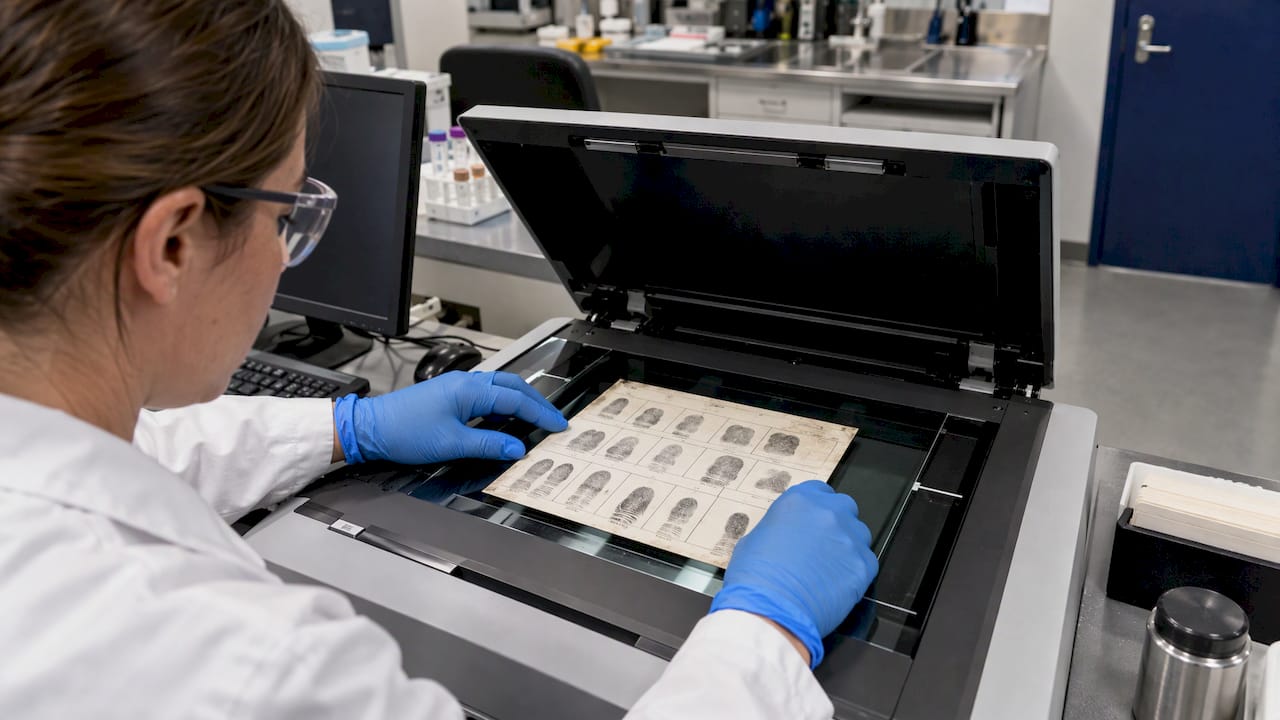
Yes, cold cases get solved, and often decades later. The pattern in the cases below is consistent: evidence kept from the original investigation is re-tested with newer forensic tools, and people keep the case alive until that happens. If you are a family member, a volunteer, a student or an advocate, the practical lesson is that a case is never closed to the public. We built Crime Solvers Central around that idea, with a searchable national database of more than 264,000 cold cases sorted by state and type.
TL;DR
- A cold case is solved when evidence identifies the person responsible. Prosecution may or may not follow, for example when the suspect has died.
- The most common breakthroughs are fingerprint database searches, DNA profiles entered into CODIS, and investigative genetic genealogy.
- Solved cases span 33 to nearly 70 years, so old evidence and old files still matter.
- Families and volunteers help by keeping cases visible, organizing information and supporting tips that reach investigators.
- Our database lets you find cases by state and situation, and members unlock full case files and tools.
Table of Contents
- What “solved” means in a cold case
- Real solved cold cases and the breakthroughs behind them
- What these cases have in common
- How families and volunteers can help
- Our perspective
- Find a case and get involved
- FAQ
- Sources
What “solved” means in a cold case
A cold case is an unsolved crime, usually a homicide or a disappearance, whose active investigation has gone quiet. “Solved” usually means investigators have identified the person responsible with evidence strong enough to name them. It does not always mean a trial.
In 1996, 15-year-old Danielle Houchins was murdered in Belgrade, Montana. The case was resolved in August 2024 after a single rootless hair was analyzed and genetic genealogy pointed to a suspect. He died the day after his interview, and state crime lab DNA then confirmed a match, according to NBC Montana’s report. The county sheriff said confirming the match brought “a lot of relief” to the victim’s family. No court case followed, but the family got an answer.
Real solved cold cases and the breakthroughs behind them
The table below summarizes cases documented by official agencies and major news outlets. Each shows a different tool at work.
| Case | Years unsolved | What solved it |
|---|---|---|
| Carroll Bonnet, Omaha, 1978 | 30 | Latent prints searched against the FBI’s fingerprint system in 2008 |
| Man found in San Diego, 1975 | 44 | 1975 prints searched in the FBI’s NGI system in 2019 |
| Vickie Lynn Belk, Maryland | 44 | Clothing re-evaluated, DNA entered into CODIS in 2022 |
| Ginger Freeman, Texas, 1981 | 38 | Genealogy records and exhumed DNA, matched in 2019 |
| Diane, Santee, California | Decades | Investigative genetic genealogy from 2020 |
| Bogle and Kalitzke, Montana, 1956 | 65 | Genetic genealogy, confirmed through the suspect’s children |
Fingerprints that waited decades
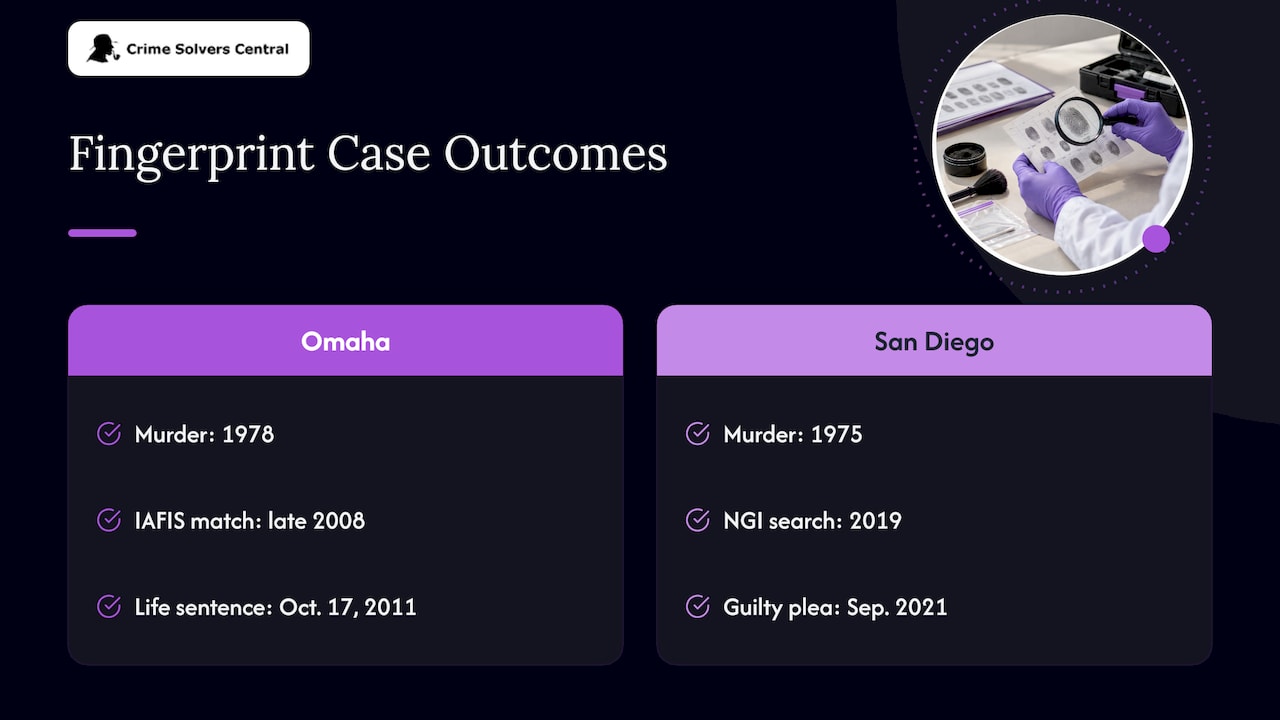
In 1978, Carroll Bonnet, 61, was stabbed to death in his Omaha apartment. In late 2008, a technician searched latent bathroom prints against the FBI’s IAFIS database and identified Jerry Watson days before his prison release. DNA confirmed it, and he was sentenced on October 17, 2011, to life in prison, per the FBI.
In San Diego, police searched 1975 latent prints against the FBI’s Next Generation Identification system in 2019. Dennis LePage was arrested in January 2020 and in September 2021 pleaded guilty to first-degree murder, according to the FBI. The lesson: a database that did not exist when the crime happened can still make the old evidence speak.
DNA profiles and CODIS
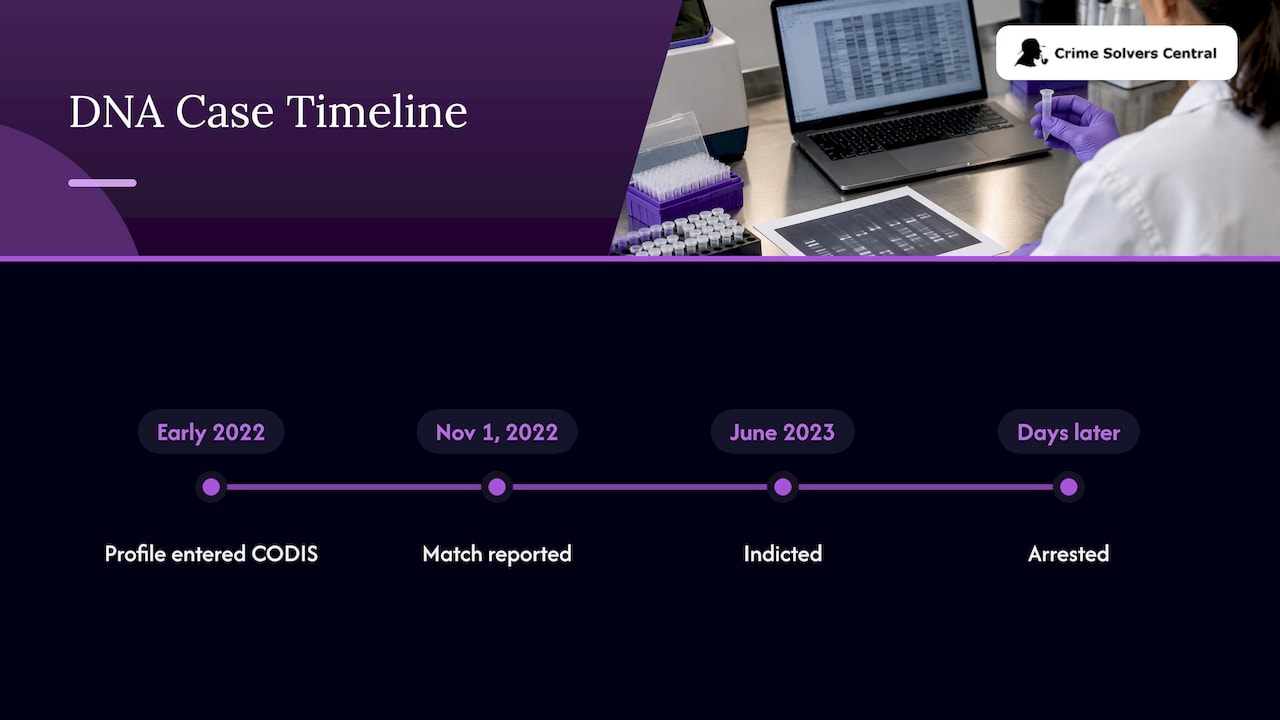
Vickie Lynn Belk was found murdered in a wooded area of Bryans Road, Maryland. In early 2022, the Charles County Sheriff’s Office re-evaluated her clothing, developed a DNA profile and entered it into CODIS, the national DNA database. On November 1, 2022, investigators were notified of a match to a man whose 1980s address was less than four miles from the scene, the sheriff’s office reported. He was indicted in June 2023 and arrested days later.
For a deeper look at the science, see our guide to cold cases solved by DNA and the role of DNA in cold cases.
Genetic genealogy
When the culprit is not in any criminal database, investigators can compare crime scene DNA with voluntary public genealogy databases and build family trees to find relatives, then narrow to a suspect.
- Texas, 1981. Real estate agent Ginger Freeman was murdered in Brazos County. Investigators used genealogy records in 2018 and exhumed a suspect’s body for DNA. The Texas DPS lab reported a match on August 30, 2019, per the state’s cold case record.
- California, 2020 to 2022. The San Diego County Sheriff’s Cold Case Team built nine family trees connecting nearly 1,300 people to identify the killer of a young woman in Santee, the sheriff’s office announced.
- Pennsylvania, 1992. Teacher Christy Mirack’s murder was solved when a lab built a family tree from the suspect’s DNA, as A&E reported.
- Minnesota, 1993. Jeanie Childs was found stabbed in her Minneapolis apartment. After 26 years, genetic genealogy, social media and traditional police work identified the killer, CBS News Minnesota reported.
The oldest solved case on record
In January 1956, Duane Bogle, 18, and Patricia Kalitzke, 16, were shot in Great Falls, Montana. In June 2021, the Cascade County Sheriff’s Office named Kenneth Gould, a horse trainer who died in 2007, as the likely suspect. A sergeant on the case believed it was the oldest U.S. homicide solved with genetic genealogy, according to The New York Times. A DNA profile from a 2001 retest of autopsy evidence was uploaded in 2019, and because Gould had been cremated, DNA from two of his children confirmed the match, CNN reported.
When the case ends in court
The Golden State Killer is the best-known example of a cold case ending in conviction. Joseph DeAngelo pleaded guilty in June 2020 to 13 counts of murder and 13 counts of kidnapping with robbery, and was sentenced to life without parole in August 2020, USA Today reported. For more high-profile investigations, read our piece on famous cold cases.
What these cases have in common
- Evidence was preserved. Clothing, latent prints, a swab and a single hair all survived for decades.
- Technology caught up. Each case turned on a database or method that was not available at the time of the crime.
- Someone kept asking. Investigators revisited files, and families and communities kept the name and the story alive.
- Closure is not always a verdict. Several suspects had died, yet families still received an answer.
How families and volunteers can help
You cannot run a lab test, but you can strengthen the conditions that lead to a solve. Keep a clear record of dates, places, names and documents. Make sure the case is visible in the places investigators and the public look. Share accurate information, and route any tip to the investigating agency rather than acting on it yourself.
Families of missing persons can start by registering the case with NamUs, the national missing persons database, then connect with others in similar situations. Our guide to registering with NamUs and connecting with families walks through it. Volunteers can read how to collaborate with communities on unsolved crimes, and students can use our outline for a criminology thesis on cold cases.
Solved cases can bring grief back to the surface, and families sometimes look for support. Resources on talking to a deceased loved one cover one way some people find comfort. A grief counselor or your doctor can also help if the weight of a case becomes hard to carry.
Our perspective
Every solved case in this article began as a file that someone refused to treat as finished. The evidence existed for years. What changed was who was looking, and with which tools.
That is why we built a national database of more than 264,000 cases, organized by state and situation. When a case is easy to find, it is easier to remember, easier to share and easier for the right person to pick up. Our members get full case details, sources, videos, forums, digital evidence boards and a flyer builder, and our volunteer coordination and safety initiatives give community effort somewhere to go.
We believe the next solved case will come from a mix of lab science and public attention. We are here to supply the second part.
Crime
Find a case and get involved
You can browse our database by state and type for free summaries. Membership unlocks complete case files and community features. Plans are Jr. Detective at $3.97 per month or $39 per year, Sr. Detective at $9.97 per month or $99 per year, and True Crime Influencer at $39.97 per month or $399 per year. See the details on our membership plans page. If you are a family member who needs a printable poster, the flyer builder lets you create one. To learn how to search well, start with how to leverage national database cold cases.
FAQ
Are cold cases solved?
Yes. The cases above were solved after 30 to 65 years using fingerprints, CODIS DNA matches and genetic genealogy. Many remain open, so each solve is worth studying for what it teaches about evidence and persistence.
What is the oldest cold case ever solved?
The 1956 Bogle and Kalitzke double homicide in Great Falls, Montana, is believed by a sergeant on the case to be the oldest U.S. homicide solved with genetic genealogy. It was announced in June 2021.
Does a solved case always mean a conviction?
No. In the Belgrade, Montana case, the suspect died before charges, but DNA confirmed his identity. Where a living suspect exists, as in the Maryland case, charges and court proceedings follow.
How can I follow unsolved cases in my state?
Search our database by state and case type to see profiles of missing persons and unsolved homicides. For unsolved homicides specifically, our guide to unsolved homicides explains what the clues usually look like.
Sources
- NBC Montana: Sheriff, genealogist discuss breakthrough in 1996 Belgrade murder
- FBI: 30-Year-Old Murder Solved
- FBI: Biometric Identification Award to San Diego Police Department
- Charles County Sheriff’s Office: 44-Year-Old Case Solved
- Texas DPS: Unsolved Homicide record
- San Diego County Sheriff: Cold Case Solved, Santee
- A&E: Christy Mirack murder
- CBS News Minnesota: Footprint to Murder
- The New York Times: Two Montana Sweethearts Were Fatally Shot in 1956
- CNN: 1956 double murder case solved
- USA Today: Golden State Killer sentencing