

Best Platforms for Solving Cold Cases in 2026

The best platform depends on what you need to do. For official records on missing and unidentified people, use NamUs. For a tip about a case on federal land, use the National Park Service tip line. For deep, organized research alongside other volunteers, use a community platform such as Crime Solvers Central. Most people get the best results by combining one official source with one research workspace. This guide shows what each type does, what it costs, who can use it and how to stay safe while you help.
TL;DR
- NamUs is the free, official national clearinghouse for missing, unidentified and unclaimed person cases. Start here if you are a family member.
- FBI ViCAP is for law enforcement only, but the public can read its alert pages on selected cases.
- Agency tip lines, such as the National Park Service cold-case line, are the right place to send a tip. You can stay anonymous.
- Crime Solvers Central is a subscription research community with a searchable database of more than 264,000 cases, sorted by state and type. Plans start at $3.97 per month.
- Never contact suspects or witnesses yourself. Pass findings to the investigating agency.
Table of Contents
- What counts as a cold case platform
- Comparison at a glance
- NamUs: the free official starting point
- FBI ViCAP and NCIC: powerful, but not for the public
- Agency tip lines: where information goes to investigators
- Community research platforms: organized help for volunteers and families
- Costs and plans
- Perspective: why we pair official records with community effort
- What public effort has actually accomplished
- How to choose: a quick decision guide
- Working safely
- Try Crime Solvers Central
- FAQ
- Sources
What counts as a cold case platform
People use the phrase for four different kinds of tool, and they do different jobs:
- Official databases hold verified case records, run by government agencies.
- Law enforcement analysis systems link violent crimes across jurisdictions, and mostly only police can use them.
- Tip channels send information straight to the agency that owns the case.
- Community research platforms help volunteers browse cases, organize what is public, share notes and build materials such as flyers.
Comparing a government database with a community workspace on price alone misses the point. They work best together. The official record tells you what is confirmed. The research workspace helps you organize and sustain the effort.
Comparison at a glance
| Platform type | Who can use it | Cost | Best for |
|---|---|---|---|
| NamUs | Anyone can search. Families, police, medical examiners and coroners can enter or manage records. | No cost | Verified missing, unidentified and unclaimed person cases |
| FBI ViCAP | Law enforcement enters and searches. The public sees selected alerts. | No cost to view alerts | Linking violent crimes across agencies |
| National Park Service cold-case roster | Public can read and send tips | No cost | Cases on national park land |
| Crime Solvers Central | Public summaries, plus members for full files and tools | $3.97 to $39.97 per month, or $39 to $399 per year | Organized volunteer research and family outreach |
NamUs: the free official starting point
NamUs is a national clearinghouse for missing, unidentified and unclaimed person cases. The National Institute of Justice funds and administers it, and the UNT Health Science Center in Fort Worth, Texas manages it. Its resources are free to law enforcement, medical examiners, coroners, forensic professionals and family members of missing persons.
Three features matter most:
- Searchable by everyone. Biometric and other sensitive details stay limited to vetted criminal justice users. Anyone can enter a missing-person record, but each one is verified with the appropriate law enforcement agency before publication.
- Free forensic help. Through the UNT Center for Human Identification, NamUs provides forensic odontology, fingerprint examination, forensic anthropology and DNA analysis, plus free family DNA collection kits.
- Family support. A Victim Services Division connects families with service providers.
There is one limit to know about. Only 17 states require law enforcement to enter cases, and the rest is voluntary. NamUs therefore does not capture every missing or unidentified person case in the country. That is why a careful search uses more than one source.
To be published, a criminal justice agency must confirm the report, supply a case number and give permission. If your loved one’s case is not listed, ask the investigating agency to enter it.
We walk through the process in our NamUs search guide for families and in our piece on advanced NamUs searches.
FBI ViCAP and NCIC: powerful, but not for the public
Two national law enforcement systems come up often in cold case discussions.
NCIC has 21 files, including the Missing and Unidentified Person files. Access is not available to the public. Potential matches between those files are generated automatically and sent to the investigating agency each day.
ViCAP helps police link homicides, sexual assaults, missing persons and unidentified remains. Only law enforcement can enter cases and search it, but the FBI publishes public alert pages for select cases when the investigating agency approves.
For a volunteer, this means you cannot search these systems. You can still read the public alerts, and you can ask the agency whether the case has been entered.
Agency tip lines: where information goes to investigators
If you know something, the fastest route is the agency that owns the case. Many agencies publish rosters and tip contacts.
The National Park Service Investigative Services Branch is one example. It keeps a public cold-case roster and takes tips by phone at 888-653-0009, online or at [email protected]. Submitters do not have to give their names.
For cases outside federal land, look up the local police department, sheriff’s office or state bureau named in the case record. Put the case number at the top of your message. State what you saw or know, when you learned it and how you know it. Keep rumor and guesses out.
Community research platforms: organized help for volunteers and families
Official channels are built for professionals. Many families and volunteers want something more: a way to browse cases by state, follow developments, compare notes and keep a case visible. That is the role of a community research platform.
Useful features to look for:
- A searchable catalog sorted by state and case type
- Full case profiles with sources
- Tools for building flyers and organizing public information
- Forums or boards for sharing findings
- Clear rules that send tips to law enforcement
Crime Solvers Central
We built Crime Solvers Central around those needs. Our national database holds more than 264,000 cases of missing persons, unsolved homicides and unidentified or unclaimed remains, sorted by state and situation. Members can open full case details, sources and videos. They can also use forums, digital evidence boards, a flyer builder, A.I. image tools and volunteer coordination resources. Our site features testimonials from people who say they used it to reconnect families and help move investigations forward.
Our overview of how families use NamUs and our database explains how the two fit together.
Costs and plans
NamUs and agency tip lines cost nothing. Crime Solvers Central uses a membership model for full case files and community tools. These are the prices published on our pricing page:
| Plan | Monthly | Yearly |
|---|---|---|
| Jr. Detective | $3.97 | $39 |
| Sr. Detective | $9.97 | $99 |
| True Crime Influencer | $39.97 | $399 |
The yearly Jr. Detective plan works out to less than the cost of a full year paid monthly, and the same is true for the other two plans. Pick a monthly plan if you want to try the platform during an active search. Pick a yearly one if you plan to follow cases over time. The pricing page lists what each plan includes.
Perspective: why we pair official records with community effort
We see the same pattern in the families and volunteers who find us. They have registered a case or read a public record, and then they hit a wall. They want to know how to keep a case in front of people, how to find similar cases in their state and how to put their time to use without getting in the way of detectives.
That is why we organized our catalog by state and case type, and why we built shared tools around it: digital evidence boards, a flyer builder, A.I. image progression and volunteer coordination. A record on its own is a starting point. A case that people keep reading, sharing and organizing around is one that stays alive.
Our advice is to register or confirm the case with NamUs, then use a community workspace to stay organized and active. Send everything you learn to the investigating agency. Our members tell us this combination gives their effort structure, and it keeps the work safe and useful.
Crime
What public effort has actually accomplished
The strongest documented wins come from public attention and science working together. In July 2026, CNN reported that a teenager known for nearly 26 years as “Chelsea Jane Doe” was identified as Tiffany Bradley. Investigators used investigative genetic genealogy: DNA analysis combined with a paper trail built from newspaper and social media records. The same report notes the method is increasingly used to name unidentified Jane and John Does, not only to find suspects.
The lesson for volunteers is that the contribution is often indirect. You keep a case visible, you help a family gather accurate details, and you point agencies toward records they can verify. Detectives and labs do the rest. If you want to understand why victims and families keep pursuing justice, that persistence is usually the common thread.
Our guides on collaborating with communities on unsolved crimes and crowd-sourced investigation cover how to do this responsibly.
How to choose: a quick decision guide
You are a family member of a missing person. Register or confirm the case with NamUs first, request the free family DNA kit through the investigating agency or NamUs, then add a community platform for outreach tools and flyers. Our family guide to the official missing persons database lays out the steps.
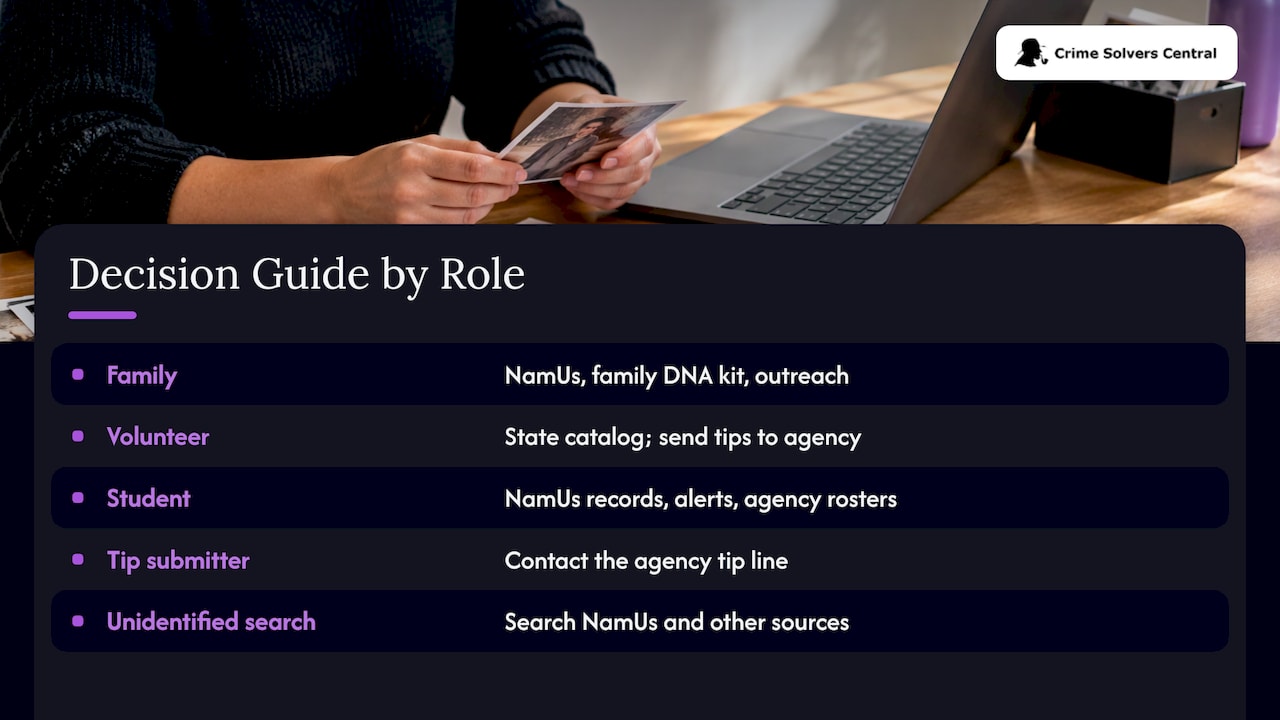
You are a volunteer. Choose a community platform with a state-by-state catalog, so you can focus on cases near you. Start with public summaries, and send anything useful to the investigating agency, not to the family or suspects.
You are a student. Use the official NamUs record structure to learn how cases are classified, and read public alerts and agency rosters. A community catalog helps you see patterns across states.
You have a tip. Skip all platforms and go straight to the agency tip line.
You are looking for an unidentified person. NamUs is the main source, but not the only one. See our guide to searching beyond NamUs.
Working safely
Good intentions can still cause harm. A few habits protect the case and the people involved:
- Do not approach suspects, witnesses or scenes on your own.
- Do not post unverified names or accusations. Public posts can damage a prosecution or hurt innocent people.
- Share leads with the agency and keep a record of what you sent and when.
- Treat family members gently. Many have waited years.
- Use the agency’s case number so your information lands in the right file.
Our safe plan for families and volunteers goes through each step.
Try Crime Solvers Central
If you want a state-by-state catalog, full case profiles and tools for organizing volunteer effort, you can join through our membership plans. You can also browse the cold case database by state to see what is listed for your area. Our About page explains our mission.
FAQ
Is there a free place to search for missing and unidentified persons?
Yes. NamUs is searchable by the public at no cost. Its sensitive biometric details are limited to vetted professionals. Because only some states require agencies to enter cases, it is smart to also check local agency pages and other databases.
Can I add a case to NamUs myself?
Anyone can enter a missing-person record, including family members. The case is then verified with the appropriate law enforcement agency before it becomes public. Unidentified and unclaimed person records are entered by medical examiners, coroners and other criminal justice designees.
Can the public use FBI ViCAP?
No. Only law enforcement agencies can enter and access ViCAP. The FBI does post public alert pages for select cases when the investigating agency approves, so you can read those.
How do I send a tip about a cold case?
Contact the agency that owns the case, and include the case number. For cases handled by the National Park Service, you can call 888-653-0009, submit online or email [email protected], without giving your name.
Which plan on Crime Solvers Central should I start with?
Plans are Jr. Detective ($3.97 per month or $39 per year), Sr. Detective ($9.97 per month or $99 per year) and True Crime Influencer ($39.97 per month or $399 per year). The pricing page lists what each includes, so you can match a plan to how involved you want to be.
Sources
- NamUs home page
- National Institute of Justice: NamUs
- DOJ privacy assessment of NamUs
- OJP: Comparison of the NamUs and NCIC databases
- Overview of national databases, including ViCAP
- National Park Service cold cases and tip line
- CNN: Chelsea Jane Doe identified through genetic genealogy
- Why victims should pursue justice