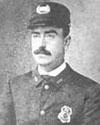
Andrew J. Craw, a white male Erie Railroad police captain in his late twenties, spent the morning of December 11, 1912, working the busy New York, Susquehanna and Western Railroad yards and coal docks at Edgewater, New Jersey, where coal from inland lines met the Hudson River waterfront and the constant movement of freight defined the rhythm of the town. Born around 1884 and later buried in Evergreen Cemetery in Otego, New York, he had risen to a position of authority in the Erie Railroad Police, responsible for safeguarding company property and personnel at a time when industrial labor disputes were increasingly volatile and sometimes deadly.
That day, the rail yards were tense with the presence of striking coal handlers, men whose anger over their working conditions and the use of strikebreakers had hardened into confrontation. As the strikers massed near the yards and coal docks in Edgewater, their frustration boiled over into open aggression.
They charged at the Erie Railroad police detail, and in the chaos that followed, what had been a labor dispute ruptured into a running fight. Gunfire erupted between the strikers and the officers guarding the area, turning the industrial landscape of tracks, cars, and coal piles into a battlefield.
In the exchange of shots, Captain Craw became a primary target. Accounts describe him being struck repeatedly by revolver fire as the confrontation intensified, while his fellow officer, Thomas Mallory, was hit by a load of buckshot. Both men were mortally wounded in the riot, and despite the efforts made after the violence subsided, they died within hours of the attack. Nine other Erie Railroad officers were also wounded, a measure of just how fierce and indiscriminate the gunfire had become once control of the scene slipped away. The deaths of Craw and Mallory stood out not just as casualties of a strike but as a stark example of how quickly industrial disputes could collapse into bloodshed when weapons and mass anger mixed in a confined space.
In the aftermath, authorities moved quickly to establish responsibility for the killings. Investigators focused on the group of striking coal handlers believed to have taken part in the attack at the Edgewater yards. Ten men were ultimately arrested and charged with the murders of Captain Craw and Officer Mallory, the state treating the confrontation not as an unfortunate by-product of a labor dispute but as a prosecutable homicide born out of the riot. When the cases reached court, the outcomes reflected both the difficulty of sorting individual culpability from mob action and the determination to punish at least some of those involved. Five of the defendants were convicted of second-degree murder and received prison sentences ranging from eight to thirty years, while the remaining five were acquitted, their roles in the violence judged unproved or less direct. The convictions and sentences, alongside the others who walked free, left a complicated legacy: the law had identified and punished some of the men behind the fatal riot, yet the broader conflict between labor and authority that had set the tragedy in motion remained unresolved, with Captain Andrew J. Craw's death remembered as one of its most haunting costs.