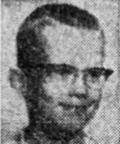
Karl Clark, also listed in cemetery records as Carl Clark, a 12-year-old male, died on January 17, 1961, in Grand Blanc, Michigan, in a family tragedy that unfolded just days after the Clarks moved into a new house on Oldbridge Drive. The home was still more of a promise than a settled place, a brick-front, story-and-a-half house in a new subdivision where neighbors had barely had time to learn the family’s names.
Boxes were still unpacked, and the neighborhood itself was so new that the sidewalks were described as looking almost freshly poured when residents gathered outside in shock after the deaths were discovered.
Karl was one of four children killed in the home, along with his siblings Karen, Kathleen, and Kurt. Their mother, Janet Rasmussen Clark, was also killed. Online memorial records identify Karl as having been born on September 16, 1948, in Flint, Michigan, and as having died in Grand Blanc on January 17, 1961. He was buried at Flint Memorial Park in Mount Morris, Genesee County, Michigan, with burial records showing the family’s deaths clustered around the same terrible date.
The available accounts describe the deaths as a murder-suicide carried out by Karl’s father, Thomas B. Clark. Reports from the time stated that the family of six was dead “at the father’s hand,” meaning Thomas killed his wife and children before taking his own life. Because Thomas died at the scene, there was no arrest, no surviving suspect to charge, and no trial or conviction. The case was not presented as an unsolved killing involving an unknown outsider, but as a domestic mass killing in which the father was identified as the perpetrator.
One of the last people known to have seen the family alive was Mrs. Ernest J. Somers, the real estate agent who had sold the Clarks their new home. She went to the house around 7 p.m. on Monday with documents that needed signatures. Thomas was there, but Janet had gone to the grocery store. Mrs. Somers waited until Janet returned, and she later recalled that Thomas seemed very nervous and unable to discuss the papers. Janet told her the documents would be returned Tuesday morning.
When Mrs. Somers returned to the house around 3:30 p.m. Tuesday, the family’s late-model station wagon was still in the driveway. She rang the doorbell for nearly five minutes, thinking Janet might be upstairs asleep, but no one answered. She left, and when she returned later, the bodies had already been discovered. The new home that had been meant to mark a secure beginning for the family had instead become the scene of their deaths.
Thomas Clark’s mother, Mrs. Oscar Ostrander, described him as a man who had seemed devoted to his wife and children, making the violence difficult for his family to understand. She said he had often spoken about his admiration for Janet and had been excited about the family getting into the new house, saying it was going to be wonderful. He had worked with Boy Scouts, enjoyed woodworking, and reportedly made things with his oldest son, a detail that adds a painful shadow to Karl’s death because it suggests father and son had once shared time together in ordinary, affectionate ways.
At the same time, Thomas had reportedly been under heavy strain. His mother said he had been worrying a great deal, and the family had tried to get him to see a doctor. His work had taken the family to St. Charles, Missouri, before they returned to the Flint area, and he had been dealing with job changes, studying in Detroit, and the pressure of settling the family again. Before moving into the new house, the Clarks had stayed at the Temp Ho Motel, then moved into the Grand Blanc home only days before the killings.
Thomas’s mother also pointed to a serious injury from years earlier. In January 1945, he suffered a back fracture while tobogganing with a church group on the grounds of the Flint Golf Club. Doctors had once warned that he might not recover or could be paralyzed, though his condition improved. According to his mother, doctors had told the family that a severe nervous shock could lead to something more serious. She believed the combined pressures in his life may have become too much for him.
For Karl, the public record leaves behind only fragments: a boy born in Flint, buried in Genesee County, and killed with his mother and siblings inside a house his family had barely begun to live in. The story is remembered less through a long courtroom record than through the stark outline of a family destroyed in a few violent moments, with the identified suspect dead alongside his victims and no criminal case left to carry forward.