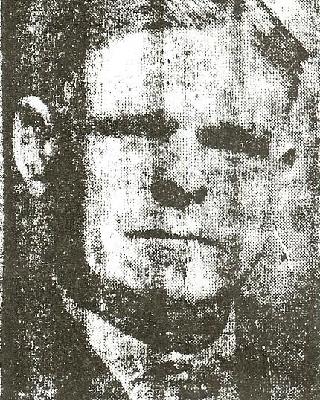
City Marshal Edward “Ed” Baum was a 38-year-old male serving as the chief law officer of the young town of Checotah, Oklahoma, when the trouble that had been simmering for years finally reached him on March 27, 1909. In the rolling country west of town, Muscogee traditionalists and their allies had gathered around the charismatic leader Chitto “Crazy Snake” Harjo, a man who resisted allotment and the dismantling of tribal sovereignty.
Newspapers and later historians would remember the clash that followed as part of the “Crazy Snake Rebellion,” a brief but intense uprising in which questions about land, law, and authority converged on a single rough cabin near Hickory Ground.
By the morning of March 27, anxiety in the area had become impossible for local officials to ignore. Reports told of Harjo's followers holding meetings at Hickory Ground and of livestock thefts and other offenses blamed on men associated with his camp. A warrant was issued for Harjo, accused of larceny and of leading a militant band that no longer recognized county authority. Baum, as city marshal of Checotah, joined forces with McIntosh County deputy sheriff Herman Odom and several other experienced lawmen: U.S. Deputy Marshal Frank Jones, veteran posseman William Carr, and Muskogee resident Frank Swift, a personal friend of Baum. All were formally deputized on March 27 and set out that afternoon from Checotah, traveling by hack and horseback toward Harjo's home near Pierce and the Hickory Ground ceremonial town, roughly fifteen miles from Baum's jurisdiction.
As the small posse neared its destination close to sundown, the landscape around Hickory Ground was not just another patch of woods but the center of a parallel government. Harjo had declared himself chief of a group that refused allotment, drawing together full-blood Creeks and freedmen still loyal to an older order. Lawmen later recalled seeing a lone man in the trees ahead of them, acting as a lookout. When the posse pressed forward, the man ran; they gave chase, overtook him, and arrested him, an ominous sign that Harjo's followers were prepared for trouble. With their prisoner in tow, the officers pushed on toward the cabin. Somewhere in that last stretch of ground between the timber and the house, the fragile line between warrant service and armed conflict finally snapped.
Accounts of the first shots differ in detail, but they agree on what mattered most to Checotah: when the firing began, Baum was hit first. Some reports describe several of Harjo's men running from the house and opening fire as the posse approached; others picture a bodyguard inside the cabin, shooting from a window into the fading light. In the opening volley, Baum fell, mortally wounded, the first officer to go down. Deputy Odom tried to reach him under fire and was himself shot and killed as he moved toward his fallen comrade. Other members of the posse fired back until their ammunition ran low, and some sources say several of Harjo's followers were killed or wounded in the exchange. One newspaper story reported that posseman Frank Swift was badly wounded, while later official tallies emphasized that two officers died in the encounter at Harjo's home and one man was killed in a related skirmish, reflecting the confusion of a battle fought in the darkening woods and retold by frightened survivors.
The survivors broke off the fight and retreated toward Checotah to raise help. Word of the killings spread quickly across eastern Oklahoma and beyond. Associated Press dispatches spoke of a “pitched battle” at Hickory Ground between five officers and some twenty men of the Snake clan, emphasizing that both Baum and Odom had been shot down in the line of duty. The news stirred anger and alarm among white settlers, who had long feared that Harjo's band might ignite a broader uprising. In Checotah and nearby towns, Baum and Odom were mourned as casualties not only of gunfire but of a larger struggle over who held authority in the old Creek country. Local papers such as the Checotah Enquirer soon carried memorial pieces in their honor, fixing their names in the public memory of the town that had sent them out and received them back in caskets.
In the days that followed, the fight at Harjo's cabin became the pretext for a massive show of state power. Governor Charles N. Haskell called out multiple companies of Oklahoma National Guard, which rushed by special train into the Hickory Ground and Pierce area. Posses and militia units swept through the countryside searching for Harjo and his supporters. Contemporary reports described the burning of Harjo's house and the plundering of Snake farms by vigilante groups who believed they were flushing out rebels. State and federal officials later tried to scale back the more sensational tales of massacres, noting that only a handful of people had actually been killed in the scattered skirmishes, but by then the image of a small “war” in the Creek Nation had taken root.
The search focused above all on Chitto Harjo himself. Within a few days, newspapers from Colorado to California carried reports that “Crazy Snake” had been captured west of Checotah, badly wounded in the thigh and being held under heavy guard on a nearby farm before transfer to the jail at Muskogee. Later historical work drawing on Creek and federal records would conclude that Harjo survived his wounds long enough to make his way to the home of Daniel Bob, where he died in 1911 of the gunshot suffered in the 1909 raid. Whatever the exact timing, there was no public, extended criminal trial in which Harjo stood in a courtroom to answer formally for the deaths of Baum and Odom; his story, like theirs, was folded into the broader narrative of the rebellion and its suppression rather than into a single homicide case file.
For the specific question of who had fired the fatal shots, another name soon emerged from the flurry of arrests. Newspapers reported that among the Seminole freedmen near Holdenville and other communities, “great excitement” arose over the seizure of one of their own, a man named Frank Coker. Coker was explicitly described in multiple dispatches as being charged with killing Marshal Baum and Deputy Odom at Crazy Snake's house. His arrest fed fears that Seminole allies might rise to join Harjo's band, and reports out of Oklahoma City warned that the Seminoles were arming in response. The available contemporary clippings, however, do not clearly record the final disposition of the charges against Coker, leaving the ultimate legal outcome of that specific accusation in shadow even as his name was linked in print to Baum's death.
Despite the uncertainty around the courtroom fate of the accused, Baum's own story did not fade. He was buried at Oak Cemetery in Fort Smith, Arkansas, his grave marked with his name and dates and surrounded by the names of his parents, his wife Minnie Euper Baum, and the son who would outlive him by half a century. Over time, his sacrifice was formally recognized on state and national memorials to fallen law enforcement officers, including the Oklahoma Law Enforcement Memorial and the Officer Down Memorial Page, which record how he rode out with a handful of officers to serve a warrant and became the first to fall under a sudden burst of rifle fire. Modern homicide and gun-violence databases still list him as a victim, noting the date and place of his death and linking his name to that of Deputy Odom. In the end, the killing of Edward Baum is remembered less as an isolated crime than as a human cost of the Crazy Snake Rebellion: one man's attempt to carry out the law in a landscape where two different systems of law were colliding, with fatal results on the edge of a clearing at Hickory Ground.