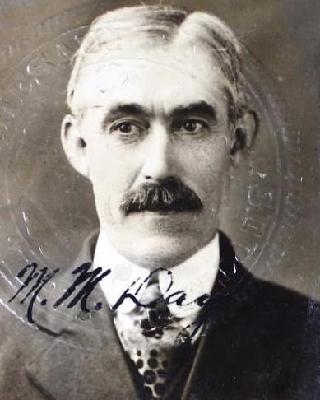
Sam Payne, a 35-year-old White male, was serving as a deputy sheriff in McDowell County, West Virginia, when a routine attempt to execute an arrest warrant turned deadly in February 1900. Although February 19 has sometimes been associated with Payne’s death, the available historical accounts identify Monday, February 19, 1900, as the date he was shot and Wednesday, February 21, 1900, as the date he died from his wounds.
The confrontation took place at Peeryville, also rendered Perryville in a contemporary account, in McDowell County rather than in Welch itself. Payne’s father, Deputy Sheriff W. M. Payne of Bradshaw, had a warrant for the arrest of Will Meyers and entrusted the task of serving it to Sam and his brother Sheridan. Meyers was wanted because of an earlier episode in which he had allegedly been firing a gun indiscriminately.
On the night of February 19, the Payne brothers went to Meyers’s residence and demanded that he surrender. Meyers refused. Instead of submitting to the warrant, he opened fire with a pistol, abruptly turning the attempted arrest into a gun battle. Payne was struck by a bullet in the breast or upper stomach region. The brothers returned fire, and Meyers was also wounded, reportedly suffering a wound to his side and another gunshot wound through his wrist. Despite being injured, Meyers managed to break out of the house while the exchange of gunfire was still unfolding and fled into the darkness. Sheridan pursued him for some distance but was unable to overtake or capture him.
Meyers did not simply disappear from the immediate area on foot. The contemporary account states that he made his way to the home of his uncle, identified as Donk Payne, where he obtained a horse belonging to his mother. He then rode out of West Virginia and escaped into neighboring Tazewell County, Virginia. That flight put a state boundary between Meyers and the scene of the shooting and left authorities searching for a wounded fugitive who had demonstrated that he was prepared to use a handgun against those attempting to arrest him. Later law-enforcement memorial information adds a significant detail about his background: Meyers had reportedly only recently been released from prison after serving a sentence for an earlier murder.
Payne, meanwhile, was gravely wounded but did not die at the scene. He was taken to his parents’ home, where he endured his injuries for approximately two days. The contemporary newspaper account described considerable suffering before his condition finally proved fatal on Wednesday, February 21. His death was therefore the direct result of the gunshot wound received while attempting to take Meyers into custody. The incident was treated in contemporary reporting as the killing of an officer in the discharge of his duty, and later memorial records likewise classify Payne’s death as a line-of-duty death caused by gunfire.
Will Meyers was the identified suspect in Payne’s fatal shooting. Despite being wounded during the confrontation and despite the information concerning his escape route into Virginia, later records state that he was never apprehended. No reliable online record located for this case establishes that Meyers was subsequently arrested, formally charged, brought back to McDowell County, tried, or convicted for Payne’s killing. The historical record therefore ends with Meyers at large after his escape into Tazewell County and with Payne dying from his wounds two days after the attempted arrest.