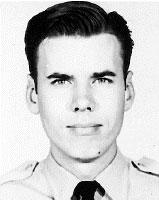
Don A. Beckstead, a 28-year-old White male Arizona highway patrolman, lived in the small community of Houck in northeastern Arizona with his wife Betty and their two young sons. He had been born in Phoenix in August 1942 and later served in the U.S. Navy's Seabees before joining the Arizona Department of Public Safety as a patrol officer assigned to the busy but isolated stretch of Interstate 40 near the New Mexico state line. His work regularly took him along the frontage roads and billboards outside Houck, an area he knew as both his beat and his home.
On the evening of February 5, 1971, events set in motion elsewhere converged on that highway. Earlier that day, fellow DPS Officer James L. Keeton had stopped a 1968 Pontiac on I-40 west of Houck for a license plate issue. Behind the wheel was 38-year-old Bertram Greenberg, a California parolee who, according to bulletins sent out from Los Angeles, was being sought as a suspect in the rape and murder of 13-year-old Mary Louise “Marylou” Hill in Griffith Park the previous afternoon. During Keeton's stop, Greenberg overpowered the officer, seized his service revolver and fatally shot him before fleeing east in the Pontiac. Keeton managed to radio for help, but he died at the scene.
A few minutes later, unaware that his colleague had just been shot, Officer Beckstead pulled over the same Pontiac east of Houck after observing what he later described as an unsafe pass. It appeared to be a routine traffic stop on a familiar stretch of road. As Beckstead approached the driver's side, Greenberg drew the stolen revolver and fired, striking the officer in the abdomen. Despite the catastrophic wound, Beckstead was able to call in his own distress message as Greenberg sped away once more along I-40 toward the New Mexico line. Emergency responders reached Beckstead and rushed him across the border to McKinley Hospital in Gallup, New Mexico, the nearest major medical facility.
Doctors in Gallup operated and treated massive internal injuries: the bullet had torn through Beckstead's small intestine, destroyed his left kidney and lodged near his back muscles. Against expectations, he initially rallied. By the following day he was conscious, able to speak with Betty and joke with his commanding officer, Lieutenant Bert Zamborini, insisting he had no interest in being moved to a desk job after he recovered. He also gave a statement describing how he had stopped Greenberg only for a traffic violation, not knowing that Keeton had already been shot. Newspaper coverage that Sunday portrayed him as “winning his fight for life,” reflecting the guarded optimism of his doctors and family.
Meanwhile, the suspect continued his flight. After crossing into New Mexico on old Route 66, Greenberg flagged down a yellow Volkswagen Beetle driven by Missouri law student James Brown and his wife, Karen Dianne, claiming car trouble and asking for a ride toward Gallup. Once inside their car, he pulled the revolver, forced them up a remote dirt road near an abandoned mine, and ordered Brown to strip down before sexually assaulting Karen. He then shot Brown in the back of the head and shot Karen as well; Brown died at the scene, but Karen survived her wound and managed to escape. Greenberg stole their Volkswagen and drove on toward Grants, New Mexico, where officers from multiple agencies located and confronted him at the junction of Highway 117 and I-40. In the ensuing shootout, their gunfire shredded the car and struck Greenberg multiple times as he tried to flee on foot. New Mexico authorities killed him on the spot; he was never taken alive or brought to trial for the murders and assaults committed during his flight from California through Arizona into New Mexico.
Back in Gallup, the apparent improvement in Beckstead's condition proved tragically short-lived. On February 7 he went into acute renal failure, a complication of both the massive blood loss and the destruction of his left kidney. McKinley Hospital did not have an artificial kidney machine, so arrangements were made to transfer him to a better-equipped facility in Albuquerque for dialysis and more advanced care. He was placed in an ambulance for the trip east, but he succumbed en route before reaching the city. Arizona DPS officially recorded his end of watch as February 7, 1971, while memorial listings and gun-violence databases note February 5 as the date of the shooting that ultimately caused his death, tying his sacrifice directly to the violence that erupted near his home community of Houck that night.
In the aftermath, law enforcement agencies and the public came to see the killings of Officers Keeton and Beckstead, along with James Brown's murder and Karen Brown's wounding, as part of a single multistate rampage by Greenberg, who was also linked in contemporary accounts to the killing of Marylou Hill in Los Angeles. With the suspect dead in a New Mexico police ambush, there were no further arrests tied directly to Beckstead's shooting. Instead, subsequent proceedings focused on honoring the fallen officers. Don Beckstead's name was engraved on state and national law-enforcement memorials, a sandstone marker was placed along eastbound I-40 near milepost 354 close to Houck, and his story has been kept alive through official tributes, family remembrances and historical accounts of that February night when what should have been a simple traffic stop ended in tragedy.