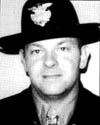
Thomas Clifford Dillon, a 32-year-old White male, was serving as chief of the Bethel Police Department when he was shot and killed in the line of duty on November 19, 1972, in Bethel, Alaska. What began as a dispute involving a dead puppy and a local taxi company escalated into an armed confrontation that ended with Dillon exchanging gunfire with a young Bethel resident and suffering a fatal wound.
The man identified in court records as responsible for the shooting was Elmer J. Nicholson, who was 21 at the time and had lived most of his life in Bethel. Nicholson had begun drinking the night before Dillon's death, consuming a substantial amount of alcohol and continuing to drink the following morning. Late that afternoon, Yellow Cab Company owner Norman Wallace encountered Nicholson carrying a dead puppy and with blood visible on his face and hands. Nicholson believed that a Yellow Cab vehicle had struck and killed the dog. Wallace told him he did not know what had happened but would try to determine whether one of the company's cabs had run over it.
The two went to the Yellow Cab garage, which at the time was attached to the home of Nicholson's parents. Nicholson sat on the garage floor with the dead puppy, rocking back and forth and saying that Yellow Cab would pay. He eventually left and went to his cousin's home, where he obtained a 12-gauge shotgun and ammunition. Nicholson later testified that he returned to the garage and fired several rounds there, including shots into a furnace and the wheel of a truck.
Nicholson then used a Yellow Cab van and had its driver contact Wallace, telling him that someone wanted to see him at the garage. When Wallace arrived, Nicholson got out of the cab with the shotgun and chambered a round. Wallace testified that Nicholson pointed the weapon toward him through the taxi's windshield, ordered him out and threatened to kill him. Nicholson disputed part of that account, saying he wanted Wallace to get out so he could show him the dead dog and later maintaining that he did not intend to shoot Wallace.
The confrontation changed when Chief Dillon arrived in a police vehicle. Dillon got out with his handgun drawn and ordered Nicholson to drop the shotgun. Nicholson initially turned the shotgun toward Dillon. The two began talking, and Dillon was able to persuade Nicholson to lower the barrel toward the ground. Accounts differed slightly about what Nicholson wanted next. Testimony indicated that Nicholson either wanted Dillon to go into the garage to talk or wanted him to see the puppy's body inside.
Wallace testified that as Dillon walked to the garage and opened its doors, Nicholson raised the shotgun back toward his shoulder. Dillon was not pointing his handgun at Nicholson at that moment, according to Wallace's account. Nicholson later gave a substantially different explanation. He said he had walked around the taxi ejecting shells from the shotgun and believed he had emptied the weapon. He also testified that he wanted Dillon to shoot him and that, when Dillon did not, he made a motion as though he were loading a shell into the shotgun. Nicholson claimed the weapon unexpectedly discharged.
Dillon was struck and fell while returning fire with his handgun. Nicholson fled, not initially realizing that one of Dillon's shots had wounded him. Witnesses disagreed about precisely how many shotgun blasts were fired during the fatal exchange and about the sequence of the gunfire. Some witnesses reported hearing two or more shotgun shots, while Nicholson insisted that he had fired only once at Dillon and that the discharge had been accidental. The number of shots would eventually become one of the most important issues in the criminal case.
After the shooting, Nicholson fled across the river and remained there for a period of time. He eventually crossed back and was arrested. Police found two shells still in the shotgun, one in the magazine and another in the chamber. Nicholson maintained that he had not reloaded the weapon after Dillon was shot.
Investigators recovered five spent 12-gauge shotgun shells and two live shells from the broader scene. Three of the spent shells were discovered inside the garage near locations consistent with Nicholson's account that he had previously fired at objects there, while two were found outside. An FBI examination determined that at least one of the unfired shells had been loaded into and ejected from Nicholson's shotgun. The physical evidence became important because prosecutors argued that Nicholson had fired more than once during the confrontation with Dillon, while the defense maintained that only one shotgun blast was fired during the actual exchange.
Nicholson was prosecuted for Dillon's killing, and his trial took place approximately 14 months after the shooting. The proceeding was divided into two phases. A jury found Nicholson guilty of first-degree murder, after which a judge conducted a separate hearing and determined that Nicholson was criminally responsible for his conduct. Nicholson received a life sentence.
The conviction did not end the case. Nicholson appealed, and the appeal eventually uncovered a serious problem involving evidence that had not been disclosed to his defense. A witness named Ben Dale had been roughly 100 feet from the shooting scene. Dale said that after stopping his pickup truck and getting out, he heard one loud shotgun blast followed by a series of sharper handgun shots. That account was potentially crucial because it supported Nicholson's assertion that he had fired only one shotgun round during his confrontation with Dillon.
A prosecutor had interviewed Dale and taken notes documenting that information, but the defense had not been given the material. The significance was considerable because prosecutors had relied on the theory that Nicholson fired two shotgun rounds at Dillon, arguing that multiple shots helped demonstrate deliberate or premeditated conduct. Nicholson's defense, meanwhile, had been unable during the original trial to produce a witness who consistently corroborated his claim that there had been only one shotgun blast.
During the appeal, the prosecution itself acknowledged that the previously undisclosed interview material could be favorable to Nicholson. A further hearing confirmed that Dale had told the prosecutor he heard only a single shotgun blast. The Alaska Supreme Court concluded that the information could have affected the jury's decision and that the failure to disclose it violated Nicholson's right to a fair trial.
On November 4, 1977, the Alaska Supreme Court reversed Nicholson's first-degree murder conviction and ordered a new trial. The court did not declare Nicholson innocent of Dillon's killing; rather, it determined that the original conviction could not stand because potentially exculpatory evidence had been withheld. The disputed evidence went directly to Nicholson's contention that the fatal shotgun discharge was a single, unintended shot rather than part of a deliberate multiple-shot attack.
Following the reversal, Nicholson was ultimately convicted of manslaughter rather than first-degree murder and received a 20-year prison sentence. Records concerning Dillon's line-of-duty death report that Nicholson was paroled in 1978. Thus, although an arrest was made shortly after the shooting and the person responsible was initially convicted of murder and sentenced to life imprisonment, the case ultimately ended with the murder conviction overturned and Nicholson held criminally responsible under the lesser offense of manslaughter.