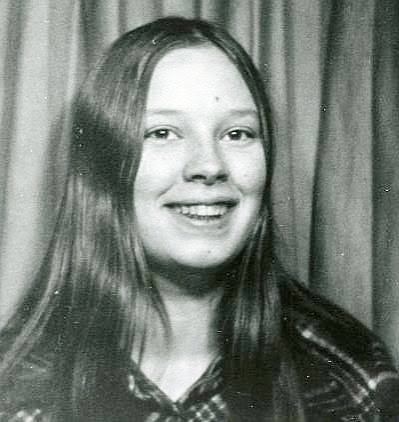
In the spring of 1981, Maureen Mosie, a 33-year-old woman, was making her way through the interior of British Columbia. Though she lived in Edson, Alberta, her path on Friday, May 8, 1981, found her in Salmon Arm, British Columbia, apparently trying to hitchhike the roughly 110 kilometers west along the Trans-Canada Highway to Kamloops. She was a distinctive figure, with brown, shoulder-length hair that had a blonde streak.
That day, she wore a fringed buckskin vest over a multicoloured blouse, blue jeans, and fur-trimmed moccasins. Witnesses later saw her getting into a car in Salmon Arm. It was the last time anyone reported seeing her alive.
The journey to Kamloops was one Maureen would never complete. The very next day, her life was discovered to have been violently cut short. A woman walking her dog made a grim discovery at the end of a run-off lane off Highway 97, about 16 kilometers east of Kamloops, near the intersection with the Trans-Canada Highway. It was Maureen’s battered body. Investigators from the Royal Canadian Mounted Police (RCMP) determined that she had been killed at the scene, though she had not been sexually assaulted.
The investigation into Maureen’s murder was extensive and, at times, unconventional. The lead detective, Sgt. Mike Eastman, was determined to find her killer. By the fall of 1981, the case file had grown to 900 pages, documenting interviews with over 1,000 people and the tracking of 11,000 license plates. In an effort to unlock memories, Eastman even employed hypnosis on several witnesses. Two hypnotized individuals recalled seeing Maureen with a suspect vehicle in Salmon Arm, while three others remembered seeing a possible murderer where her body was found. The detective also sought the help of an Ottawa-based psychic.
From witness accounts, police were able to assemble a description of a suspect and his vehicle. A composite sketch was created of a man believed to have given Maureen a ride. He was described as being in his late 20s or early 30s, with dark, collar-length hair and a two-week-old beard. His car was characterized as a noisy, greenish-blue "junker," possibly with an Alberta license plate hanging from the front bumper, no rear plate, and a dangling tailpipe. Multiple sets of tracks were found in the area where Maureen's body was located, but police believe one specific set belonged to her killer.
Despite the detailed investigation and the promising leads, no one was ever charged in the murder of Maureen Mosie. Her case was one of several unsolved "hitchhiker murders" that plagued the highways of British Columbia during that era. In 1981, dozens of homicide detectives held a conference in Kamloops to compare notes on what was then being called the “Highway Murders,” looking for connections between the growing number of unsolved cases.
Decades later, Maureen Mosie’s case remains open. Her murder is now officially included in the RCMP's Project E-PANA investigation, which examines the cases of missing and murdered women along three major provincial routes: Highways 16, 97, and 5. This series of unsolved cases has become tragically known as the "Highway of Tears." Maureen is one of at least 18 women on the official E-PANA list, whose deaths and disappearances span from 1969 to 2006, leaving behind a legacy of unanswered questions and grieving families. Police continue to ask for anyone with information about her case to come forward.