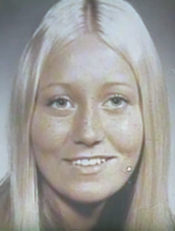
At 23 years old, Louella Jeanne George was building a happy life in London, Ontario. Having grown up on a farm, she had moved to the city and found a job she enjoyed as a hospital cashier. She lived in an apartment building directly across the street from the hospital on Grand Avenue and was happily engaged to be married. Her future was full of promise, but it was stolen from her on the night of April 15, 1977, by a man who had been terrorizing the women of London and nearby Guelph for
years.
When Louella, a dependable employee, failed to show up for her shift at the hospital, a concerned coworker went to her fourth-floor apartment to check on her. Tragically, they discovered Louella deceased in her home. Investigators at the scene found evidence that she had been strangled and sexually assaulted. Though her apartment appeared tidy, a closer look revealed a sinister truth. There were no signs of a forced entry, a detail that baffled police until the killer himself later confessed his method.
The investigation into Louella’s murder was part of a much larger and more terrifying picture. For four years, a serial killer had been preying on women in the area, a man the media would dub "The Bedroom Strangler" and "The Balcony Killer." This predator, Russell Maurice Johnson, was an auto worker and bodybuilder who used his physical strength to scale the exterior walls of apartment buildings, sometimes climbing many stories to find an unlocked balcony door. He would stalk his victims, often watching them sleep for hours before attacking.
Louella was one of at least seven women Johnson murdered between 1973 and 1977. His early victims' deaths were chillingly deceptive. Johnson was meticulous, often cleaning the crime scene, washing his victims, and tucking them into bed to make their deaths appear natural. As a result, the deaths of his first few victims were initially attributed to medical issues or accidents, allowing him to continue his killing spree undetected. Louella’s murder, however, showed a more overt violence that helped police connect the cases. Investigators later found some of her stolen jewelry and undergarments discarded in a nearby trash can.
The breakthrough in the string of terrifying attacks came in July 1977, following the murder of another young woman, Donna Veldboom, who lived in the same building as Johnson. While reviewing tenants, police discovered that Johnson had also lived in the same building as Louella George. When brought in for questioning, Johnson quickly confessed to the murders of Louella, Donna Veldboom, and another victim, Diane Beitz. He went on to admit to four other homicides and at least 11 non-fatal sexual assaults, stunning investigators who had not previously linked him to the earlier deaths.
In February 1978, Russell Maurice Johnson went on trial for the murders of Louella George, Diane Beitz, and Donna Veldboom. He claimed he had an "uncontrollable urge" to rape and kill. A jury found him not guilty by reason of insanity. Johnson was ordered to be confined indefinitely to a secure mental health facility, the Waypoint Centre for Mental Health Care in Penetanguishene. He has remained institutionalized since the verdict.
The resolution of the case brought an end to the reign of terror that had gripped the communities of London and Guelph, where women lived in fear, locking their balcony doors even on the highest floors. For the family and loved ones of Louella Jeanne George, the legal outcome could never replace the bright future that was so cruelly extinguished. Her life is remembered not as a statistic in a serial killer's gruesome count, but for the vibrant young woman she was, on the cusp of a new life with her fiancé.