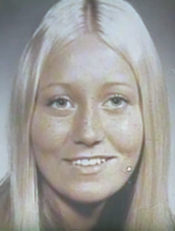
In the autumn of 1973, Mary-Catherine Hicks was a 20-year-old woman in her final year as a student at the University of Western Ontario in London. She was living in a ground-floor apartment on Talbot Street, immersed in her studies and the life of a university senior. But on the morning of October 19, 1973, her promising future was abruptly extinguished.
Mary-Catherine was found deceased in her bed, and the scene offered no immediate answers.
When police and medical examiners arrived, they found no signs of a struggle or forced entry. Mary-Catherine appeared to be sleeping peacefully, with a pillow partially covering her face. In the absence of any obvious signs of violence, her death was tragically misunderstood. The initial ruling was that she had died accidentally, from an allergic reaction to prescription medication. Her grieving family in Toronto was told her death was a kind of "adult crib death," a sudden and inexplicable loss that left them without clear answers but with no reason to suspect foul play. For years, this official explanation stood, masking a much darker reality.
The truth about Mary-Catherine’s death remained hidden for four years, a secret kept by the man who had silently entered her apartment that night. Russell Maurice Johnson, an auto factory worker and bodybuilder, was leading a double life. By night, he became a predator, stalking women in London and Guelph, Ontario. Known for his disturbing ability to scale high-rise apartment buildings, he would peer into windows, sometimes for hours, before breaking in through unlocked balcony doors. His attacks were quiet and terrifying, earning him the nicknames "The Bedroom Strangler" and "The Balcony Killer."
Johnson was meticulous, a trait that allowed his earliest crimes to go undetected. After he murdered Mary-Catherine in her sleep, he carefully cleaned the scene and tucked her into bed, arranging her body in a natural-looking sleeping position to mimic a peaceful death. He employed this same chilling method with his next victims, leading investigators to attribute their deaths to natural causes or accidents as well. It was only when his crimes grew more violent and less carefully concealed that a pattern of a serial killer began to emerge.
In July 1977, Johnson was finally arrested for the murders of three other women whose deaths were clearly violent homicides. During his interrogation, he shocked investigators by not only confessing to the crimes he was charged with but also admitting to four other murders, including that of Mary-Catherine Hicks. He told police he had an uncontrollable urge to rape and kill and claimed that if he had received proper psychiatric treatment when he was diagnosed as a sexual deviant in 1969, his victims would still be alive.
At his trial in 1978, Russell Maurice Johnson was charged with three of the seven murders he confessed to. He was found not guilty by reason of insanity, a verdict based on his inability to comprehend the gravity of his actions. Johnson was diagnosed with a host of disorders, including sexual sadism and necrophilia. He was confined indefinitely to the Waypoint Centre for Mental Health Care, a secure psychiatric facility in Penetanguishene, Ontario.
Mary-Catherine Hicks was the first of at least seven women known to have been killed by Johnson. The reclassification of her death from a medical accident to a homicide brought a new and horrifying dimension to her family's grief. Though Johnson was never tried specifically for her murder, his confession closed the case. He remains confined to the mental health facility, and every year, he applies for more lenient conditions. At these hearings, family members of his many victims often attend to voice their opposition, ensuring that the devastating impact of his crimes is never forgotten.