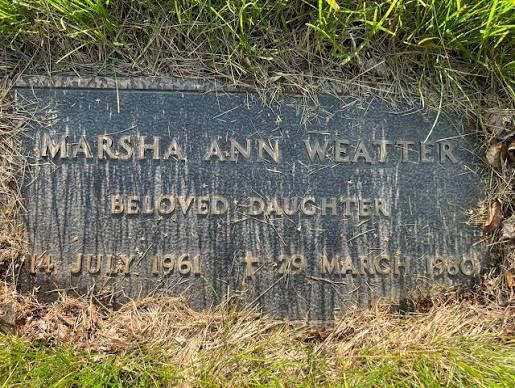
In the spring of 1980, nineteen-year-old Kathy Allen and her friend, Marsha Weatter, 18, left their homes in Fairbanks, Alaska, for an adventure. The two young women planned to hitchhike across the Western United States, exploring the country with the freedom of the open road. They promised their families they would be back home by April 6, 1980. It was a promise they would tragically be unable to keep, as their journey put them in the path of a predator.
Kathy and Marsha were last seen
in March 1980 at a restaurant in Ritzville, a small city in eastern Washington. After that last sighting, they vanished. As the days turned into weeks and the April 6 deadline came and went with no word, their families grew increasingly worried. By May, with no sign of the girls, their parents hired private investigators to search for them. The search yielded no clues, and the families’ desperate wait for answers stretched on for months, filled with uncertainty and fear.
The mystery of their disappearance took a grim and unusual turn on October 10, 1981. Pheasant hunters walking through grass and sagebrush about 150 yards north of Interstate 90, near Ephrata, Washington, made a shocking discovery. They found human remains, later identified as Kathy Allen and Marsha Weatter. An autopsy revealed that both young women had been shot to death. For seventeen months, their bodies had lain hidden, not just by the remote landscape, but by a layer of volcanic ash from the cataclysmic eruption of Mount St. Helens on May 18, 1980, which had blanketed the state.
For years, the case remained cold. Investigators had few leads to follow, and the killer remained a ghost. The break finally came from an entirely different case, years later. The man responsible was Martin Lee Sanders, a truck driver born in Montana. His occupation gave him the mobility and anonymity to commit crimes across state lines. In 1987, Sanders was arrested in Wyoming for the kidnapping and rape of two female hitchhikers in Montana a year earlier. He was convicted and sentenced to 20 years in prison for those crimes.
While incarcerated, Sanders’s dark secrets began to unravel. In 1989, he boasted to a cellmate, confessing to the 1983 murders of two other teenage girls, Rhonda Rima and Elizabeth Marks, in Spokane, Washington. He revealed details that only the killer could have known. The cellmate alerted authorities, and Sanders was extradited to Washington in 1990 to face charges for the Spokane murders.
Faced with the possibility of the death penalty, Martin Lee Sanders struck a deal. He pleaded guilty to the murders of Rima and Marks. As part of that plea agreement, he also formally admitted to kidnapping and murdering Kathy Allen and Marsha Weatter in 1980. By confessing to all four murders, he avoided a death sentence and was instead sentenced to life in prison. The court agreed not to prosecute him separately for the murders of Kathy and Marsha.
Sanders was incarcerated at the Coyote Ridge Corrections Center in Connell, Washington, for the remainder of his life. His string of violent crimes against young women had come to an end, but not before he had devastated multiple families. After more than three decades behind bars, Martin Lee Sanders died of a heart attack in prison on April 4, 2022. For the families of Kathy Allen and Marsha Weatter, the admission of guilt brought a painful resolution, finally confirming who was responsible for ending the two young friends' adventurous journey so brutally and so far from home.