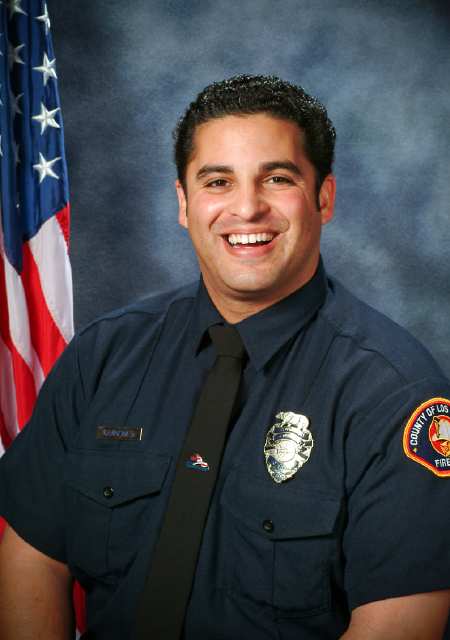
On the afternoon of Sunday, August 30, 2009, catastrophic conditions unfolded across the Angeles National Forest as the rapidly advancing Station Fire threatened lives and installations in the rugged mountains north of Los Angeles. At Camp 16 on Mount Gleason, an inmate firefighting camp operated by the county and state corrections authorities, flames approached with unexpected speed and ferocious heat. Los Angeles County Fire Department Captain Tedmund Dean Hall, a 47-year-old white male and a devoted 26-year veteran of the fire service, took action alongside 34-year-old Firefighter Specialist Arnaldo Quinones. As the blaze encircled the facility, the two men directed dozens of prison camp inmates and correctional staff to take shelter inside the dining hall and set defensive backfires to protect the buildings.
With fire encroaching on every perimeter and blinding smoke cutting visibility to zero, Captain Hall and Specialist Quinones climbed into their department utility truck to scout a viable escape route down the mountainside. While attempting to navigate the narrow, winding dirt fire road through thick walls of flame and heavy smoke, Captain Hall, who was behind the wheel, is believed to have been overcome by smoke or lost visual orientation. The truck veered off the road and plummeted approximately 800 feet down an unforgiving, steep canyon ravine south of Acton, near the Tujunga Canyon area. The vehicle slammed into boulders and landed upside down before being engulfed by fire. Both firefighters were killed instantly.
The Los Angeles County Department of Medical Examiner-Coroner evaluated the incident and determined that Captain Hall died from multiple traumatic injuries sustained in the crash. Because homicide detectives and arson investigators discovered incendiary accelerant evidence along Angeles Crest Highway where the blaze originally started on August 26, the entire fire was ruled an intentional act of arson. Under California law, a death resulting from the commission of an inherently dangerous felony like arson constitutes murder, prompting the Los Angeles County Sheriff's Homicide Bureau to officially classify both line-of-duty fatalities as homicides.
Captain Hall, known fondly to family, friends, and colleagues as Ted, had dedicated his adult life to public service. Born in Fontana and raised in Southern California, he was widely regarded as a deeply principled fire officer and an avid outdoorsman who loved motorcycle riding. He lived in Victorville with his wife, Katherine, and was a dedicated father to two adult sons, Randall and Steven. In September 2009, thousands of uniformed first responders from across the nation filled Dodger Stadium for a massive memorial service honoring Captain Hall and Specialist Quinones, drawing dignitaries and national tributes, followed by posthumous presentations of the California Medal of Valor.
The Station Fire went on to burn 160,577 acres across more than 250 square miles, destroying 89 residences and dozens of other structures, making it the largest wildfire in Los Angeles County history at the time. A multi-agency task force comprising sheriff's detectives, arson investigators, and federal agents tracked dozens of potential leads and questioned persons of interest, but no suspect was ever definitively linked to setting the fatal fire. The Los Angeles County Board of Supervisors and the State of California established a combined $150,000 reward for information leading to the arrest and conviction of whoever ignited the blaze. Despite the passage of years, the case remains an open, unsolved homicide investigation, and detectives continue to seek tips that could bring accountability for the arson that took Captain Hall's life.