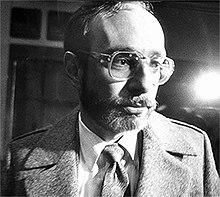
Parler W. Edwards, a 71-year-old Black man, was working as a taxi driver in the Buffalo area when he was murdered on October 8, 1980. His body was discovered stuffed inside the trunk of his taxi, which had been left in suburban Amherst. Investigators determined that Edwards had been beaten to death with a blunt object. After he was killed, his body was mutilated and his heart was removed.
Contemporary reports stated that investigators recovered a blunt instrument they believed could have been the murder weapon.
The brutality of Edwards's death became even more alarming the following day. On October 9, the body of another taxi driver, Ernest Jones, was discovered near the Niagara River in Tonawanda. Jones had also been violently killed and his heart had been removed after death. His bloodstained taxi was later located several miles away in Buffalo. The similarities between the two killings immediately led investigators to believe Edwards and Jones had likely been murdered by the same person. The crimes prompted an enormous police response involving approximately 100 officers, described at the time as the largest manhunt in Erie County history. Investigators quickly received dozens of telephone tips as fear spread throughout the Buffalo area.
Edwards's murder occurred against the backdrop of another frightening series of killings. Beginning on September 22, 1980, several people had been fatally shot around Buffalo, Cheektowaga and Niagara Falls with a. 22-caliber weapon. Those attacks became associated with the unidentified ".22-Caliber Killer." Because those victims had been shot while Edwards and Jones had been beaten and subjected to postmortem mutilation, Erie County District Attorney Edward C. Cosgrove initially expressed doubt that the shootings and the two taxi-driver murders had been committed by the same individual. Investigators therefore faced the possibility that more than one killer was targeting people in the region.
Attention eventually turned to Joseph Gerard Christopher, a Buffalo-area man who became known as the ".22-Caliber Killer" and later the "Midtown Slasher." Christopher was taken into custody after attacking another soldier with a knife at Fort Benning, Georgia, in January 1981. While in military custody, he began making extraordinary admissions. Testimony later presented in court showed that Christopher told military personnel and medical staff that he had killed numerous people. At one point he claimed responsibility for 13 killings, some committed with a. 22-caliber firearm, and told another person that his victims had been nonwhite and that the attacks occurred between September 1980 and January 1981.
Those statements made Christopher an obvious suspect in the wider series of Buffalo-area killings, including the murders of Edwards and Jones. Later accounts of the investigation have repeatedly associated him with the two taxi-driver murders, and when Christopher was interviewed by Buffalo journalists in 1983 and spoke about the number of people he had killed, he reportedly did not deny responsibility for the Edwards and Jones killings. Nevertheless, that fell short of a specific, legally established confession to Edwards's murder. Christopher was never formally prosecuted for killing Edwards, and no murder charge involving Edwards resulted in a trial or conviction.
Christopher was successfully prosecuted for other killings. On April 27, 1982, following a nonjury trial, he was convicted of three counts of second-degree murder for fatal shootings committed in Buffalo during September 1980. On May 24, he received consecutive sentences of 25 years to life, 20 years to life and 15 years to life, effectively producing a 60-years-to-life sentence. Those convictions were ultimately overturned in 1985 after New York's highest court determined that psychiatric evidence relevant to Christopher's mental competency had improperly been excluded. Later that year, a Manhattan jury convicted him of murdering Luis Rodriguez and attempting to murder Ivan Frazier during the December 1980 stabbing attacks in New York City.
Despite Christopher's admissions to numerous racially motivated killings and the longstanding belief that he may have been responsible for Edwards's death, the evidence available publicly does not show that authorities ever secured a charge against him for the October 8 murder. Modern records activity also continues to identify the Edwards homicide as an Amherst Police Department investigation; in 2025, Buffalo Police reported that its surviving 1980 log information showed the case had been handled by Amherst authorities. As a result, Parler W. Edwards's murder remains without a documented prosecution or conviction specifically establishing who killed him, with Joseph Christopher remaining the individual most frequently associated with the crime in historical accounts.