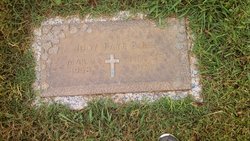
Judy Faye Bibee, an 18-year-old female from North Carolina, was killed in Pasco County, Florida, in late November 1977. Although information supplied with the case gives November 1 as the date of death, multiple online records instead place her death on November 25, 1977, and accounts of the case describe her body being discovered around the Thanksgiving holiday near the Dade City dump. A cemetery record likewise lists November 25 as her date of death. Bibee had been living in the Dade City area with migrant workers after coming to Florida from North Carolina. She was also a young mother; available accounts indicate that she left behind a small child who was living with relatives.
The circumstances of the killing were exceptionally violent. Bibee had suffered numerous stab wounds, and contemporary descriptions of the case characterized the attack as unusually brutal. One account states that the medical examiner regarded the nature and number of the wounds as evidence of a sadistic killing. Her body was discovered near the municipal dump outside Dade City, and investigators believed she had been dead only a matter of hours when she was found. Unlike several other women killed in the Tampa Bay area during the same period, whose deaths involved gunshots or strangulation, Bibee's death was caused by repeated stabbing.
Her murder occurred during an alarming series of killings in Pasco, Hillsborough, and Pinellas counties that became associated with what was sometimes called the Gulf Killer, the Red Light Murders, or the Dale Mabry Strip murders. During the 1970s, numerous women—and a smaller number of men—were found murdered throughout the Tampa Bay region. Several of the women had connections to bars, adult entertainment establishments, or prostitution along Tampa's Dale Mabry Highway. Bodies were found in orange groves, fields, roadside locations, wooded areas, and other isolated places. Because of similarities among some of the deaths, law-enforcement agencies considered whether a single killer might be responsible, although investigators never established that all of the killings were committed by one person.
By the autumn of 1977, concern about the mounting number of unsolved deaths had become serious enough that authorities assembled a multi-agency investigative unit involving officers from several counties. Investigators interviewed women who worked in bars, strip clubs, and prostitution and examined similarities among the victims and crime scenes. Several victims had been shot in the head, some had been strangled, and purses or other belongings were missing in a number of cases. Police believed that some victims had been killed somewhere other than where their bodies were eventually abandoned. Other theories suggested that violence connected to pimps or organized criminal activity could explain at least some of the deaths. Investigators publicly acknowledged that they could not determine whether one murderer or several unrelated offenders were responsible.
Bibee's killing did not fit every pattern attributed to the suspected series. The extensive stabbing distinguished her death from the shootings that characterized a number of the other cases, and the available online accounts do not establish that she worked along the Dale Mabry Strip. Her known circumstances instead placed her among migrant workers near Dade City. Consequently, while her death has repeatedly been included in lists of victims potentially connected to the larger Tampa Bay and Pasco County murder series, the evidence publicly available online does not demonstrate that the same offender who killed any of the other victims also killed Bibee.
Several men eventually became connected to investigations of murders within the broader series, but none is documented in available online sources as having been arrested, charged, tried, or convicted specifically for Bibee's killing. Gene Arthur Wirtjes was convicted in connection with the murder of Jo Ann Parnell, another woman whose body had been found in Pasco County, and received a 25-year prison sentence in 1979. His case, however, was tied to a separate motive involving Parnell's potential testimony in an aggravated-battery matter, and there is no publicly documented evidence establishing Wirtjes as Bibee's killer.
Robert M. Hardagree was arrested in 1980 for the killing of Cindy Carlton Stewart, another victim sometimes grouped with the larger series. Investigators determined that Stewart had been drinking with Hardagree and another man before being taken to an isolated location and murdered. Hardagree was convicted and sentenced to life imprisonment. Nothing in the available accounts links him to Bibee's stabbing, and his prosecution concerned Stewart's death rather than the earlier Pasco County homicide.
Convicted serial killer Gerald Stano also entered the investigation after confessing to numerous Florida murders. He claimed responsibility for several women whose deaths had been associated with the Tampa Bay series, including Diana Valleck, Enid Branch, Joan Foster, and Emily Grieve. The reliability of some of Stano's confessions was later questioned, and he eventually maintained that investigators had pressured him into admitting crimes he had not committed. Available accounts of his claimed victims do not identify Bibee as one of the murders to which he confessed.
Another man, Jerry Frank Townsend, was at one point examined as a possible suspect in Pasco County killings after his arrest in Miami and his confessions to multiple murders. Townsend was intellectually disabled and later determined to have falsely confessed to crimes he did not commit. After DNA evidence and reviews of his cases undermined the convictions obtained through those confessions, he was released after spending more than two decades in prison. There is no reliable evidence that Townsend murdered Bibee, and his history illustrates the uncertainty surrounding some of the suspects considered during attempts to solve the wider series.
Despite arrests and convictions for individual killings that were once grouped with the same cluster of Tampa Bay murders, Bibee's case itself appears to have remained unresolved. Online sources do not identify a person formally charged with her murder, nor do they report a trial or conviction arising directly from her death. The broader investigation produced suspects, disputed confessions, and convictions in other cases, but no publicly documented prosecution has established who carried out the repeated stabbing near Dade City. Decades later, Judy Faye Bibee's killing remains one of the unresolved deaths associated with a particularly violent period in Pasco County and the greater Tampa Bay area.