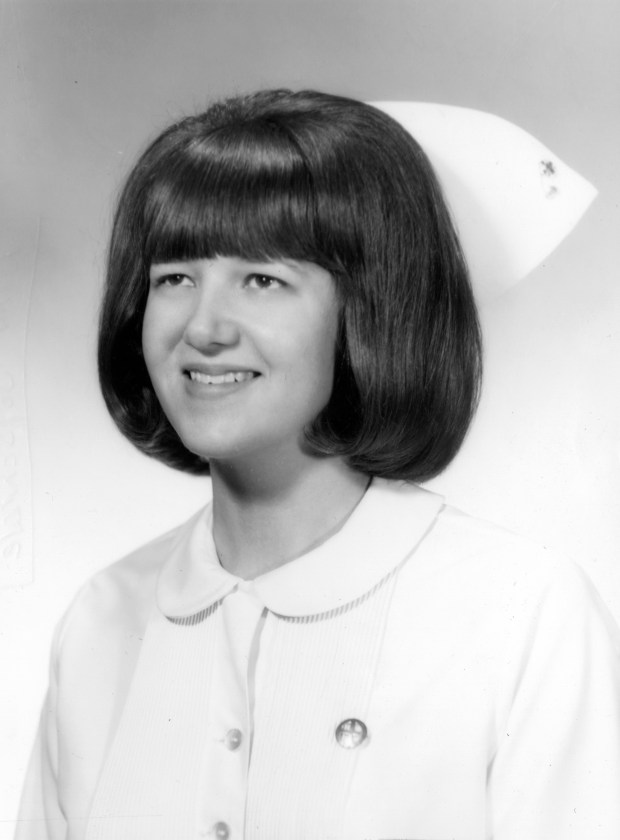
On the hot evening of July 13, 1966, Patricia Ann Matusek, a 20-year-old white female, was dropped off at her townhouse dormitory on Chicago's Far South Side by a friend. A student nurse at South Chicago Community Hospital, Patricia was looking forward to her upcoming graduation. Her inspiration to enter the nursing profession was deeply personal, stemming from the care she provided to her dying teenage cousin years earlier. That night, however, a man named Richard Speck, a 24-year-old unemployed seaman with a criminal record, broke into the residence that housed Patricia and eight other student nurses. Armed with a knife and a gun, he systematically held the women captive for hours.
What began as a robbery quickly escalated into a horrific mass murder. Speck took the women one by one to different rooms, where he either stabbed or strangled them. Patricia Ann Matusek was found strangled in a bathroom, her hands tied behind her back with a piece of a bedsheet. In total, eight of the nine women in the townhouse were killed that night: Gloria Davy, Valentina Pasion, Merlita Gargullo, Nina Jo Schmale, Pamela Lee Wilkening, Suzanne Bridget Farris, Mary Ann Jordan, and Patricia Ann Matusek. The sole survivor was Corazon Amurao, an exchange student from the Philippines, who managed to hide under a bed, her presence going unnoticed by the killer. In the morning, her screams for help from a second-floor ledge alerted a passerby and led to the discovery of the gruesome scene.
The lone survivor's testimony was crucial in identifying the perpetrator. From her description and fingerprints left at the scene, police identified Richard Speck as the suspect. A massive manhunt ensued, and Speck was arrested on July 17, 1966, after a suicide attempt led a doctor at Cook County Hospital to recognize him from a newspaper photo. Speck was indicted on eight counts of murder. His trial began in April 1967, and after less than an hour of deliberation, a jury found him guilty. He was sentenced to death in the electric chair. However, due to a Supreme Court ruling regarding the exclusion of jurors opposed to the death penalty, his sentence was commuted to multiple life sentences, ranging from 100 to 300 years. Speck died of a heart attack in prison on December 5, 1991, the day before his 50th birthday. The case, often referred to as the "crime of the century," left a lasting scar on the city of Chicago and the nation, highlighting a loss of innocence and forever changing the public's perception of safety and random acts of violence.