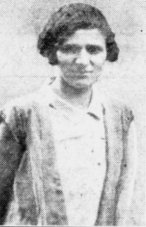
Pearl D. Robinson, a 33-year-old white woman, was killed in Elmira, New York, on the night of Wednesday, July 5, 1933, after an evening that—on the surface—looked ordinary. Witness accounts later pieced together a rough final itinerary: she was seen with a man named Raymond Snyder at the Snyder Paint shop on George Street, and he reportedly left her waiting for a streetcar at 13th Street and Oakwood Avenue around 11:00 p.m. Not long after, employees of the Elmira Light, Heat, and Power Company said they saw her step off the last Franklin Street car on Broadway at 12:07 a.m., a detail that fixed her final movements to a narrow window in the small hours.
By dawn, the neighborhood learned what had happened. In the backyard at 756 Spruce Street, Mrs. Flora Wilson chased a loose hen and stumbled into brush and shadow—and there, partly hidden by a berry bush, lay Robinson’s body. The violence described in later reporting was hard to comprehend: a battered head and torn clothing, along with a large number of curved knife wounds consistent with a small paring knife. An iron implement was found near the scene, but investigators reported it yielded no usable fingerprints, and the absence of a clear trail made the crime feel as if it had erupted from nowhere and vanished just as quickly. Crowds surged to the location anyway; accounts describe motorists jamming the area so badly that police had to be mobilized to clear the roads, turning a private backyard into a grim public spectacle.
In the days that followed, suspicion moved restlessly through Elmira. Newspapers and police attention swung from the men who knew her to “known criminals,” along with others labeled in the language of the time as “reputed perverts.” One man involved in an argument connected to Robinson was questioned and released; her estranged husband was interviewed as well and reportedly showed he had been at his farm in Trumansburg that night. Alongside the theory that she might have known her killer, another, colder possibility took hold: that she had simply crossed paths with the wrong stranger. Reports circulated of a man chasing two girls on Broadway between 10 and 11 p.m. the same night; they described a short man with a dark complexion in a dirty gray suit. A piece of gray plaid cloth, said to match the suit description, was reportedly found snagged on a wire fence at 768 Cedar Street, not far from where Robinson was discovered.
The case soon widened beyond Elmira when authorities in Kent, Ohio, explored a possible link between Robinson’s killing and the slaying of Mary Klincko, which occurred about fifteen days later. That cross-state fear focused attention on a roaming suspect named Gabriel Domoto described as a “psychopathic vagrant.” According to later summaries of period reporting, three people in Elmira identified him as having been in the area around the time Robinson was killed. Investigators said he could not provide an alibi and spoke “incoherently” about women and blood when questioned. When he was found carrying a paring knife of the type believed to have made Robinson’s wounds—and with its tip broken off—the investigation took an extraordinary step: Robinson’s body, already buried, was exhumed and brought back to Elmira in hopes of locating the missing fragment. Domoto was ultimately committed to the Massillon Ohio State Hospital for the criminally insane, and, because of his condition, he was not tried for the slayings—leaving the community with an official suspect, but no courtroom ending.
Decades later, the story of Robinson’s death re-emerged in a different, darker light. In July 1960, Frederick Charles Wood—an Elmira man with a long criminal history who had been paroled after serving time for a 1942 killing—was captured in New York City after vanishing from supervision, and police soon tied him to the deaths of two elderly men in Queens. Once in custody, he confessed not only to those murders but also to older crimes, including Robinson’s 1933 killing, describing it as an attack on a woman he did not know on Elmira’s Southside; the confession revived the old question of whether the wrong person had been blamed and warehoused for the crime. Yet even then, certainty slipped away: accounts note that Wood had a reputation for lying and attention-seeking, and his former defense attorney expressed doubts about whether he truly committed the 1933 murder, while Wood’s mother also denied his responsibility for it. What did reach a definite conclusion was Wood’s fate for the murders proved against him—he was convicted and ultimately executed at Sing Sing in March 1963—while Robinson’s own case remained haunted by the gap between suspicion, confession, and proof.