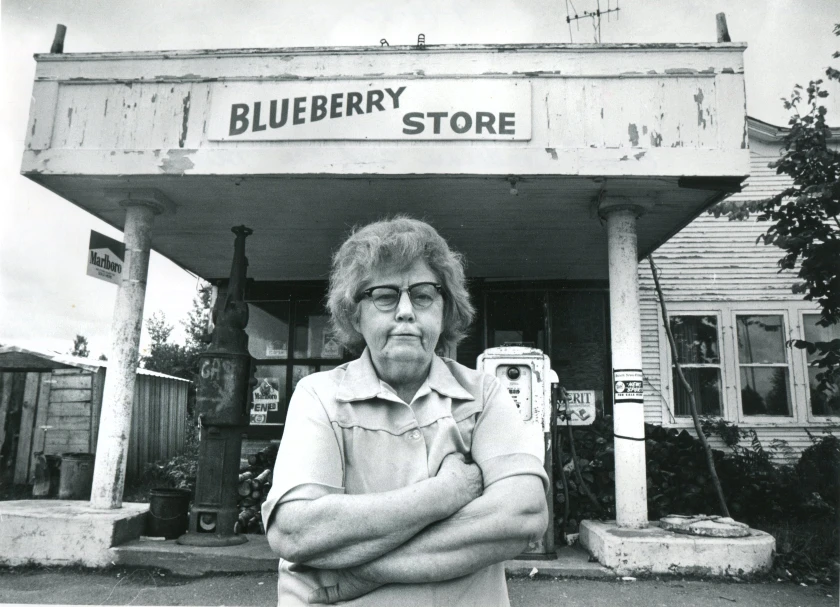
Irene Carlson, a 77-year-old White/Caucasian woman, was living in the small community of Blueberry, Wisconsin, when her life ended violently on August 6, 1976. Carlson was a widow who operated the Blueberry Antique Shop, a local business along the highway near Maple in Douglas County. What should have been an ordinary summer day became the beginning of a homicide investigation that would eventually be connected to a man suspected of leaving a trail of victims across the United States.
Carlson had plans to go shopping with a friend that day, but she never arrived. Concerned about her unexplained absence, the friend contacted Carlson's neighbor, Ethel Jondreau, who operated the nearby Blueberry Store. Jondreau later recalled that she had heard what sounded like a gunshot coming from the direction of Carlson's property, although at the time she thought the sound might have been children setting off leftover fireworks. When Carlson still failed to appear, Jondreau and the friend went to the antique shop to check on her.
Inside, they discovered Carlson lying near the doorway. She had been shot in the back of the head. Historical accounts of the case state that the weapon was a. 22-caliber handgun. The circumstances suggested a sudden, close-range attack inside the business, leaving Carlson with little opportunity to escape. Her death deeply unsettled the tiny Blueberry community, where residents were accustomed to knowing their neighbors and where such violence was extraordinary.
The investigation eventually focused on Allen Leroy Anderson, a career criminal who was traveling around the country during 1976. Anderson had been staying at a treatment or halfway facility in Washington State before leaving in June after stealing an employee's automobile, wallet and credit cards. Investigators later reconstructed an extensive trail involving stolen vehicles, robberies, credit-card transactions and killings in numerous states. Carlson's killing came to be regarded by investigators and later historical reporting as the first homicide in Anderson's suspected 1976 cross-country killing spree.
The manner in which Carlson was killed also became important. Investigators who followed Anderson's movements linked him to a series of victims who had been shot in the back of the head, often with a. 22-caliber firearm. A Washington, D.C., detective investigating vehicles and stolen credit cards was able to trace Anderson's movements across the country and connect him with homicides in several states, including Wisconsin. Police eventually recovered a. 22-caliber revolver when Anderson was taken into custody, although available accounts do not establish through publicly accessible forensic records that the recovered weapon was conclusively matched to the bullet that killed Carlson.
Anderson was arrested in Los Angeles on October 28, 1976, several months after Carlson's death. By then, authorities in numerous jurisdictions were investigating him for killings committed during his travels. Court records later described his actions as a coast-to-coast series of robberies and murders. Anderson pleaded guilty to homicide charges in Minnesota and California, faced a murder indictment in Virginia, and entered a no-contest plea in a Florida murder case. He received substantial prison sentences, and at one point was sentenced to death in Florida, although that judgment was later overturned by the Florida Supreme Court because of constitutional problems involving statements he had made without counsel present.
Despite the strong investigative connection between Anderson and Carlson's death, available historical reporting does not identify a separate Wisconsin trial or conviction in which Anderson was found guilty of murdering Carlson. Accounts discussing the Blueberry homicide therefore generally describe him as the alleged or suspected killer rather than as a person convicted specifically for her murder. His convictions for other killings ensured that he remained imprisoned while authorities in other states continued to regard him as responsible for additional deaths.
Carlson's murder remained remembered locally long after 1976. Decades later, the Old-Brule Heritage Society recalled her antique shop and specifically identified Anderson as the alleged killer, while later newspaper reporting described Carlson as the first of the eight victims attributed to his 1976 killing spree. The image that endured in Blueberry was of a widow running her small antique business, preparing for a shopping trip with a friend, and instead being killed inside the shop where neighbors expected to find her safe.