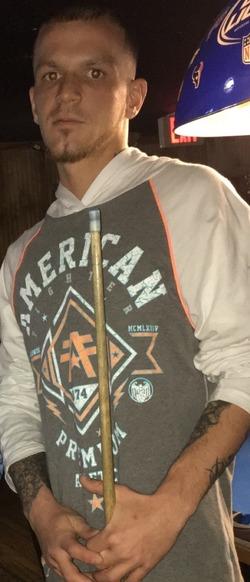
Gary Wayne Bisbee Jr., a 23-year-old White man known to relatives and friends as "Bud," was killed during the night of May 25 or the early morning of May 26, 2016, inside a home on North Sterling Drive in Proctorville, a community in Robeson County near Orrum. Although some early records associated his death with Orrum, contemporary reporting and court records identified Bisbee as being from Lumberton and placed the shooting at the Proctorville residence. Born in Robeson County on September 3, 1992, he worked in sales for Little Debbie Cakes and was the father of a young daughter. His death brought a sudden and violent end to a life closely connected to family, work, and the surrounding community.
The case began with what appeared to be a kidnapping report. Columbus County authorities encountered Zonna Chanae Locklear beside North Carolina Highway 410 near Chadbourn. She claimed that she had been in bed with Bisbee when two unidentified men entered her Proctorville home, shot him, forced her at gunpoint to drive them into Columbus County, and then left her beside the road before taking her white Honda Accord. Because her account suggested that a wounded man might still be inside the residence, Columbus County officials asked the Robeson County Sheriff's Office to investigate.
When deputies arrived at the North Sterling Drive home, a vehicle was parked outside, but no one responded at the door. Looking through a window, officers could see Bisbee lying motionless on a bed near the front entrance. Deputies entered and found that he had already died from multiple gunshot wounds. Evidence later presented in court showed that he had been struck once in the head, twice in the side, and once in the arm. Investigators initially worked from Locklear's description of two unknown intruders, while officers searched for the supposedly stolen car and attempted to reconstruct what had happened inside the house.
Locklear's story soon began to unravel. Investigators obtained cell-phone records and other evidence that contradicted the account of a random home invasion and kidnapping. Authorities determined that she knew Comanche Brooks Locklear, Bisbee's former friend, and that the two had coordinated the events leading up to the shooting. Court records later revealed that Comanche and Zonna had been romantically involved. Bisbee had previously lived in a trailer on Comanche's property, but their friendship deteriorated amid disagreements involving money and Bisbee's continued presence there.
According to testimony and the later appellate record, Zonna invited Bisbee to her home while pretending to be romantically interested in him. The plan was for her to alert Comanche when Bisbee was undressed so Comanche could enter, assault him, and force him from the house naked. Bisbee reportedly had a firearm beneath his pillow, while Comanche arrived carrying his own gun. Zonna testified that she fled from the bedroom when Comanche entered, heard a rapid series of gunshots, and then saw Comanche emerge carrying two firearms. He told her that Bisbee was dead.
What may initially have been described as a plan to humiliate or beat Bisbee instead became a killing and an armed robbery. Prosecutors maintained that Comanche took Bisbee's firearm after shooting him. Comanche and Zonna then devised the false story about two intruders, a kidnapping, and a stolen vehicle in an attempt to divert suspicion. The staged account explained why Zonna was found beside the highway and why law enforcement was directed back to her home. Investigators, however, doubted her version and eventually concluded that the kidnapping narrative was part of a cover-up.
Zonna Chanae Locklear was arrested on June 3, 2016, and initially charged with first-degree murder and conspiracy to commit first-degree murder. She was held without bond. Several days later, Comanche Brooks Locklear was arrested and charged with first-degree murder, conspiracy to commit first-degree murder, robbery with a dangerous weapon, and conspiracy to commit robbery with a dangerous weapon. Authorities identified him as the second person charged and continued investigating whether others had helped conceal the crime or assist the suspects afterward.
The investigation expanded well beyond the two principal defendants. In January 2018, Christopher Michael Chavis and Carol Butler Locklear were arrested on charges of accessory after the fact to first-degree murder. Each was placed under a $100,000 bond. Authorities also announced that they were seeking Michael Dock Elvis Jr. on the same type of accessory charge. By the time Comanche's case reached trial, prosecutors stated that three other people faced accusations of helping after Bisbee's murder, although publicly available reporting at that stage did not provide final outcomes for each of those accessory cases.
Comanche Brooks Locklear went on trial in Robeson County in 2019. The proceeding lasted seven days, and Zonna testified for the prosecution under the terms of a plea agreement. Prosecutors argued that the killing was committed with premeditation and malice and that it occurred during an armed robbery because Comanche took Bisbee's gun. The defense did not deny that Comanche had shot Bisbee but argued for a second-degree murder conviction, contending that he had not arrived at the home with a preexisting intention to kill or rob him.
The precise motive remained difficult to define. Prosecutors said Comanche and Bisbee had once been friends but had experienced a falling out. Evidence showed disputes over money, Bisbee's former living arrangement, and the complicated relationship involving Zonna. Several possible explanations emerged during the trial, but authorities said no single, clear motive was conclusively established. What the jury accepted was that Comanche entered the bedroom armed, fired repeatedly at Bisbee, took his firearm, and participated in a deliberate effort to disguise the killing as the work of unidentified intruders.
After deliberating for nearly four hours, the jury found Comanche Brooks Locklear guilty of first-degree murder and robbery with a dangerous weapon. Superior Court Judge James Gregory Bell sentenced him to life in prison without the possibility of parole for the murder. He also received an additional sentence of 64 to 89 months for the armed robbery, to begin after the life sentence. Prosecutors had originally considered seeking the death penalty but later chose not to proceed with the case as a capital prosecution.
Zonna's original murder charge was reduced through her agreement with prosecutors. She pleaded guilty to accessory after the fact to first-degree murder and conspiracy to commit common-law robbery and was required to testify truthfully against Comanche. At the time his conviction was reported, she had not yet been sentenced. Her testimony became an important part of the state's reconstruction of the plan, the shooting, and the fabricated kidnapping story, although the jury was responsible for determining how much weight to give her account.
Comanche appealed his convictions, arguing that his trial attorney had provided ineffective assistance by presenting evidence that cost the defense the right to make the final closing argument and repeated damaging information already introduced by prosecutors. On January 4, 2022, the North Carolina Court of Appeals rejected those arguments. The appellate panel concluded that the defense decisions were part of a strategy to challenge evidence of premeditation and robbery and that Comanche had not shown that a different approach would probably have changed the verdict. The court found no reversible error, leaving his convictions and sentences intact.
Gary Wayne Bisbee Jr.'s death was therefore not left as an unsolved home invasion or a mysterious encounter with unidentified assailants. Investigators dismantled the kidnapping story, identified the people involved, and secured a first-degree murder conviction against the man found responsible for firing the fatal shots. The life-without-parole sentence brought a measure of legal resolution, but it could not restore the young father whom his family knew as Bud. Behind the investigation, conflicting stories, arrests, plea agreement, trial, and appeal remained the loss of a son, brother, friend, and father whose life ended in a bedroom where he had been deliberately lured into danger.