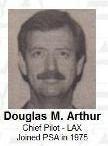
Douglas M. Arthur, aged 44, tragically lost his life on December 7, 1987, in a catastrophic event involving Pacific Southwest Airlines Flight 1771. The flight, en route from Los Angeles to San Francisco, was hijacked by David Burke, a disgruntled former employee of USAir, the parent company of Pacific Southwest Airlines. Burke had been terminated from his position for petty theft and was suspected of involvement in a narcotics ring. In a vengeful act, he boarded the flight with a concealed firearm, which he used to kill his former supervisor, Ray Thomson, and subsequently the flight crew, before causing the plane to crash near Cayucos, California.
Douglas M. Arthur, an off-duty pilot for PSA, was among the 43 passengers and crew members who perished in the crash. It is believed that Arthur attempted to intervene during the hijacking, possibly trying to regain control of the aircraft. Unfortunately, his efforts were in vain as the plane ultimately crashed, resulting in no survivors.
The incident was one of the deadliest mass murders in California's history and led to significant changes in airline security protocols. Investigations into the crash confirmed that Burke had smuggled the weapon onto the plane, exploiting the lack of stringent security measures at the time. This tragedy underscored the need for improved security to prevent similar incidents in the future.
In the aftermath, there were no arrests or further suspects beyond David Burke, who died in the crash. The focus of litigation and legal proceedings centered on the airline's security policies and the circumstances that allowed Burke to board the flight with a firearm. The incident prompted a reevaluation of airline security measures, leading to stricter regulations and the implementation of more rigorous screening processes for passengers and their belongings.