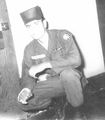
Perry Ray Robinson Jr., also known as Ray, was 35 years old when he was last known to have contact in Pine Ridge, South Dakota, on April 1, 1973. NamUs lists him as a Black/African American male, 6 feet 2 inches tall, about 200 pounds, with black hair, brown eyes, and a beard. His NamUs case identifies the FBI Minneapolis Field Office as the investigating agency and notes that he was missing from tribal land in connection with Pine Ridge, South Dakota.
Robinson was a civil rights activist from Alabama who traveled to South Dakota during the 1973 Wounded Knee occupation. According to NamUs, he went there to participate in the American Indian Movement takeover of Wounded Knee. The occupation occurred during a period of deep conflict on the Pine Ridge Reservation and became a major event in the struggle for Native sovereignty and treaty rights. The Associated Press has described the occupation as a 71-day standoff that began in late February 1973 and ended in May 1973, during which activists and federal authorities were positioned around Wounded Knee amid gunfire, scarce supplies, and intense pressure.
Online reporting indicates that Robinson had left his home in Bogue Chitto, Alabama, in April 1973 after responding to a call for support from the American Indian Movement. South Dakota News Watch reported that he was 35 when he went to Wounded Knee, that he never returned, and that no one was ever charged in connection with what happened to him. His wife, Cheryl Buswell-Robinson, later recalled that he had called home from a conference in Taos, New Mexico, in March 1973 and told her he intended to join the Wounded Knee occupation. Communication from inside the occupied area was extremely difficult, and when a caravan of Black civil rights activists later returned to Alabama without him, his family was left facing the beginning of decades of uncertainty.
The circumstances surrounding Robinson’s disappearance remained painful and unresolved for his family for many years. Cheryl Buswell-Robinson initially wondered whether he might have been arrested during the occupation, but she later learned that rumors in South Dakota suggested he had been killed in a bunker at Wounded Knee and buried nearby. Reporting from News From The States states that when the FBI closed its investigation into Robinson’s disappearance in 2014, the agency confirmed to the family that Robinson had been killed at Wounded Knee and buried in an unknown grave. The Associated Press has also reported that the FBI confirmed in 2014 that Robinson died at Wounded Knee, although his body was never recovered.
Because his remains have not been recovered, Robinson’s case remains especially devastating for his loved ones. Cheryl Buswell-Robinson has spoken publicly about the grief of raising their three children without answers and without being able to bring him home. In recent reporting, family members and advocates have continued to seek permission for a culturally sensitive search of possible burial areas on the Pine Ridge Reservation, including methods such as cadaver dogs or ground-penetrating radar. Those efforts have been complicated by concerns about disturbing the sacred Wounded Knee area, including the site’s history connected to the 1890 massacre.
Robinson’s disappearance sits at the intersection of Black civil rights history, Native rights activism, and the long aftermath of Wounded Knee. He went to South Dakota in solidarity with Indigenous people during a volatile and historic struggle, and he did not come home. Although federal authorities have reportedly stated that he died during the occupation, the absence of recovered remains has denied his family the certainty, mourning rituals, and physical return that many families need after such a loss. More than fifty years later, Perry Ray Robinson Jr. is remembered not only as a missing man, but as a husband, father, and activist whose family has continued to seek truth, dignity, and a final resting place for him.Last Seen: Apr 1, 1973