

Why Cold Case Units Are Established: the Full Story

Cold case units are specialized law enforcement teams created to systematically revive dormant criminal investigations by applying fresh expertise and modern forensic methods to cases where active leads have run dry. The question of why cold case units are established comes down to a fundamental problem in criminal justice: serious crimes, including homicides, sexual assaults, and missing persons cases, go unsolved not because they are impossible to crack, but because the original investigation ran out of time, resources, or technology. Agencies like the Ohio Bureau of Criminal Investigation and the Indiana State Police have built dedicated units precisely to close that gap. These teams do not replace original detectives. They pick up where the system left off, armed with tools that did not exist when the case first went cold.
Why cold case units are established in law enforcement
The core reason cold case units exist is systemic capacity. Detectives working active caseloads cannot simultaneously revisit years-old evidence, track down witnesses who have moved, or submit degraded samples for re-testing. When a case goes dormant, it does not disappear from the books. It accumulates alongside hundreds of others, waiting for attention that never comes through normal operations.
Cold case units solve this by removing the bottleneck. They are staffed specifically to handle dormant investigations, which means detectives are not pulled between a fresh homicide and a 15-year-old one. That focus alone changes outcomes. The benefits of cold case investigations extend beyond individual case closures. They restore public trust, deliver accountability for offenders who believed time had protected them, and provide families with answers that active units simply cannot prioritize.

The significance of unsolved cases is also statistical. Every unresolved homicide represents a potential repeat offender still in the community. Solving old cases is not just about justice for past victims. It is a public safety calculation. Dedicated teams institutionalize that calculation as standard practice rather than leaving it to chance.
What operational challenges lead to forming dedicated units?
Several structural problems inside law enforcement agencies make cold case units necessary rather than optional.
-
Caseload pressure: Active detectives in major cities can carry dozens of open cases simultaneously. Revisiting cold files competes directly with current investigations for the same hours.
-
Institutional knowledge loss: Detectives retire, transfer, or leave agencies. Original case knowledge walks out the door with them unless it is formally documented and handed off.
-
Technology gaps: Evidence collected in the 1990s or early 2000s was processed with the tools available then. Modern DNA extraction can now build profiles from degraded samples that would have been discarded as unusable two decades ago.
-
Witness availability changes: People who refused to talk at the time of a crime sometimes become willing to cooperate years later. Cold case units are positioned to act on that shift when it happens.
-
Documentation fragmentation: Physical case files, photographs, and evidence logs from older investigations are often undigitized, making them inaccessible without dedicated review effort.
Organizational reforms address these gaps more reliably than any single new tool. Clearance rate analysis consistently shows that staffing structure and supervision quality predict outcomes more than technology adoption alone.
Pro Tip: If you are researching a specific cold case, check whether the relevant jurisdiction has a dedicated cold case unit or participates in a state-level task force. That distinction tells you a great deal about how actively the case is being reviewed.
How do cold case units improve clearance rates?
The purpose of cold case teams is measurable. When agencies fund and staff these units properly, clearance rates on older cases improve. The mechanism is not mysterious. It is the product of focused expertise, structured workflows, and access to forensic technology that did not exist at the time of the original investigation.
Forensic technology as a force multiplier
The Indiana State Police launched a forensic genealogy unit in 2026, and the result was a 19% DNA backlog reduction within months of operation. That number reflects what happens when a dedicated team applies genetic genealogy, a method that traces suspects through distant relatives in public DNA databases, to cases that previously had no viable suspect. This technique has identified perpetrators in cases that sat unsolved for 30 or 40 years.
Forensic genealogy is one tool among several. Cold case units also use:
-
Re-testing of physical evidence with updated DNA extraction protocols
-
Digital reconstruction of degraded audio or video recordings
-
Cross-referencing of old case data against modern criminal databases like CODIS
-
Digitization of paper case files to enable keyword searching and pattern analysis
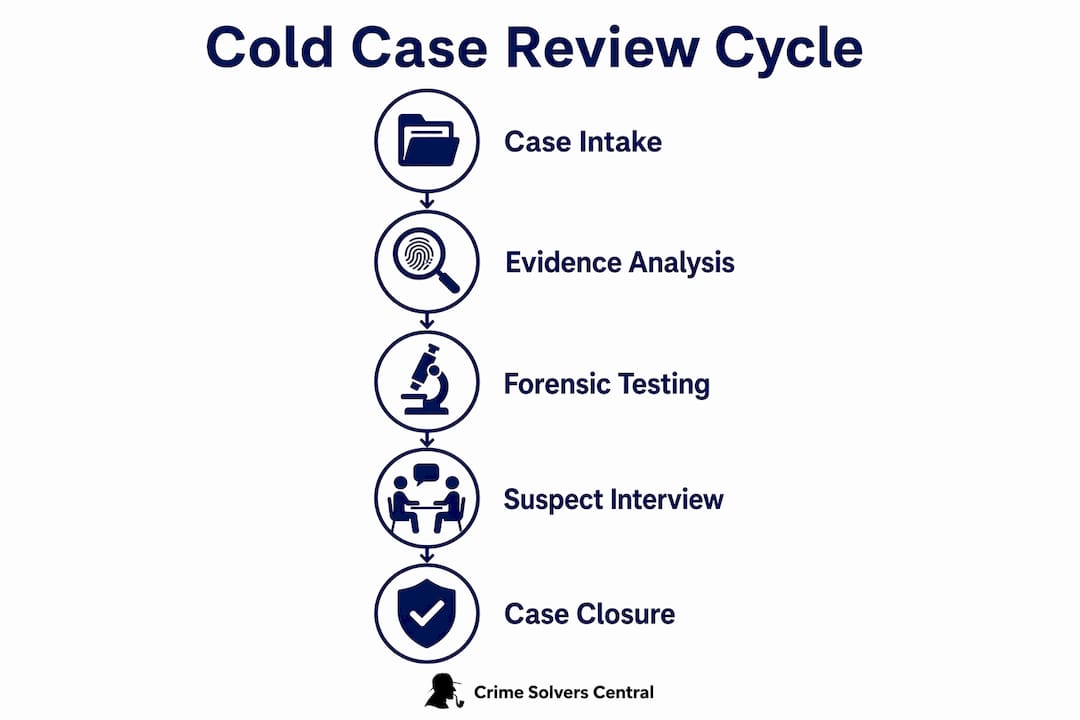
Structured review cycles vs. ad hoc revisits
| Approach | How it works | Outcome |
|---|---|---|
| Ad hoc revisit | Detective reviews a cold case when time allows | Inconsistent, dependent on individual initiative |
| Structured periodic review | Unit schedules regular case audits on a fixed cycle | Systematic, catches new leads as they emerge |
| Trigger-based reopening | New witness tip, DNA match, or technology advance prompts review | Responsive, maximizes new information value |
The Tarrant County cold case task force in the Dallas-Fort Worth area uses both periodic reviews and trigger-based reopenings to manage its caseload. This dual approach captures both the slow accumulation of new forensic capability and the sudden arrival of new witness information.
What collaborative roles do cold case units play with other agencies?
Cold case units rarely operate in isolation. Their effectiveness depends on coordination with local police departments, state agencies, federal databases, and prosecutors. This is where the benefits of cold case unit dedicated teams become most visible at scale.
The Ohio Bureau of Criminal Investigation’s cold case unit completed over 200 case reviews in partnership with local law enforcement agencies across the state. Oklahoma’s dedicated unit has solved 98 cases since 2018. These numbers reflect a model where a state-level unit provides specialized capacity that smaller local departments cannot maintain on their own. A rural sheriff’s office with three detectives cannot staff a cold case unit. A state BCI can, and it can serve dozens of jurisdictions simultaneously.
The relationship with prosecutors is equally critical. Solving a cold case is not the same as prosecuting one. Evidence standards, chain of custody documentation, and witness credibility all require careful preparation before charges can be filed. Cold case units work directly with district attorneys to build cases that will hold up in court, not just identify a likely suspect. That prosecutorial partnership is what converts an investigative lead into a conviction.
Pro Tip: Families of cold case victims can request case status updates from the relevant prosecutor’s office. If a cold case unit is actively working with prosecutors on a case, that office is often the best point of contact for progress information.
What funding models support sustainable cold case units?
Funding is the most persistent obstacle to cold case work. Unlike patrol operations or active homicide units, cold case investigations do not generate the same political urgency. Families and advocates often have to fight for the resources that make these units possible.
Sustainable cold case units typically rely on a combination of funding streams:
-
Federal and state grants: The Bureau of Justice Assistance and similar agencies offer grants specifically for cold case DNA testing and investigative support. These grants fund re-testing costs that can reach $20,000 per case for complex forensic genealogy work.
-
Task force partnerships: Multi-jurisdictional task forces pool resources from several agencies, spreading costs while expanding the unit’s reach. The Tarrant County model uses grant-funded partnerships to maintain workflow even when permanent salary funding is uncertain.
-
Nonprofit and community support: Organizations focused on victim advocacy sometimes fund specific re-testing requests or provide investigative support through trained volunteers.
-
Legislative appropriations: Some states have passed dedicated cold case funding bills, creating stable budget lines that do not depend on annual grant cycles.
The cost-effectiveness argument for cold case investment is strong. Solving a cold homicide removes a potential repeat offender from the community, avoids the long-term costs of an unsolved case remaining open, and delivers measurable public safety value. The return on investment is not just moral. It is operational.
Key takeaways
Cold case units exist because unsolved serious crimes represent a systemic capacity failure, and dedicated teams with focused resources, modern forensic tools, and structured review cycles are the proven response.
| Point | Details |
|---|---|
| Systemic capacity drives creation | Cold case units form because active detectives cannot sustain cold case reviews alongside current caseloads. |
| Forensic technology expands solvability | DNA re-testing and genetic genealogy now resolve cases that were forensically impossible to crack at the time of the crime. |
| Structured workflows produce results | Periodic reviews and trigger-based reopenings institutionalize case progress rather than leaving it to chance. |
| Collaboration multiplies impact | State-level units like Ohio BCI serve dozens of local jurisdictions, solving cases smaller departments cannot handle alone. |
| Funding diversity sustains operations | Grants, task force models, and legislative appropriations each play a role in keeping cold case units operational long-term. |
Why cold case units deserve more credit than they get
The public conversation about cold cases tends to focus on the dramatic: the DNA match after 30 years, the genealogy breakthrough that named a suspect from a family tree. Those stories are real and they matter. But they obscure something more important about why cold case units improve clearance rates over time.
The real story is organizational. Clearance improvements come from giving detectives time, supervision, and structure, not just handing them a new forensic tool. I have seen cases where the evidence for a conviction existed for years but sat in a box because no one had the bandwidth to connect it to a database update. Cold case units fix that problem. They are not a technology story. They are a management story.
What frustrates me is the funding instability. A unit that solves 98 cases in seven years, as Oklahoma’s has done, should not have to fight for its budget every legislative cycle. The return is documented. The families waiting for answers are real. The public safety case is not ambiguous. Cold case units deserve the same institutional permanence as any other specialized investigative division.
If you follow criminal justice closely, push for that permanence. Advocate for dedicated budget lines. Support the organizations that help families stay engaged with the process. The cases do not get colder on their own timeline. The system’s capacity to address them should not either.
— Crime
How Crimesolverscentral supports cold case investigations
Crimesolverscentral maintains a national cold case database by state covering over 264,913 missing persons and unsolved homicide cases, organized by state and situation for direct public access. The platform connects families, advocates, and law enforcement supporters with the case data they need to apply pressure, submit tips, and track investigative progress. You can learn how to crowdsource tips on specific unsolved homicides or explore how citizens can help move cases forward. Whether you are a family member seeking answers or a criminal justice advocate pushing for systemic change, Crimesolverscentral gives you the tools and the data to act.
FAQ
Why are cold case units established in the first place?
Cold case units are established because active detectives cannot maintain ongoing reviews of dormant cases alongside current investigations. Dedicated units solve this by focusing exclusively on older cases with fresh expertise and modern forensic methods.
How do cold case units improve clearance rates?
Clearance rates improve when cold case units apply structured review cycles, DNA re-testing, and forensic genealogy to cases that lacked those tools originally. The Indiana State Police’s 2026 genealogy unit achieved a 19% DNA backlog reduction, demonstrating the direct impact of dedicated resources.
What types of cases do cold case units typically handle?
Cold case units focus primarily on serious violent crimes including homicides, sexual assaults, and missing persons cases. These are the cases where the public safety stakes are highest and where modern forensic advances are most likely to produce new leads.
How are cold cases funded for re-investigation?
Cold case units rely on federal grants, state appropriations, multi-jurisdictional task force partnerships, and nonprofit support. Individual forensic genealogy tests can cost up to $20,000 per case, making grant funding a critical component of sustained operations.
Can the public help cold case units solve crimes?
The public contributes meaningfully through tip submissions, witness cooperation, and community pressure that keeps cases visible. Platforms like Crimesolverscentral provide structured access to case data that helps citizens engage directly with the investigative process.