

The Role of Coroners in Unidentified Cases Explained
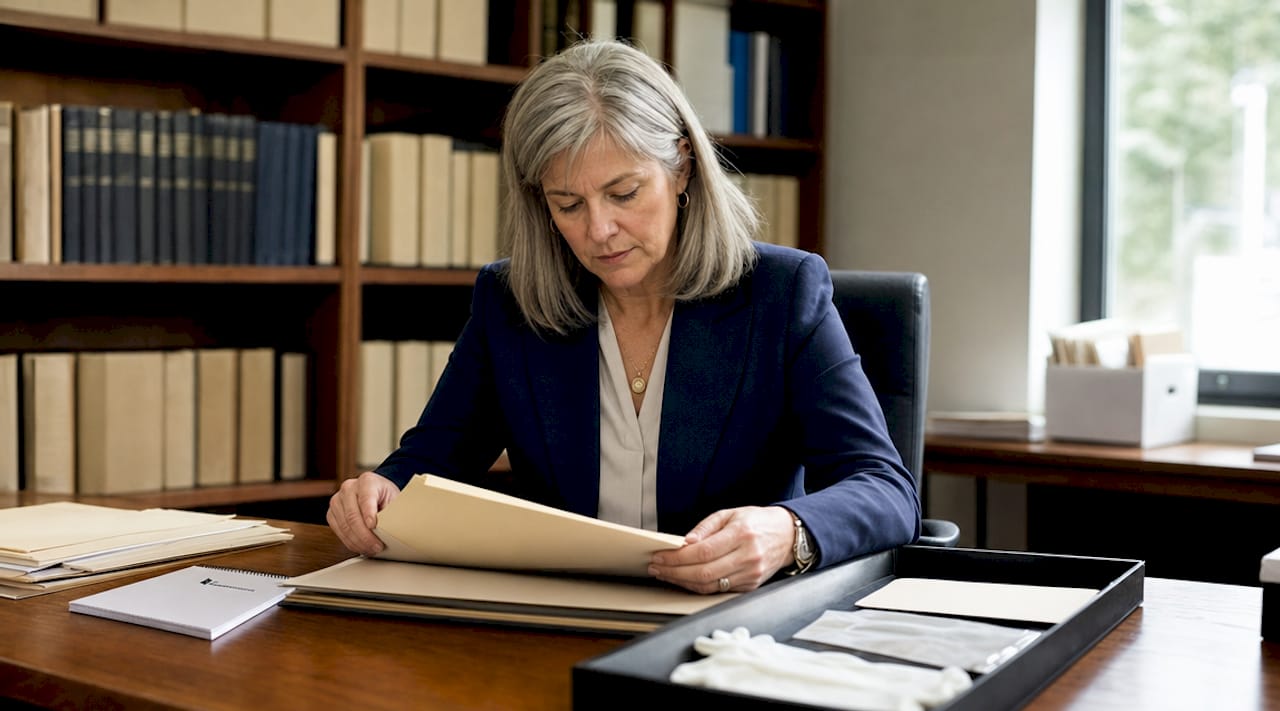
The role of coroners in unidentified cases is to establish the identity of unknown deceased individuals and determine the cause, manner, time, and place of death. This work, formally called a medicolegal death investigation, sits at the intersection of forensic science, law, and public health. Coroners coordinate with law enforcement, forensic specialists, and families to resolve cases that might otherwise remain permanently open. Tools like fingerprint analysis, dental records, and DNA profiling are standard, and national databases like NamUs and CODIS extend that reach across jurisdictions. For families searching for answers, understanding how this process works is the first step toward finding closure.
What is the role of coroners in unidentified cases?
Coroners carry a statutory mandate to answer four core questions about every death: who died, when, where, and how. When identity is unknown, that first question becomes the entire investigation. Offices like the Sacramento County Coroner and San Bernardino County Coroner Division treat identification not as a formality but as a primary evidentiary obligation that shapes every subsequent step.
The core responsibilities of a coroner include examining the body, collecting physical evidence, ordering laboratory tests, and documenting findings in a formal report. In unidentified cases, those duties expand to include cross-referencing missing persons reports, contacting law enforcement agencies, and publishing case details for public review. The coroner’s office becomes the central clearinghouse for all information related to that individual.
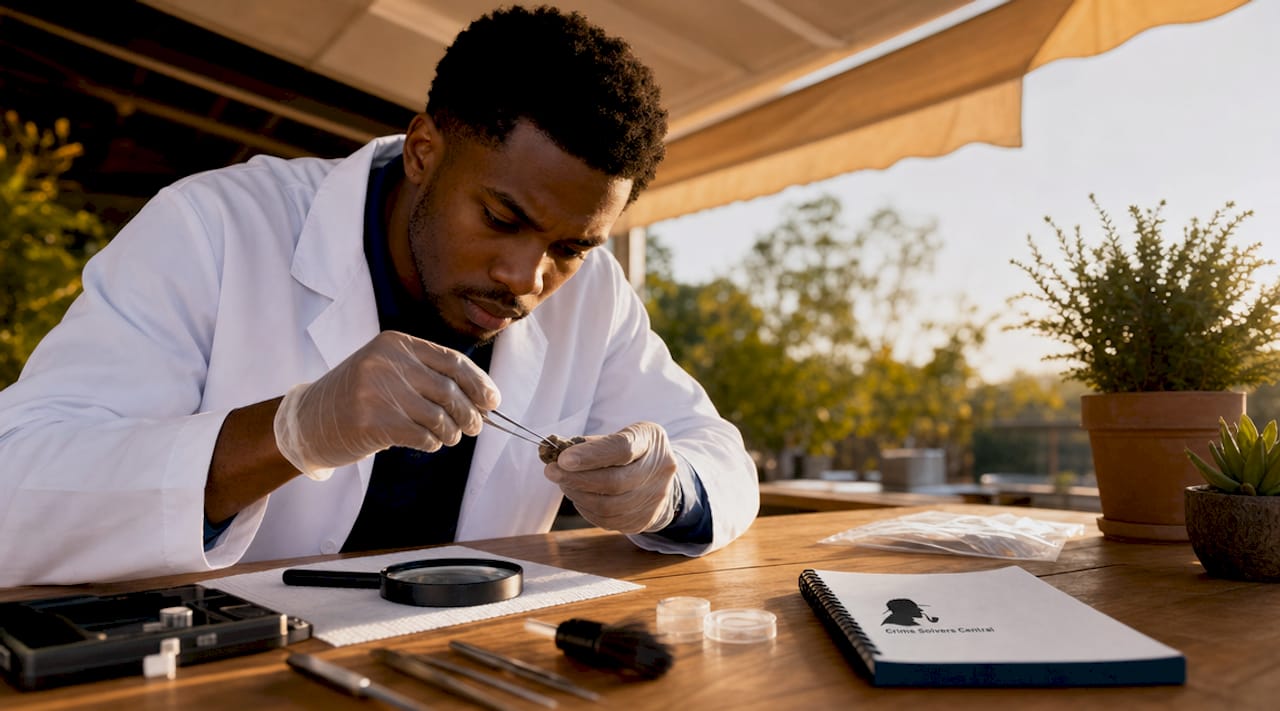
Coroners also carry a public health function. When a pattern of deaths suggests a systemic risk, such as a contaminated drug supply or an unsafe location, coroners are authorized to comment publicly on those findings. This dual role, serving both the individual case and the broader community, makes the coroner’s office one of the most consequential points of contact in any unidentified remains investigation.
What forensic methods do coroners use to identify unknown remains?
Identifying unknown remains requires layering multiple forensic techniques because no single method works in every case. The standard forensic workflow used by offices like San Bernardino County includes fingerprint analysis, dental record comparisons, full body X-rays, and DNA testing. Each method addresses a different type of evidence and serves as a check on the others.
The primary identification methods coroners rely on include:
-
Fingerprint analysis: Compared against local, state, and federal databases, including the FBI’s Next Generation Identification system
-
Dental comparisons: Matched against records from known dentists when a potential identity is established
-
DNA profiling: Submitted to CODIS (Combined DNA Index System) for comparison against profiles from missing persons cases
-
Skeletal X-rays: Used to estimate age, sex, and prior injuries that may match medical records
-
Anthropological assessment: Forensic anthropologists analyze bone structure to narrow demographic characteristics
Beyond physical evidence, family and public input about the deceased’s last known movements and associates, called terminal episode information, directly improves identification outcomes. A family member recalling a distinctive tattoo or a prior surgery can redirect an entire investigation.
Pro Tip: If you believe a missing family member may match an unidentified case, document every physical detail you can recall, including tattoos, scars, dental work, and prior fractures. This information is exactly what coroners need to make a match.
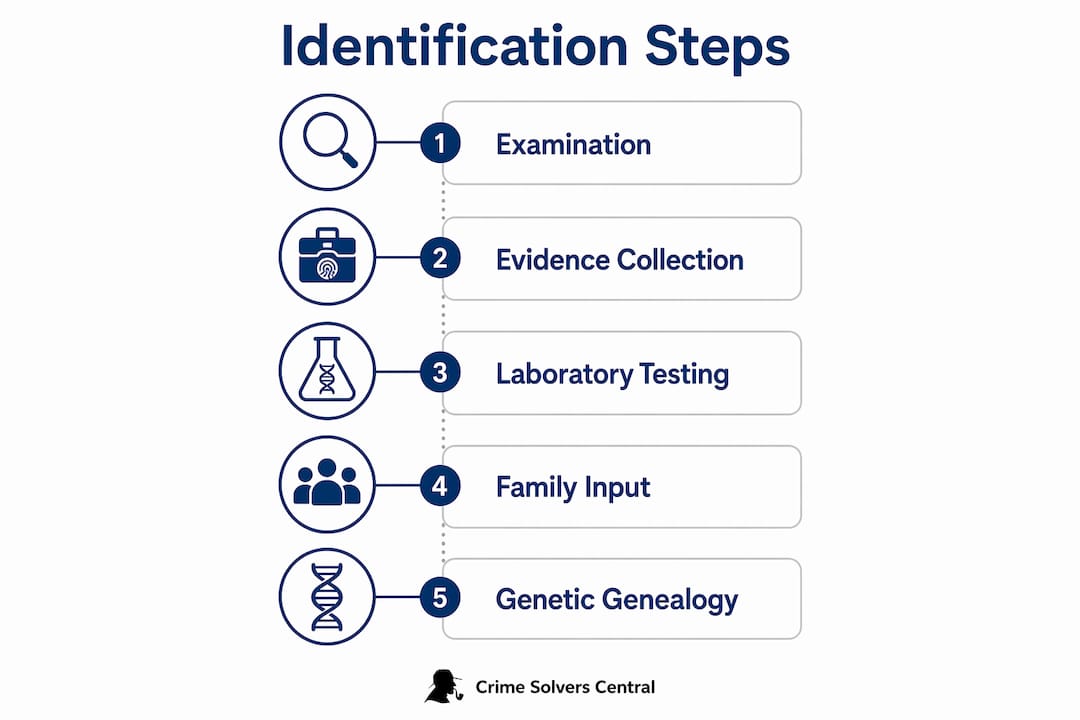
Investigative genetic genealogy represents the most advanced tool now available. This technique builds a family tree from DNA found on remains and cross-references it against consumer genealogy databases to identify biological relatives. It has resolved cases that sat unmatched in CODIS for decades.
How do coroners involve families and the public in identifying remains?
Family and public participation is not optional in unidentified remains investigations. It is an expected and integral part of the process. Coroners’ offices publish active unidentified case listings, often called John Doe or Jane Doe files, that include physical descriptions, clothing, location found, and estimated age. Sacramento County maintains a publicly accessible database of these cases specifically to invite community recognition.
When a potential match is identified, the process moves through several structured steps:
-
The family or tipster contacts the coroner’s office with identifying information
-
Investigators compare the submitted details against case records
-
If the match is plausible, DNA or dental comparison is requested
-
Positive identification triggers a formal notification to next of kin
-
The coroner’s office coordinates viewing arrangements or release of remains
The Maricopa County Unidentified Persons Bureau outlines a clear protocol for family notification and next-of-kin search that includes working with the public fiduciary when no family can be located. This matters because a significant number of unidentified individuals have no immediate family actively searching for them.
When families cannot be found, remains are not simply discarded. Coroners maintain secure storage and keep cases open for future identification. The legal and ethical obligation to identify the deceased does not expire with the initial investigation. Families who come forward years later still have a pathway to answers.
One underappreciated challenge is the emotional weight families carry while waiting. Coroners’ offices increasingly recognize that clear, regular communication, even when there is no new information to report, reduces the psychological burden on families. Some offices now assign dedicated family liaisons to unidentified cases for exactly this reason.
What legal and procedural responsibilities govern coroners’ work?
The legal framework governing coroners varies by jurisdiction, but the core obligations are consistent. In the United States, coroners and medical examiners operate under state statutes that define when an investigation is mandatory. In the United Kingdom and Australia, mandatory inquests are required whenever the identity of the deceased is unknown. This legal trigger ensures that unidentified cases receive formal judicial oversight, not just administrative processing.
The procedural steps in a typical U.S. unidentified case investigation follow this sequence:
-
Remains are received and secured at the coroner’s facility
-
A forensic examination, including autopsy if warranted, is ordered
-
Physical evidence is collected and submitted to appropriate laboratories
-
The case is entered into NamUs, the national missing and unidentified persons database
-
Law enforcement is notified and cross-agency coordination begins
-
Findings are documented and published according to state transparency requirements
The table below compares how three jurisdictions approach unidentified remains investigations:
| Jurisdiction | Inquest required? | Primary database used | Family notification process |
|---|---|---|---|
| United States | Varies by state | NamUs, CODIS | Coroner or medical examiner contacts next of kin directly |
| United Kingdom | Yes, when identity unknown | Coroner’s court records | Coroner’s officer manages family contact |
| Australia | Yes, mandatory | State coroner databases | Coroner’s office with support services |
Coroners also hold the authority to order autopsies without family consent when the cause of death is undetermined or when foul play is suspected. This authority is not discretionary in unidentified cases. It is a legal requirement designed to protect both the integrity of the investigation and the public interest.
Transparency is another legal obligation. Most U.S. jurisdictions require coroners to publish findings and maintain records accessible to authorized parties. This openness serves families, law enforcement, and public health agencies simultaneously.
How do coroners coordinate with forensic specialists and agencies?
No coroner’s office operates in isolation. Investigating unidentified remains requires a network of forensic specialists, law enforcement agencies, and national databases working in parallel. The role of forensic specialists in these investigations includes forensic pathologists who perform autopsies, forensic anthropologists who analyze skeletal remains, and forensic odontologists who compare dental records.
Cross-agency data sharing is the backbone of long-term identification success. NamUs, operated by the U.S. Department of Justice, provides no-cost forensic services to coroners and law enforcement agencies nationwide and allows families to submit missing persons information directly. This bidirectional data flow means a family in Texas can submit a missing persons report that matches remains found in Oregon.
CODIS, the FBI’s Combined DNA Index System, holds DNA profiles from unidentified remains and missing persons. When a new profile is uploaded, the system runs automatic comparisons against all existing entries. A match can surface years after the original case was filed, which is why coroners keep cases open indefinitely.
The most striking example of long-term forensic collaboration comes from El Paso County, where investigators used DNA and genetic genealogy in 2026 to identify a homicide victim whose remains had gone unidentified since 1986. Nearly 40 years passed between discovery and identification. This case illustrates that the absence of a current match does not mean a case is closed.
Pro Tip: Families of long-term missing persons should submit DNA reference samples to NamUs even if they have already filed a missing persons report with local law enforcement. The two systems do not automatically share data, and a NamUs entry significantly expands the search.
Forensic anthropologists contribute demographic profiles from skeletal analysis that narrow the pool of potential matches before DNA testing begins. This triage function reduces laboratory costs and accelerates the identification timeline. The complexity of unidentified remains investigations makes this kind of specialist collaboration not a luxury but a necessity.
Key takeaways
The most effective approach to unidentified case investigations combines forensic science, cross-agency data sharing, and sustained family engagement to resolve cases that no single method or office could close alone.
| Point | Details |
|---|---|
| Identification is a legal mandate | Coroners must establish identity as a primary evidentiary obligation, not an administrative step. |
| Multiple forensic methods are standard | Fingerprints, dental records, DNA, X-rays, and anthropology are all used in parallel to maximize match probability. |
| NamUs and CODIS extend reach nationally | Submitting cases and DNA profiles to both databases gives investigators access to matches across all U.S. jurisdictions. |
| Cases stay open indefinitely | Identification can occur decades after initial investigation, as demonstrated by the 1986 El Paso County case resolved in 2026. |
| Family input accelerates identification | Terminal episode information and physical details provided by families directly improve the quality and speed of investigations. |
What families often miss about the coroner’s role
Working with Crimesolverscentral has shown me something that formal guides rarely say plainly: families tend to underestimate how much their own knowledge matters to the coroner’s investigation. The assumption is that forensic science will do the work. In reality, the science needs a starting point, and families are often the only people who can provide it.
I have seen cases where a single detail, a distinctive birthmark, a healed broken wrist, a specific brand of shoe, was the thread that connected remains to a missing persons report. Coroners are trained investigators, but they cannot know what they do not have access to. The families who stay engaged, who call the office regularly, who submit DNA reference samples, and who update their missing persons reports when new information surfaces, are the ones who get answers.
The emotional difficulty of that sustained engagement is real. Waiting without certainty is one of the hardest things a family can do. What I would tell any family in that position is this: the coroner’s office is not a closed door. It is a process, and your participation is part of that process by design. The California wrongful death guide from Oaks Law Firm is one resource that helps families understand their legal standing while an investigation is ongoing, particularly when foul play is suspected.
The evolution of investigative genetic genealogy has changed the calculus for cold cases in a way that should give families genuine hope. Cases that were forensically dead ends five years ago are now solvable. The technology exists. The question is whether the right data is in the right database.
— Crime
Find support and search unidentified cases nationwide
Crimesolverscentral maintains a national cold case database covering over 264,913 cases organized by state, including unidentified remains and missing persons. Families can search active cases, submit information, and connect with investigators and community members working toward the same goal. The platform is designed for exactly the situation this article describes: a family that needs answers and does not know where to look next. If you believe a missing loved one may be listed as an unidentified decedent, searching the Crimesolverscentral database is a direct and practical first step. Community members can also contribute through membership and health and safety initiatives that support ongoing identification efforts across the country.
FAQ
What does a coroner do when a body cannot be identified?
A coroner documents all physical evidence, enters the case into NamUs and CODIS, and publishes a public listing with descriptive details to invite community recognition. The case remains open indefinitely until a positive identification is made.
How long does it take to identify unidentified remains?
There is no fixed timeline. Some cases are resolved within days through fingerprint matches, while others, like the 1986 El Paso County homicide victim identified in 2026, take decades when advanced techniques like investigative genetic genealogy are required.
Can families search for unidentified remains online?
Yes. Coroners’ offices like Sacramento County publish active unidentified case listings online, and NamUs allows families to search the national database and submit missing persons information directly at no cost.
What is NamUs and how does it help families?
NamUs is a U.S. Department of Justice database that connects missing persons reports with unidentified remains cases nationwide. It offers no-cost forensic services to coroners and law enforcement and accepts direct submissions from families of missing persons.
Do coroners notify families when remains are identified?
Yes. Once a positive identification is confirmed, the coroner’s office contacts next of kin directly and coordinates viewing arrangements or release of remains. When no family can be located, the public fiduciary assumes responsibility for subsequent handling.