

What Is a Missing Persons Report? A Family Guide
A missing persons report is the formal legal document filed with law enforcement to notify authorities that someone’s location and safety are unknown, triggering an immediate investigation. Filing this report is the single most time-sensitive action a family member or advocate can take. The first 48 to 72 hours after a person disappears are the most critical window for investigation. Every hour without a report is an hour law enforcement cannot act. Crimesolverscentral maintains a national database of over 264,913 cases, and the cases with the best outcomes share one thing: they were reported fast.
What is a missing persons report and why does it matter?
A missing persons report is an official notification to police that an individual’s whereabouts are unknown and that their safety may be at risk. It is not a request for help. It is a legal trigger that compels law enforcement to open a case, classify the situation, and begin an investigation. The moment you file, the clock starts on a structured response.
Federal law sets the standard for how quickly these reports must be processed. Suzanne’s Law requires that missing persons under 21 be entered into the National Crime Information Center (NCIC) database within 2 hours of the report. Adults must be entered the same day. NCIC is the nationwide law enforcement database that gives every officer in the country access to the case during routine stops, traffic checks, and investigations.
The report also feeds into NamUs, the National Missing and Unidentified Persons System. NamUs is a public database that assists in long-term cases by helping match missing individuals with unidentified remains. For families of adults who have been missing for months or years, NamUs entry is one of the most powerful tools available. Understanding the role of public databases in these cases helps families push for every available resource.
What information is required when filing a missing persons report?
The quality of your report directly affects the speed and accuracy of the investigation. Incomplete or vague information leads to slower classification and delayed action. Gather as much of the following as possible before you contact police.
- Full legal name, date of birth, and Social Security number if available
- Physical description: height, weight, hair color, eye color, and distinguishing features such as tattoos, scars, or birthmarks
- Recent photographs from multiple angles, ideally taken within the past few months
- Last known location and time, including who last saw the person and under what circumstances
- Medical conditions, disabilities, or cognitive impairments that affect the person’s ability to care for themselves
- Medications the person takes and how long they can safely go without them
- Circumstances suggesting risk, such as signs of a struggle, threats received, or a history of mental health crises
- Vehicle information if the person may be traveling, including make, model, color, and license plate
Recent photos from multiple angles and a detailed physical description are vital because they help the public recognize the person and inform safety concerns for first responders. A photo taken years ago is far less useful than one from last month.
Pro Tip: Prepare a “go folder” now, before you ever need it. Keep a printed copy of a recent photo, your family member’s physical description, their doctor’s contact information, and any relevant medical records in one place. If someone goes missing, you can hand this folder to police immediately.
How do law enforcement agencies process a missing persons report?
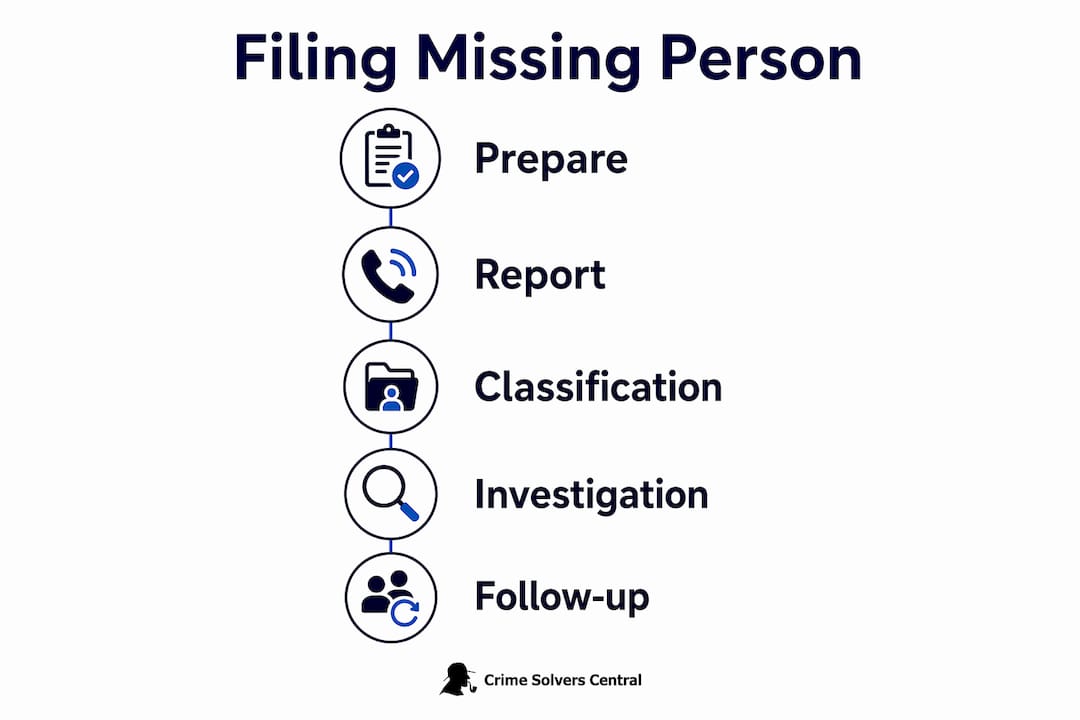
Once you file, police follow a structured process designed to prioritize cases by risk level. Understanding this process helps you know what to expect and how to push for the right classification.
- Immediate acceptance. There is no waiting period to file a missing persons report. Law enforcement must accept the report immediately, regardless of how long the person has been missing.
- Case classification. Police assign one of several categories based on the information you provide.
- NCIC and NamUs entry. The case is entered into federal databases within the legally required timeframe.
- BOLO alerts. “Be On the Lookout” alerts go out to local and regional law enforcement agencies.
- Detective assignment. A detective or investigator takes over the case and begins gathering additional information.
- Coordination with other agencies. When jurisdiction is unclear or the person may have traveled, multiple agencies are notified.
How classification affects the investigation
Police classify missing persons into categories that determine urgency and resource deployment. The four primary classifications are Endangered, Involuntary, Juvenile, and Disability. Each category signals a different level of risk and triggers a different response.

| Classification | Who it applies to | Investigation priority |
|---|---|---|
| Endangered | Person faces immediate risk of harm | Highest urgency, maximum resources |
| Involuntary | Person disappeared against their will | High urgency, active investigation |
| Juvenile | Person under 18 | Automatic high priority regardless of circumstances |
| Disability | Person with cognitive or physical impairment | Elevated urgency due to vulnerability |
Accurate reporting of medical or cognitive conditions directly influences which category police assign. A person with dementia who wanders away from home qualifies for the Disability classification, which triggers a faster, more intensive response than a standard adult case.
Pro Tip: If you believe the situation is dangerous, say so clearly and specifically when filing. Tell the officer exactly why you believe the person is at risk. Vague concern carries less weight than a specific statement like “She has severe diabetes and left without her insulin.”
Common misconceptions and challenges when filing a missing persons report
The biggest myth in missing persons cases is the 24-hour or 48-hour waiting period. This waiting period does not exist in federal law or in the law of any U.S. state. If a police officer tells you to wait, they are wrong. You have the legal right to file immediately.
A second common misunderstanding involves adults. Adults 18 and older have the legal right to go off-grid voluntarily. Police cannot force contact with a competent adult who has chosen to disappear. This does not mean police will do nothing. It means the investigation focuses on establishing whether the disappearance was voluntary or whether evidence of danger exists. Your job is to give officers every piece of information that points toward risk.
Families often feel that police are not taking the case seriously. In most situations, the barrier is not indifference. It is a lack of information that allows officers to classify the case as high risk. The more specific and documented your report, the faster the classification changes and the faster resources are deployed.
Police ask personal questions during the report to establish a risk profile, not to judge the missing person. Questions about mental health history, substance use, or relationship conflicts are standard investigative tools. Answer them honestly. Withholding information to protect someone’s reputation can slow the investigation.
If an officer refuses to accept your report or classifies it incorrectly, ask for a supervisor immediately. If the supervisor does not resolve the issue, escalate to your state’s missing persons clearinghouse or contact the FBI. Persistence is not rudeness. It is your legal right and your responsibility to the person who is missing.
Filing reports in multiple jurisdictions is also correct when you are unsure of the last known location. Multiple reports increase case visibility and do not cause confusion. More database entries mean more officers who can recognize the person during routine stops. Learn more about common delays in reporting and how to avoid them.
Practical steps for families and advocates after filing
Filing the report is the beginning, not the end. What you do in the hours and days after filing shapes the investigation’s momentum.
- Designate one primary contact. A single primary contact person should handle all communication with police. Multiple family members calling with different information creates confusion and slows updates. Choose one person and stick with it.
- Prepare a missing person checklist. Gather photo IDs, medical records, dental records, and a list of the person’s regular contacts, social media accounts, and known locations. Keep this organized and ready to hand over.
- Document everything. Write down the name of every officer you speak with, the date and time of every call, and the content of every conversation. This record protects you if the case stalls.
- Share information with your community. Post on social media, contact local news outlets, and reach out to nonprofit organizations that support missing persons families. Public awareness generates tips that police cannot generate alone.
- Request regular updates. Ask the assigned detective how often you can expect updates and what the process is for receiving them. Set a schedule and follow it.
- Preserve evidence. Do not clean the missing person’s room, car, or workspace. Do not delete their text messages or social media accounts. These may contain critical investigative leads.
Pro Tip: Ask the detective whether the case has been entered into NamUs and whether a public entry has been created. A public NamUs entry allows anyone, including medical examiners and forensic specialists, to search the database. If the entry has not been made, request it directly.
Avoid common mistakes in missing persons searches that can slow the investigation or compromise evidence. Families who stay organized, stay persistent, and stay in contact with both law enforcement and community resources give their loved ones the best possible chance.
Key Takeaways
A missing persons report is a legal trigger for immediate law enforcement action, and the quality and speed of that report directly determine how fast and how effectively police can respond.
| Point | Details |
|---|---|
| No waiting period exists | File a missing persons report immediately. Federal law requires police to accept it without delay. |
| Report quality determines classification | Detailed medical and circumstantial information leads to a higher-priority case classification. |
| NCIC and NamUs entry is mandatory | Minors must be entered into NCIC within 2 hours. Adults must be entered the same day. |
| Multiple jurisdictions help | Filing in more than one jurisdiction increases database visibility and the chance of recognition. |
| One contact, organized records | Designate a single family contact for police and document every interaction to keep the case moving. |
What I’ve learned from watching families navigate this process
Working with missing persons cases over time reveals a pattern that most families do not expect. The families who get the fastest, most thorough police response are not the ones who are the most emotional. They are the ones who walk in with a folder.
A folder with a recent photo, a typed physical description, a list of medical conditions, and a written timeline of the last 24 hours tells an officer everything they need to classify the case correctly in the first five minutes. That classification determines whether a detective is assigned today or next week. That detail matters more than anything else in the early hours.
The second thing I have seen derail investigations is families who hold back information because they are embarrassed. A missing adult’s history of depression, substance use, or a recent argument with a partner feels private. It is private. It is also exactly what officers need to assess risk. Sharing it is not a betrayal. It is the act of someone who wants their person found.
The process is not perfect. Officers sometimes push back. Departments sometimes understaff their missing persons units. When that happens, escalate. Ask for a supervisor. Contact your state clearinghouse. The law is on your side. Use it.
— Crime
Crimesolverscentral and the search for missing persons
Crimesolverscentral exists for exactly the moments when the official process feels like it is not enough. The platform’s national missing persons database catalogs over 264,913 cases organized by state and situation, giving families, advocates, and community members a place to search, share, and support active investigations. Whether a case is newly filed or years old, visibility matters. Cold cases get solved when more people see them. Crimesolverscentral connects families with the community attention that law enforcement alone cannot generate. If someone you know is missing, search the database, share the case, and join the network of people working to bring them home.
FAQ
Is there a waiting period before filing a missing persons report?
No waiting period exists. Law enforcement must accept a missing persons report immediately, regardless of how long the person has been gone.
What is the NCIC and why does it matter?
The NCIC is the National Crime Information Center, a federal database accessible to law enforcement nationwide. Missing persons under 21 must be entered within 2 hours of the report; adults must be entered the same day.
Can police refuse to file a report for a missing adult?
Police cannot legally refuse to accept a missing persons report. If an officer declines, ask for a supervisor or escalate to your state’s missing persons clearinghouse or the FBI.
What does “Endangered” classification mean for a missing persons case?
Endangered is the highest-priority classification, assigned when the missing person faces an immediate risk of harm. It triggers maximum resource deployment and the fastest investigative response.
What is NamUs and should I request entry into it?
NamUs is the National Missing and Unidentified Persons System, a public database that helps match missing individuals with unidentified remains. Requesting a public NamUs entry for your loved one’s case expands visibility to forensic specialists and the general public.