

Unsolved Murders in Canada: How to Search and Help

Canada has no single national list of unsolved murders. Cases are held by individual police services, provincial cold case units and the RCMP, so the best way to find one is to start with the force that owns the file. This guide shows where those official lists live, how to send a tip that investigators can use, and how readers in the United States can help without getting in the way.
TL;DR
- Canada’s unsolved homicides are tracked by the investigating police service, not one central public database. The RCMP, provincial units and city police each publish their own cases.
- Statistics Canada counted 788 homicides in 2024, so the pool of future cold cases grows every year.
- Tips go to the police service in charge or to Crime Stoppers. No unsolved homicide file is ever formally closed, and a small detail can matter.
- Families of missing people should know about Canada’s national DNA program for missing persons and unidentified remains.
- We organize cases by U.S. state, so for a Canadian case, official Canadian sources come first. Our methods still apply to any cold case.
Table of Contents
- Why there is no single list of unsolved murders in Canada
- Where to find official unsolved cases
- A quick map of the main sources
- What makes cold cases hard, and why they still get solved
- How to send a tip that investigators can use
- Our perspective: what we have learned about cold cases
- If you are a U.S. reader with a Canadian connection
- Caring for yourself while you search
- How Crime Solvers Central can help
- FAQ
- Sources
Why there is no single list of unsolved murders in Canada
In the U.S. you can often search a state or city cold case page. Canada works the same way, only more fragmented. Municipal police forces, provincial police in Ontario and Quebec, and the RCMP (which polices most of the rest of the country under contract) each decide which cases to feature publicly.
That is why a search for “unsolved murders Canada” returns a mix of things: a crowd-edited encyclopedia list of famous cases, podcasts, independent advocacy pages, and police web pages with a handful of names. Each is useful for a different reason, and none is complete.

The scale explains the gaps. Statistics Canada reports 788 homicides in 2024, a rate of 1.91 per 100,000 people, down from 1.99 in 2023. The same release shows the rate rose 30% between 2014 and 2024. Not every homicide goes unsolved, but every year some do, and the older ones become cold cases that a small team may revisit only occasionally.
Where to find official unsolved cases
Start with the police service that investigated. These are the kinds of pages worth bookmarking.
Provincial cold case units
In British Columbia, the Provincial Unsolved Homicide Unit is a standalone team within the BC RCMP Major Crime Section. It assists RCMP detachments with unsolved homicides, and it publishes a tip line, 1-877-543-4822. The BC RCMP also keeps a page of unsolved cases where ongoing investigations are highlighted to generate public information. Each entry gives the date, the circumstances and how to contact police.
Other provinces run their own units or assign cold cases to major crime sections. If you are looking for a case from Alberta, Ontario or Quebec, search the name of the province’s police service plus “cold case” or “unsolved homicide.”
Municipal police services
Big-city forces, such as those in Toronto, Vancouver and Montreal, often keep their own cold case pages. If a victim lived in a city with its own police service, that page is probably more current than any list compiled by a third party.
Missing persons and unidentified remains
Many unsolved murders begin as missing persons reports, and some victims are never identified. The RCMP’s missing persons page says between 70,000 and 80,000 people are reported missing in Canada in a given year. Most are found within seven days, though it notes about 500 remain missing after a year. Canada’s national database of missing persons and unidentified remains is searchable by the public, which makes it a useful companion to any homicide search.
Crowd-sourced lists and encyclopedias
Public lists of famous cases are a good way to learn names and dates, from 1918 to the present. Treat them as a starting point. Details change, and a list can lag behind an arrest, an identification or a new lead. Before you share or build on anything you read there, confirm it on a police page or in reliable news coverage.
A quick map of the main sources
| What you need | Where to look | Best for |
|---|---|---|
| An open homicide case in a province | Provincial unit or police service cold case page | Current facts, tip lines |
| A missing person who may be dead | National missing persons and unidentified remains database | Matching a name to remains |
| Background on a famous case | Encyclopedia lists, long-form journalism | Context, history |
| Fugitives wanted for murder | The police service that issued the warrant, plus national wanted lists | Tracking suspects |
| Cases by U.S. state | Our cold case database | Missing persons and homicides in the United States |
What makes cold cases hard, and why they still get solved
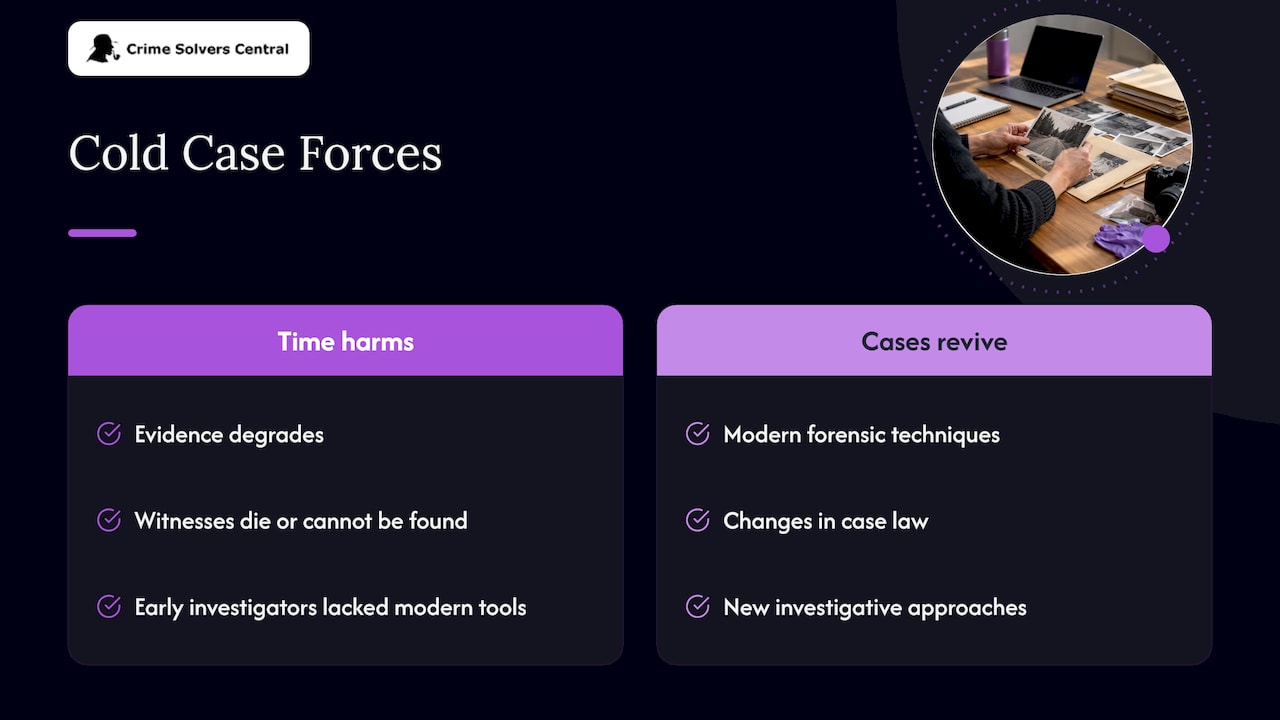
Time works against investigators. A U.S. Department of Justice report to Congress on cold cases explains that evidence degrades, witnesses die or cannot be found, and early investigators lacked today’s scientific tools. That is why courtroom outcomes in historic cases are rare. The report covers U.S. civil rights-era cases, but the evidentiary problems it describes are common to old homicides everywhere.
The BC RCMP’s unsolved homicide unit describes the same tension from the Canadian side. Time can erode evidence, but older cases can also be revived by modern forensic techniques, changes in case law and new investigative approaches that did not exist when the crime happened.
DNA has changed the picture
The RCMP created the National Missing Persons DNA Program to support missing persons and unidentified remains investigations nationally. Humanitarian profiles from missing people and unidentified remains are compared against the National DNA Data Bank, which holds about 500,000 profiles. For privacy, samples from relatives of a missing person are compared only against humanitarian profiles. They are barred from comparison with crime scene or convicted offender profiles.
If you are a family member, that detail matters. Giving a reference sample does not put you or your relatives into a criminal database. Ask the investigating police service or the coroner’s or medical examiner’s office how to arrange it.
Fugitives and cross-border cases
Some Canadian murders stay open because the suspect left the country. In October 2025, the BC RCMP joined the Bolo Program’s Top 25 list of Canada’s most wanted fugitives, which carries rewards of up to $100,000 for information leading to the arrest of the top five. The RCMP also reports that, working with Mexican authorities, it supported the arrest of 10 Canadian fugitives in Mexico over 12 months, including people wanted for murder. For U.S. readers, that cross-border reach is relevant. A tip from someone south of the border can matter to a Canadian file.
How to send a tip that investigators can use
The RCMP’s guidance is blunt: never assume your information is unimportant or that someone else already reported it. The unit says investigators continually review unsolved cases and a single tip can be the break. Here is how to make yours count.
- Identify the case precisely. Note the victim’s full name, date and place of death or disappearance, and the police service involved. Use the police page, not a podcast summary.
- Separate what you saw from what you heard. Write “I saw” and “someone told me” as different lines. Investigators weigh them differently.
- Add dates, places and names. Even approximate dates help. Say how sure you are.
- Choose the channel. Contact the investigating police service, or use Crime Stoppers. In BC, the RCMP lists Crime Stoppers at 1-800-222-TIPS (8477) and the Provincial Unsolved Homicide Unit tip line at 1-877-543-4822. Other provinces list their own numbers on their police pages.
- Keep it off social media first. Posting a theory before police have the information can contaminate witnesses and put you at risk.
We go deeper on the process in How to Report Information About a Cold Case, and on structure in 5 Steps Families Use to Build Credible Tip Packets.
Our perspective: what we have learned about cold cases
We built Crime Solvers Central around one belief: forgotten cases get attention when information is easy to find and people are organized around it. Our database holds more than 264,000 cases, sorted by state and type, and that focus is deliberate. It covers cases in the United States, so we are not the right place to look up a Canadian homicide, and we would rather say so than send you in circles.
What carries over is the method. Cold cases move when families, volunteers and investigators work from the same facts. That means a clear case profile, a consistent timeline, and tips routed to the agency that owns the file. It also means being realistic. Volunteers do not solve murders from a laptop. They help by keeping a name visible, organizing public records, and sending police information that is well documented.
We also watch for the signals that show a case is actually moving. Public updates, renewed appeals and agency statements matter more than online speculation. Our guide to four public signals of real cold case progress explains what to look for. And if you want to work with others, collaborating with communities on unsolved crimes covers how to do it without overstepping.
— Crime
If you are a U.S. reader with a Canadian connection
Many Americans land on this topic for personal reasons: a relative who lived near the border, a case followed through a podcast, or a victim who moved between countries. Here is how to act.
- Contact the Canadian police service directly. Tip lines accept calls and online tips from outside Canada. Give the case name and your location.
- If the case crosses borders, tell your local U.S. police too. Agencies share information through formal channels, and a local report can help.
- Check for a U.S. side. A victim or suspect with a U.S. address may also appear in American records. You can look in our database by state.
- Be careful with fundraising and flyers. Use only information that police have made public. Our safe plan for families and volunteers covers how to do that.
Caring for yourself while you search
Reading about unsolved murders for hours takes a toll, and families live with the weight for years. If an unresolved case is affecting your sleep, work or relationships, talk to a licensed therapist or a grief counselor, ideally one with trauma training. Some families look for faith-based options, and a trauma-informed counseling practice in the Phoenix area explains what that kind of care involves. If you are in crisis in the U.S., call or text 988.
How Crime Solvers Central can help
If your interest is in U.S. cold cases, or you want tools you can reuse on any case, a membership gives you access to full case details, sources, videos, forums, digital evidence boards and a flyer builder. Plans on our pricing page are Jr. Detective at 3.97 USD per month or 39 USD per year, Sr. Detective at 9.97 USD per month or 99 USD per year, and True Crime Influencer at 39.97 USD per month or 399 USD per year. You can also start free by browsing summaries on the home page.
FAQ
What are some famous unsolved murders in Canada?
Well-known examples include the 1918 Grande Prairie immigrant murders in Alberta and the 1924 Canadian Pacific Railway train bombing, both listed in a public list of unsolved homicides in Canada. Because that list is crowd-edited, check any case against a police source before relying on it.
How many unsolved missing persons cases are there in Canada?
No single public figure covers every case. The RCMP says 70,000 to 80,000 people are reported missing each year, and about 500 remain missing after a year. Most are found within a week.
Who is the most wanted person in Canada right now?
That changes often. As of October 2025, the Bolo Program’s Top 25 list was headed by Bryan Fuentes Gramajo, wanted for murder by the Toronto Police Service. Check the current list, since arrests change the ranking.
Can I report information about a Canadian cold case from the United States?
Yes. Contact the police service handling the case or Crime Stoppers, and state clearly where you are and how you know what you are reporting. For BC cases, the RCMP lists a dedicated unsolved homicide tip line, and other provinces list their own numbers on police pages.
Sources
- Police-reported crime for selected offences, Canada, 2023 and 2024 (Statistics Canada)
- Provincial Unsolved Homicide Unit (BC RCMP)
- Unsolved Cases (BC RCMP)
- Missing persons (RCMP)
- The National Missing Persons DNA Program (Public Safety Canada)
- 2024 Emmett Till Annual Report for Congress (U.S. Department of Justice)
- BC RCMP joins Bolo Program in unveiling Top 25 list (RCMP)
- RCMP takes fight against transnational organized crime beyond borders (RCMP)
- List of unsolved murders in Canada (Wikipedia)