

52% Cleared: Search U.S. Unsolved Killings in Public Records

Unsolved killings are homicides that remain legally open: no arrest, no conviction, no official resolution, sometimes for decades. As of January 2025, NamUs listed 25,478 active unresolved missing persons cases and 15,139 unidentified persons cases in its public database. Start your search there, then turn to a resource like Crime Solvers Central for fuller case files and community tools.
TL;DR:
- NamUs is public, but NCIC is restricted and only partly overlaps; try variants, wider date ranges, approximate locations, and physical traits when searches fail.
- About 52% of U.S. homicides were cleared in 2023, while NamUs counts people rather than incidents and cannot be compared directly with clearance rates.
- Forensic genetic genealogy identifies possible relatives and creates investigative leads, not proof; investigators must confirm identities through standard STR DNA testing before arrest.
- Send investigators a documented tip packet with dates, names, locations, and records; contact the original agency and leave speculation out.
- When publicizing a case, share verified details and the official case number, but withhold crime scene facts that could compromise evidence or an investigation.
Table of Contents
- Where to Find Public Records and Searchable Databases for Unsolved Killings
- How Often Murders Go Unsolved: Clearance Rates, Trends, and Data Caveats
- How Modern Investigations Reopen and Solve Cold Cases
- How to Research an Unsolved Killing Yourself
- Representative Case Stories That Illustrate How Unsolved Killings Are Advanced
- Our Perspective on Supporting Researchers and Families
- How a Crime Solvers Central Membership Helps
- FAQ
- Sources
Where to Find Public Records and Searchable Databases for Unsolved Killings
The National Missing and Unidentified Persons System, known as NamUs, is a public repository for missing, unidentified, and unclaimed persons cases. It publishes three case categories: missing persons, unidentified remains, and unclaimed persons, the last of which includes identified individuals whose remains have gone unclaimed by family. NamUs reported over 18,000 active unclaimed cases as of early 2025, a volume that often surprises researchers who assume unidentified cases are rarer than they actually are.
NamUs is public by design, which sets it apart from the FBI’s National Crime Information Center. NCIC data is restricted to authorized criminal justice users, while NamUs publishes case information the public can access. A federal review found that NCIC and NamUs operate as separate, only partially overlapping systems, which means some cases in NCIC never surface in a public search. That fragmentation is one reason a family member or researcher can come up empty on NamUs even when a case is technically logged somewhere in the system.
Beyond NamUs, supplementary paths exist: podcast episode indexes built around specific regions or eras, nonprofit victim advocacy projects that maintain their own case lists, and state-level clearinghouses run by attorneys general or state police. None of these replace NamUs, but they sometimes surface local detail that a national database omits.
Effective searching depends on flexible inputs. Try these approaches:
- Search name variants, nicknames, and maiden names rather than a single spelling.
- Widen date ranges by a year or two on either side of the known timeframe.
- Use approximate location (county or region) when a city search returns nothing.
- Add physical descriptors like height, tattoos, or dental work when a name search fails.
Pro Tip: If a NamUs search returns no result, try searching by case characteristics alone, age range, location, and year, since clerical errors in names are common in older case files.
How Often Murders Go Unsolved: Clearance Rates, Trends, and Data Caveats
About half of U.S. homicides go unresolved in a given year. The 2023 national homicide report estimates roughly 19,800 homicide victimizations, with about 52% of incidents cleared by arrest or exceptional means, leaving close to half uncleared in that year alone.
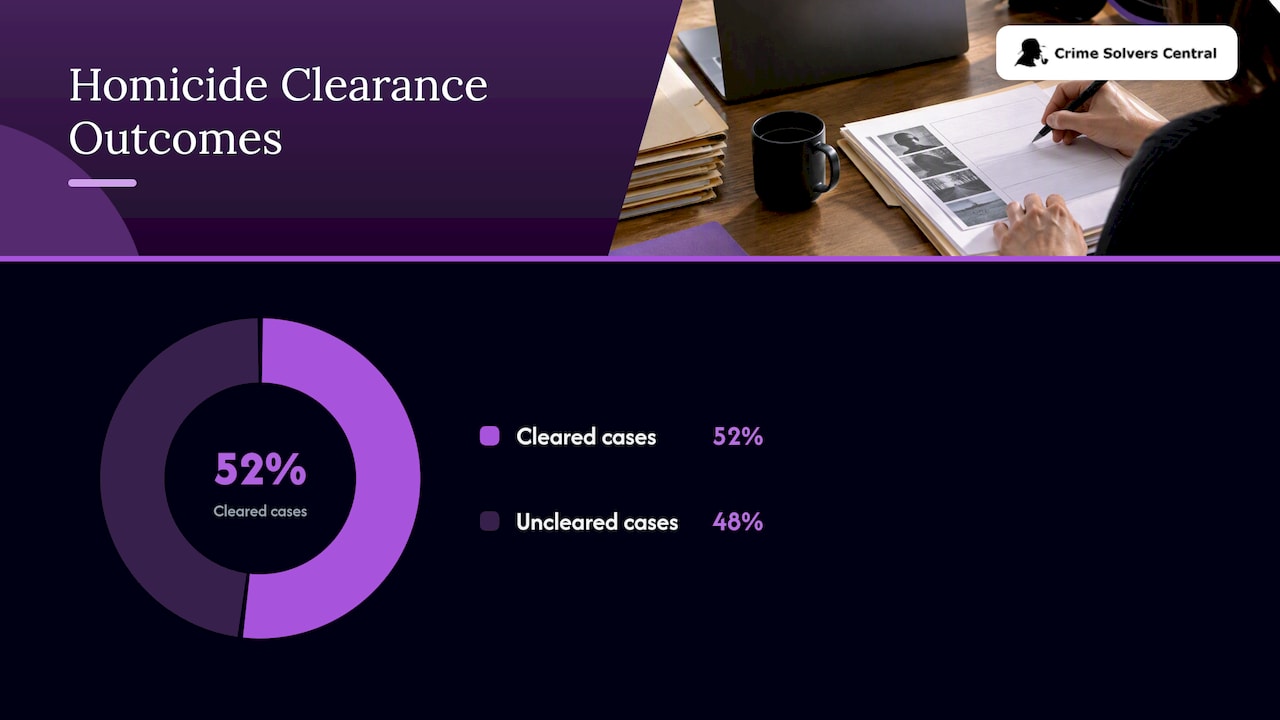
That single-year number undersells the scale of the backlog. Clearance rates have trended downward since the 1960s, and a National Institute of Justice estimate places the accumulated total of unresolved homicides nationwide in the hundreds of thousands. Every uncleared case from prior decades stays open, stacking on top of each year’s new total, which is why the cold-case pool keeps growing even as annual homicide counts fluctuate. The FBI’s 2023 data also shows murder and non-negligent manslaughter dropped 11.6% compared to the year before, a reminder that fewer new homicides don’t automatically mean a smaller unsolved backlog.
Part of the confusion around “how many cases go unsolved” comes from mismatched data sources. Several data sources are sometimes cited interchangeably, but they measure different things:
- The Supplementary Homicide Report (SHR) tracks incident-level detail on victims, offenders, and circumstances, historically the backbone of homicide trend analysis.
- The National Incident-Based Reporting System (NIBRS) is another source of homicide data, with information collected through the FBI’s reporting program.
- NamUs tracks individual missing, unidentified, and unclaimed person cases rather than homicide incidents, so its case counts aren’t directly comparable to clearance-rate statistics.
A further distinction matters for anyone researching a specific case: “unsolved” and “unidentified” aren’t synonyms. A homicide can be unsolved even when the victim is fully identified, and a set of remains can be identified years before any suspect is named. Mixing up the two categories when searching a database often leads to dead ends, since the case may sit in a different list than expected. National clearance figures have data limitations, so they should not be treated as an exact census.
How Modern Investigations Reopen and Solve Cold Cases
Forensic genetic genealogy has become the technique most associated with cold-case breakthroughs. It works by comparing crime-scene DNA, converted into a SNP-based profile, against genetic genealogy databases to find biological relatives of an unknown suspect or victim. That comparison produces a lead, not proof. The Department of Justice’s interim policy states explicitly that FGG generates investigative leads only, and that any arrest requires traditional STR DNA typing to confirm the identity before charges proceed. Investigators then track down a reference sample from the identified relative or the suspect directly to run that confirmation.
Forensic genetic genealogy generates genetic associations used only as investigative leads; arrests require traditional STR DNA confirmation and FGG searches must follow defined criteria and safeguards.
U.S. Department of Justice, Interim Policy on Forensic Genetic Genealogical DNA Analysis and Searching
DNA doesn’t resolve every case equally well. A 2024 analysis found that the effect of DNA evidence on homicide clearance is context-dependent: matches help resolve some situational profiles of homicide but don’t uniformly raise clearance rates across every case type. Re-testing preserved evidence with current DNA methods can contribute to cold-case breakthroughs.
Technology isn’t the whole story. Research on homicide investigation practices found that detective management, formal training, and analytical methods influence clearance performance as much as any forensic tool. Systematic reviews of old files, cross-referencing cases, and consistent investigative protocols can complement forensic advances in cold-case work.
Media and community campaigns add another layer. Podcasts and local press coverage have repeatedly generated tips that revived stalled investigations:
- A six-part podcast series on a 1982 Louisiana cold case brought forward new witnesses and led to arrests decades after the crime.
- Local news anniversary coverage often prompts tips from people who didn’t realize a detail they remembered was relevant.
- Social media sharing of case flyers extends a case’s reach well beyond its original jurisdiction.
Pro Tip: When sharing a cold case online, include the case number from the official database listing. It can help law enforcement match tips to the correct file.
How to Research an Unsolved Killing Yourself
Researching a cold case productively means organizing what you know before you search, then searching in the right order.
- Assemble the case basics first. Gather dates, last known location, photos, physical descriptors, and any case or report number you already have.
- Search public databases next. Check NamUs using flexible date ranges and location fields, then check a deeper catalog like our cold case database by state for additional context on the same case.
- Build a tip packet before contacting investigators. Investigators find dates, names, locations, and any documentation far more useful than speculation or theories about who was involved.
- Amplify carefully. Share verified details through media, podcasts, or social posts, but hold back anything that could compromise evidence, such as specific wound details or crime-scene specifics that only the offender would know.
A few practical habits make this process smoother:
- Keep a simple log of every source you check and what you found, so you don’t repeat searches.
- Contact the original investigating agency, not just a general tip line, when you have new information.
- Avoid publishing theories about a specific living person’s involvement, which can create legal exposure and derail an active investigation.
For readers who want to go further, our guide on collaborating with communities on unsolved crimes and our walkthrough on crowdsourcing tips on unsolved homicide cases cover coordination tactics in more depth than a single checklist can.
Representative Case Stories That Illustrate How Unsolved Killings Are Advanced
Three patterns show up again and again in cases that eventually move forward:
- Preserved evidence, retested years later. A rape kit, clothing fiber, or blood sample collected decades ago and properly stored can be reanalyzed with current DNA extraction methods, sometimes producing a CODIS match that the original technology couldn’t generate.
- Genealogy leads confirmed through STR testing. An unknown profile gets uploaded to a genealogy database that permits law enforcement searches, a SNP comparison identifies likely relatives, investigators trace the family tree to a specific person, and a reference sample confirms the match through standard STR typing before any arrest.
- Publicity that surfaces a forgotten witness. A podcast series, documentary, or renewed local news coverage reaches someone who saw something decades earlier but never connected it to the case until the story resurfaced.
The common thread across all three is preservation and persistence: evidence kept intact, databases checked more than once, and cases kept visible long after the initial coverage faded. Cross-agency cooperation, a local department working with state crime labs or federal genealogy resources, tends to show up in cases that move from cold to active again, which is part of why task forces and multidisciplinary advisory teams get assigned to the hardest files.
Our Perspective on Supporting Researchers and Families
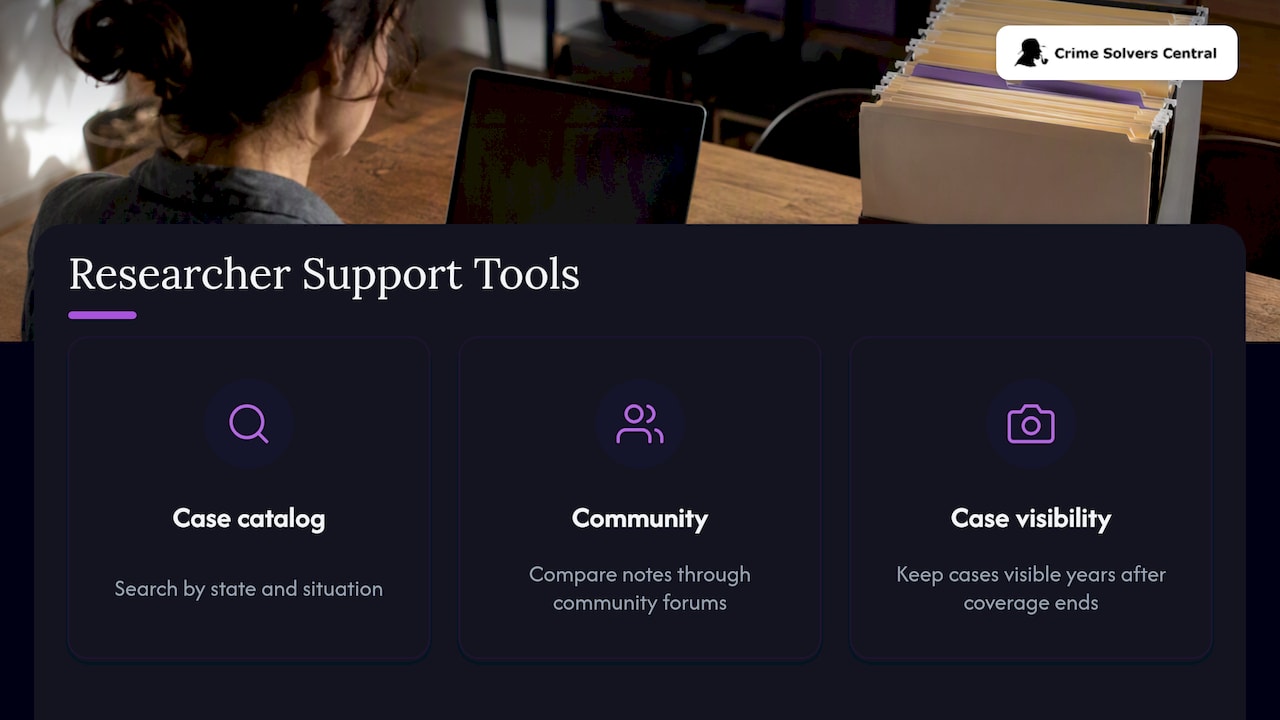
We built our national case catalog because public databases, while essential, only go so far for a family trying to track a single case over years. Our database holds cases organized by state and situation, so a parent, sibling, or independent researcher can search by location and circumstance rather than guessing which agency holds the file.
Members use full case files, digital evidence boards, and community forums to compare notes with other researchers working the same region or era. Our flyer builder and AI image progression tools help families keep a case visible years after initial coverage ends, which matters given how often new tips surface only after renewed publicity. If you’re researching a specific case, our case catalog is a reasonable place to start.
— Crime
How a Crime Solvers Central Membership Helps
Full case files, digital evidence boards, and volunteer coordination tools sit behind our membership, built for readers who need more than a summary page. A Jr. Detective membership starts the deeper search at $3.97 per month or $39 per year, and Sr. Detective and True Crime Influencer memberships are also available.
- Unlock complete case files, sources, and video on cases like the ones we track in Chicago and Hattiesburg.
- Coordinate with other researchers through forums and digital evidence boards.
- Build flyers and use AI image progression tools to keep a case visible.
Compare plans on our pricing page and pick the tier that fits how deep you want to go.
FAQ
How many homicides go unsolved in America?
Roughly half of homicides in a given year go uncleared: the 2023 national report found about 52% of incidents cleared by arrest or exceptional means, leaving the rest open. Accumulated over decades, researchers estimate the total unresolved homicide count in the hundreds of thousands nationally.
What state is #1 in homicide?
National clearance and homicide data are typically reported at the national level in the sources we rely on, and no single state ranking is confirmed across them. Check your state’s specific crime statistics agency for a reliable state-by-state breakdown.
What is the biggest unsolved missing person case?
There is no single confirmed “biggest” case; NamUs alone lists 25,478 active unresolved missing persons cases as of January 2025, spanning every state. Searching by location and year in a public database is more productive than looking for one headline case.
What are some interesting unsolved mysteries?
Unsolved killings span every era and region, and what counts as “interesting” depends on what a researcher is drawn to, whether that’s a decades-old cold case, an unidentified remains case, or one revived through forensic genetic genealogy. Our state-by-state case database organizes thousands of these cases for browsing by location and circumstance.
How does forensic genetic genealogy actually solve a case?
Forensic genetic genealogy compares crime-scene DNA to genealogy databases to identify likely relatives of an unknown person, producing an investigative lead rather than proof. The DOJ’s interim policy requires that any match be confirmed through traditional STR DNA typing before an arrest can be made.
Sources
- Namus
- Homicide Victimization in the United States, 2023
- United States Department of Justice Interim Policy: Forensic Genetic Genealogical DNA Analysis and Searching
- When DNA Is and Isn’t Magic: A Conjunctive Analysis of How Context Matters in Homicide Investigations | Office of Justice Programs
- Serial Killer Connections Through Cold Cases | National Institute of Justice