

Unsolved Crimes: Where to Search, How to Help

If you’re looking for a cold case right now, start with three free resources: NamUs (the National Missing and Unidentified Persons System), the FBI Major Cases page, and your state’s unsolved-homicide list. Each one is searchable, publicly accessible, and updated by law enforcement. For deeper case archives, community tools, and member-only investigative resources, Crimesolverscentral maintains a national database of over 264,913 cases organized by state and case type.
The NIJ Cold Case Working Group defines a cold case as an unsolved violent crime, missing person, or unidentified person that has remained open for at least three years and still has potential for resolution through new information or advanced technology. In practice, agencies vary: some label a case cold after one year, others after five. The three-year benchmark is the most widely adopted standard.
Here’s where to start:
- NamUs: Search by name, state, age, physical description, or case number. Families can also submit a case directly through the portal.
- FBI Major Cases: Provides case narratives, evidence summaries, and official tip submission links for high-profile federal investigations.
- State unsolved-homicide pages: Most state bureaus of investigation (the Georgia Bureau of Investigation is one example) publish searchable lists with contact information for the assigned detective.
- Crimesolverscentral: Offers case profiles categorized by state and situation, with member access to full case files, digital evidence boards, and community forums.
Stat: NIJ analysis estimates tens of thousands of unresolved homicides in the period studied, a figure that reflects decades of declining clearance rates.
Key Takeaways
Cold cases remain legally open and prosecutable in most jurisdictions, and the combination of official databases, forensic advances, and organized community effort gives every case a realistic path to resolution.
| Point | Details |
|---|---|
| Start with official databases | Search NamUs, FBI Major Cases, and your state’s unsolved-homicide page before any other resource. |
| Scale of the problem | NIJ estimates roughly 242,000 unresolved homicides in the period studied, with clearance rates declining since 1975. |
| Submit tips through official channels | Use agency tip forms, include dated records and corroborating details, and preserve chain of custody for any physical evidence. |
| Ethics matter in volunteer work | Share public information, coordinate searches with law enforcement, and never handle or publish evidence independently. |
| Crimesolverscentral | Provides 264,913+ cases by state plus member tools (full case files, flyer builder, forums) that complement official databases. |
Table of Contents
- What counts as an unsolved crime, and how big is the problem?
- Where to find authoritative case databases and how to use them
- How cold-case investigations progress and what affects solvability
- How families and the public can help without compromising a case
- Famous unsolved cases worth knowing as research starting points
- What happens after you submit a tip
- Why databases and community collaboration are the right approach
- Crimesolverscentral gives researchers and families deeper tools than public databases alone
- Sources
- FAQ
What counts as an unsolved crime, and how big is the problem?
The phrase “unsolved crimes” covers a wide range of open investigations, but within law enforcement, the more precise term is cold case. The NIJ working definition requires three elements: the crime is a violent offense, missing-person case, or unidentified-remains case; it has been open for at least three years; and credible new information or technology could plausibly move it forward.
That last condition matters. A case isn’t cold simply because it’s old. It’s cold because active leads have dried up and the file is waiting for something new.
The transition to “cold” is an internal policing label, not a legal status. Homicide has no statute of limitations in most U.S. jurisdictions, meaning a case from 1978 can still result in prosecution today. What varies is the agency’s resource commitment, not the law’s reach.
Why exact counts are hard to pin down:
- Definitions differ by agency (1–5 years before a case is reclassified)
- Not all jurisdictions report to federal databases
- Missing-person and unidentified-remains cases are tracked separately from homicides
- Some cases are reclassified as solved, accidental, or non-criminal without public notice
Stat: The homicide clearance rate fell from 78.3% in 1975 to 59.4% in 2016, which means roughly four in ten homicides in recent decades went unresolved. That gap compounds annually.
For researchers, this means no single database holds every case. Cross-referencing NamUs, FBI records, and state pages is the only way to build a complete picture.
Where to find authoritative case databases and how to use them
Every major database has a different strength. Knowing which one to open first saves hours.

NamUs
NamUs is the federal government’s primary public portal for missing persons and unidentified human remains. It’s free, searchable by the public, and directly connected to law enforcement case managers. Families can create or update a case themselves. Search fields include name, age range, state, physical characteristics, and case number. When a name is unknown, filtering by approximate age, sex, and geographic region often surfaces relevant records.
FBI Major Cases
The FBI Major Cases page covers high-profile federal investigations, including kidnappings, serial offenses, and cases with interstate elements. Each profile includes a case summary, known evidence details, and a direct tip-submission link. This is the right starting point when a case crossed state lines or involved federal jurisdiction.
State unsolved-homicide pages
Every state bureau of investigation maintains some version of an unsolved-case list. The Georgia Bureau of Investigation’s page is a frequently cited example of a well-organized state resource, but similar pages exist across the country. To find yours: search “[state name] bureau of investigation unsolved homicides” or “[state name] attorney general cold cases.” Most pages include the victim’s name, date, county, and a detective contact. NIJ guidance specifically points researchers toward these state-level resources as authoritative starting points.
Nonprofit and community databases
| Database | Best for | Key features |
|---|---|---|
| NamUs | Missing persons, unidentified remains | Public case creation, forensic services, law enforcement integration |
| FBI Major Cases | High-profile federal cases | Official narratives, tip forms, federal jurisdiction |
| Project Cold Case | Homicide research, family advocacy | Community-sourced leads, archived news, family contact options |
| Crimesolverscentral | Deep case archives, volunteer tools | 264,913+ cases by state, member tools, AI image tools, flyer builder |
Search tactics that actually work:
- Try alternate spellings of names (nicknames, maiden names, phonetic variants)
- Filter by date range first, then narrow by geography
- Search vehicle descriptions or neighborhood names as keywords when victim identity is unknown
- Cross-reference NamUs case numbers against state pages for the same individual
Pro Tip: When leveraging national database cold cases, always note the case number from each database. The same person may appear under different identifiers across NamUs, state records, and nonprofit catalogs.
How cold-case investigations progress and what affects solvability
Not all cold cases are equally solvable, and understanding why helps researchers focus their energy.
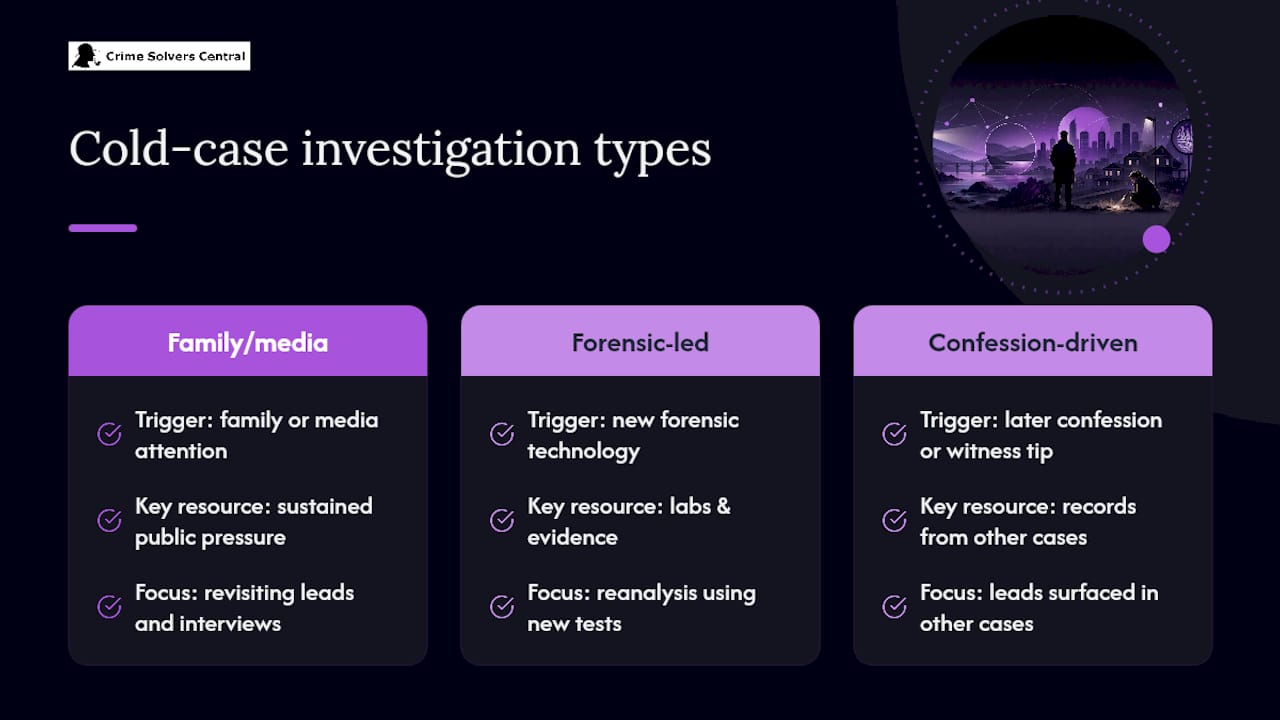
NIJ/OJP research identifies three types of cold-case investigations: family- or media-triggered reviews, forensic-led reopenings enabled by new technology, and cases cracked by a later confession or witness implication. Each type has a different resource profile. Family-triggered reviews depend heavily on sustained public pressure. Forensic reopenings require lab access and evidence preservation. Confession-driven cases often hinge on unrelated criminal proceedings surfacing new information.
What predicts solvability
Four factors consistently appear in NIJ research as predictors of whether a cold case can be resolved:
- Physical evidence availability: Cases with preserved biological samples are strong candidates for DNA reanalysis or forensic genetic genealogy.
- Victim and crime characteristics: Cases with identified victims and known crime scenes have more investigative anchors than unidentified-remains cases.
- Original investigation progress: Cases where early detectives documented leads thoroughly are easier to reopen than those with sparse files.
- Agency resources: Cold-case units with dedicated staffing and database access close cases at higher rates than agencies relying on active-duty detectives to work cold files on the side.
Common barriers
Tunnel vision is a documented investigative hazard in cold-case work. When an original investigation fixated on one suspect or theory, subsequent detectives inherit those assumptions. Fresh eyes, outside review panels, or new technology can break that pattern. Lost or degraded evidence is the other major barrier: biological samples stored improperly for decades may be too compromised for modern testing.
How technology is changing the odds
Advances in DNA technology, forensic genetic genealogy, and AI-assisted file review have reopened cases once considered permanently stalled. Forensic genetic genealogy, which builds family trees from partial DNA profiles, has identified suspects in cases where no CODIS match existed. AI-assisted document review can process thousands of pages of investigative files in hours, flagging overlooked connections. Audio forensics tools add another layer, helping analysts recover usable content from degraded recordings.
Stat: NIJ’s Solving Cold Cases with DNA program supported the review of more than 140,000 cases, resulting in over 5,000 CODIS uploads and roughly 2,000 database hits in a single program period.
Pro Tip: If you’re a family member with physical evidence, contact the assigned detective before sending anything. Chain-of-custody documentation is critical. Evidence submitted without proper handling can be inadmissible.
How families and the public can help without compromising a case
The most common mistake well-meaning people make is acting before they understand the rules. Sharing unverified information publicly, handling physical evidence, or contacting suspects directly can damage a prosecution’s chances, even when the intent is to help.
What investigators actually want from the public:
- Contemporaneous records: dated photos, written notes from around the time of the crime, text messages, or documents that place people or vehicles at specific locations
- New information about changes in a person’s life circumstances (sudden moves, behavioral shifts, unexplained wealth) that postdate the original investigation
- Corrections to the public record: if a published detail is wrong, investigators want to know
- Tips submitted through official channels, not social media
How family members can work effectively with investigators:
- Request a case status update in writing from the assigned agency. Most jurisdictions have a process for this.
- Keep a personal case file: copies of all correspondence with law enforcement, news coverage, and any documents you’ve gathered. Organize by date.
- Work with victim advocacy organizations that have established law enforcement relationships. They can navigate agency protocols more efficiently than individuals acting alone.
- Avoid public accusations. If you believe you know who is responsible, submit that information through the official tip line and let investigators verify it.
What volunteers and citizen investigators should and shouldn’t do:
- Sharing official flyers and public case information on social media is genuinely helpful and costs nothing.
- Organized search events, when coordinated with law enforcement, can locate physical evidence that agencies lack the manpower to find.
- Do not handle, photograph, or move any physical object that could be evidence. Report its location to law enforcement instead.
- Do not publish the personal information of individuals you suspect. Doxxing creates legal liability for you and can compromise an investigation.
Community collaboration on unsolved crimes works best when it stays within these boundaries. The cases that benefit most from public involvement are those where investigators need leads, not those where someone online has already decided who did it.
How to evaluate information before sharing it:
- Does it come from a primary source (court records, official case files, named law enforcement statements)?
- Can it be corroborated by a second independent source?
- Is the person sharing it identified and accountable?
- Does it add new facts, or does it just repeat existing speculation?
Famous unsolved cases worth knowing as research starting points
These cases appear frequently in cold-case research because they illustrate different patterns in evidence, jurisdiction, and investigative longevity. They’re useful as reference points when learning how to frame database searches.
- The Zodiac Killer (California, 1968–1969): Multiple confirmed victims, extensive physical evidence including letters and a cipher, and no confirmed prosecution despite decades of investigation. Illustrates how jurisdictional fragmentation across multiple agencies can stall a case even with substantial evidence.
- The Black Dahlia (Los Angeles, 1947): Elizabeth Short’s murder generated enormous media coverage and hundreds of suspect interviews. The case shows how early investigative chaos, before standardized forensic protocols, can permanently compromise solvability.
- JonBenét Ramsey (Colorado, 1996): DNA evidence collected at the scene has been retested multiple times using advancing technology. The case is a textbook example of forensic genetic genealogy’s potential, and it remains open as of 2026.
- Maura Murray (New Hampshire, 2004): A missing-person case with no confirmed remains, illustrating how the absence of a body changes the investigative framework entirely. NamUs holds her case profile.
- The Delphi Murders (Indiana, 2017): Two teenage girls killed on a hiking trail; a suspect was charged in 2022 after digital evidence from one victim’s phone surfaced. This case shows how digital forensics can break a case years after the crime.
For each of these, famous cold cases and the investigations that shaped justice provides additional context and research entry points. When searching databases, use the victim’s full name, the year, and the state as your initial filters, then expand to physical descriptions or associated locations if the initial search returns nothing.
What happens after you submit a tip
Most people who submit a tip never hear back, and that silence is not evidence that nothing happened.
Agencies triage incoming tips through an initial screening process. A tip is logged, assigned a reference number, and checked against the open case file. If it introduces genuinely new information, it moves to the detective or cold-case unit assigned to the case. If it duplicates something already in the file, it’s noted but doesn’t trigger a new investigative action.
Realistic timelines:
- Initial acknowledgment: some agencies send an automated confirmation; many do not
- Investigative review: days to weeks, depending on caseload and tip volume
- Outcome notification: agencies are generally not required to inform tipsters of outcomes, and most don’t
What agencies may ask for:
- Your contact information (tips can be anonymous, but named tips are weighted more heavily)
- The source of your information and how you obtained it
- Any physical evidence you’re aware of and its current location
If you want to follow up, contact the assigned detective directly by name if that information is public, or call the agency’s cold-case unit. Reference your tip’s date and any confirmation number you received. Keep the conversation factual and brief.
Privacy is generally protected for named tipsters, though this varies by jurisdiction. If you have concerns about your safety in connection with a tip, say so explicitly when you submit it. Most agencies have protocols for handling sensitive-source information.
Why databases and community collaboration are the right approach
The conventional wisdom in true crime circles is that persistence solves cold cases. That’s partly true, but persistence without structure usually generates noise rather than leads. What actually moves cases forward is organized, documented, evidence-respecting effort directed at the right channels.

Crimesolverscentral’s approach is built around that principle. The platform hosts over 264,913 cases because scale matters: a researcher who can search across states, filter by case type, and cross-reference community-sourced information in one place covers more ground than one bouncing between disconnected agency pages. The community tools, including forums, digital evidence boards, and volunteer coordination features, exist because successful cold-case task forces consistently show that organized group effort outperforms individual sleuthing.
The databases covered in this guide, NamUs, FBI Major Cases, state pages, and nonprofit catalogs, are not competing resources. They’re complementary layers. Official databases hold authoritative records. Community platforms hold the connective tissue: archived news, family-submitted details, and the kind of contextual knowledge that doesn’t fit a government form field. Using both is the only way to build a complete picture of a case.
Crimesolverscentral gives researchers and families deeper tools than public databases alone
Public databases are the right starting point, but they stop at the case summary. Crimesolverscentral’s paid membership unlocks the full case file: source documents, videos, digital evidence boards, a flyer builder, AI image tools for age progression and reconstruction, and access to community forums where families and researchers share leads in real time.
For family members, the platform consolidates what would otherwise require hours of cross-referencing: state records, news archives, community tips, and investigative timelines in one searchable location. For volunteers, the flyer builder and volunteer coordination tools make it straightforward to run a public appeal that meets law enforcement standards. The membership also includes access to safety initiatives and fundraising resources for families who need financial support during long investigations.
Where official channels provide the record, Crimesolverscentral provides the infrastructure to act on it. Search the database by state to find a case, then decide whether a full membership gives you the tools your research requires.
Sources
Government and official resources:
- Expert Panel Issues New Best Practices Guide for Cold Case Investigations | National Institute of Justice
- National Best Practices for Implementing and Sustaining a Cold Case Investigation Unit (NIJ)
- When Does a Criminal Investigation Go Cold? Timelines and the Law - LegalClarity
Legal framework:
Community and nonprofit databases:
How to pick the right source: Use NamUs for missing persons and unidentified remains. Use FBI Major Cases for federal or multi-state investigations. Use state pages for local homicides and official detective contacts. Use Crimesolverscentral for deep case archives, cross-state research, and volunteer coordination tools.
FAQ
What are the most famous unsolved crimes?
The Zodiac Killer, the Black Dahlia murder, and the JonBenét Ramsey case are among the most widely researched. Each illustrates a different investigative challenge: jurisdictional fragmentation, early forensic limitations, and the ongoing potential of DNA retesting.
What is the most famous cold case in the world?
The Zodiac Killer case is frequently cited as the most recognized unsolved criminal investigation globally, spanning multiple confirmed victims, physical evidence, and coded letters that have never been fully deciphered despite decades of public and law enforcement scrutiny.
Have any famous cold cases been solved?
Yes. The Golden State Killer case is a prominent recent example of a decades-old case broken by advances in DNA technology applied to genealogy databases.
What is the strangest unsolved case?
The Tamam Shud case is widely considered one of the most baffling: an unidentified man found dead on a beach with a scrap of paper bearing a phrase from a rare book, no confirmed identity, and no cause of death ever officially established.
How do I submit a tip on an unsolved case?
Use the official tip form on the relevant agency’s website, NamUs, or the FBI Major Cases page. Include dated records, specific locations, and any corroborating details. Crimesolverscentral’s member platform also provides organized tip documentation tools for families and researchers working across multiple cases.