

True Crime Evidence Board: How to Build One Responsibly
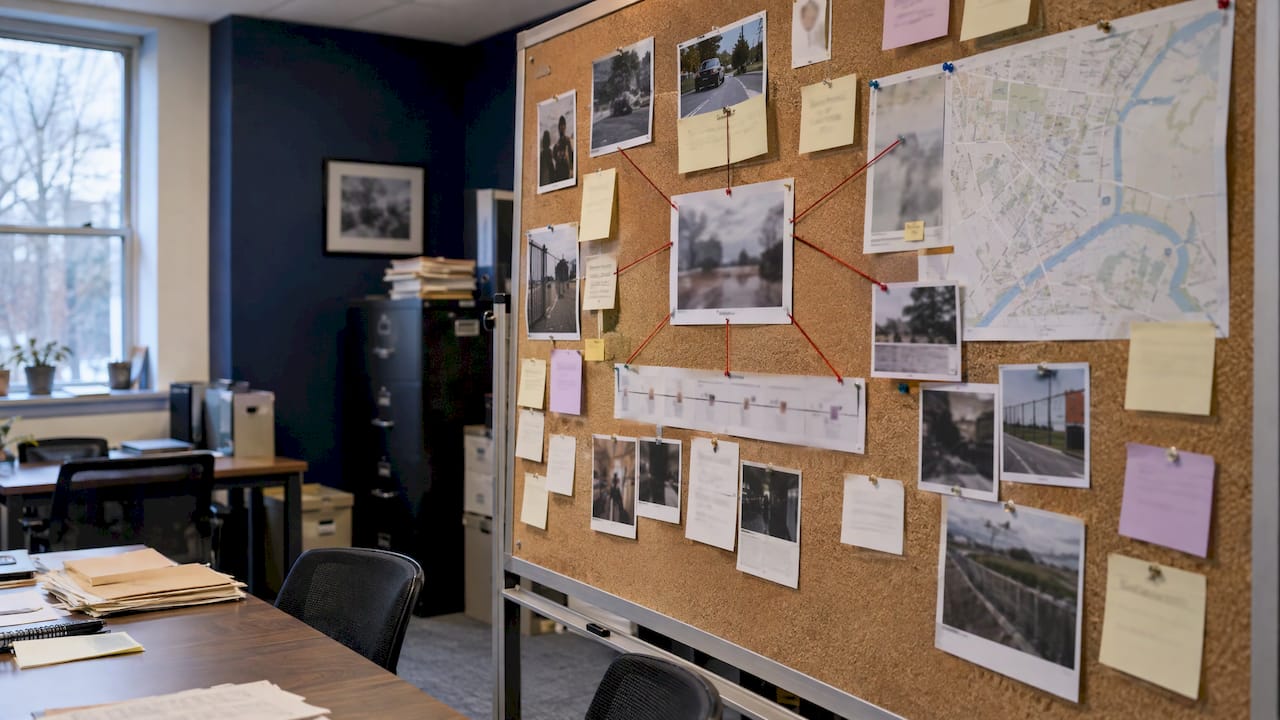
A true crime evidence board is a visual map of a case: people, places, dates, documents and the links between them. For a real missing-person or cold case, the best board is a digital one. It is built from sourced facts, it keeps verified information visibly apart from theory, and it exists to produce a clear, factual summary you can hand to the agency that owns the case. Our members build their boards on Crime Solvers Central, next to a searchable national database of 264,913 cases sorted by state and situation.
This guide walks through what to put on the board, how to build it step by step, how to draw connections without overstating them, and how to keep real people safe while you work.
TL;DR
- An evidence board is a thinking tool: it shows what is known, what is missing and what is only a guess.
- Start from the case file and public records, then build a sourced timeline before you draw a single connection.
- Use a clear line key: solid for confirmed links, dashed for probable ones, dotted for single-source or alleged ones.
- Keep the board private while you work, and send only concise, sourced facts to the investigating agency.
- Digital boards are easier to correct, date-filter and share safely than corkboards and string.
Table of Contents
- What an evidence board is, and what it is not
- What goes on the board
- How to build the board, step by step
- Showing connections without overstating them
- Physical board or digital board?
- Safeguards for real cases
- Where to start on Crime Solvers Central
- Our perspective
- FAQ
- Sources
What an evidence board is, and what it is not
An evidence board, also called a crime board, is a physical or digital tool that maps clues, suspects, timelines and connections, using photos, notes and links to bring patterns into view. A school-district research guide from Blue Valley Libraries describes it in just those terms, and it is the same structure you see on screen in detective shows.
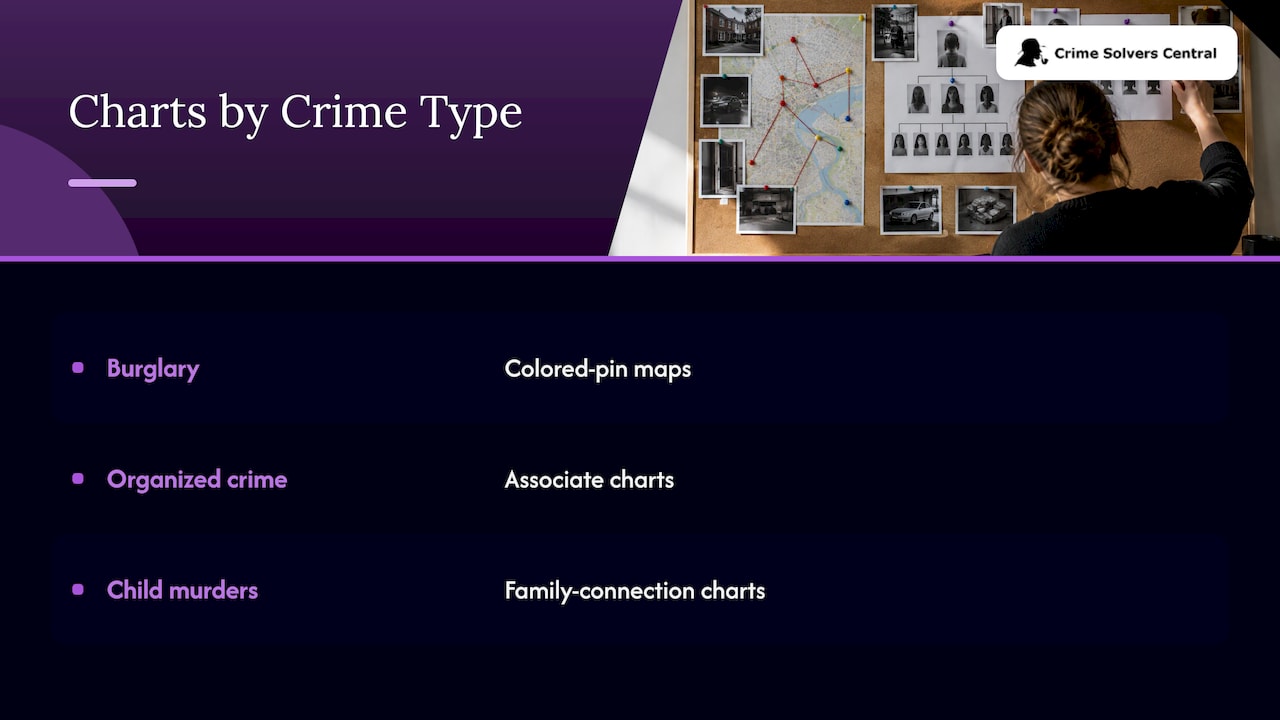
Television gets one thing wrong. Real boards were never one giant wall of crazy. A retired Scotland Yard detective quoted by Cracked explains that different crimes got different charts: colored-pin maps for burglary patterns, associate charts for organized crime and full family-connection charts for child murders. The same report notes that modern investigators tend to use computer visualization tools in place of tape and string.
That matters for you, whether you are a family member, a volunteer, a student or an advocate. A good board is not a collage of suspicions. It is a working document built for one question at a time: where was this person, who was around them, and what does the record actually show?
What goes on the board
The standard ingredients are consistent across guides: a central subject, photographs, a timeline, maps, document references, witness statements, person profiles and the links between them. For a missing-person or unsolved case, organize them into six groups.
The central subject
Put the missing or deceased person in the middle: name, age, last known location, date last seen and a short description. Everything else radiates outward from here. Anchoring the board on one person or one event keeps it readable.
Timeline
This is the spine of the board. Every entry needs a date, a time when known, and a source. Mark whether each entry is documented, such as a receipt, call log or surveillance frame, or only recalled by a witness. Guidance on documenting missing-person cases from Lawyeree starts with an incident overview (date, time and place of the disappearance) and a chronological record of events leading up to it.
People
List family, friends, coworkers, witnesses and anyone named in the file. Note each person’s relationship to the central subject and where the information came from. Record people who were investigated and cleared as cleared. Do not publish their names.
Places and maps
Mark the last known location, the scene where remains were found if applicable, workplaces, routes and any reported sightings. Maps help you test whether a timeline is physically possible.
Evidence and documents
List each item with what it is, where it was found, who holds it and, if known, its condition. A cold case checklist from a U.S. professional training resource starts with a review of the original file: first responder reports, statements, crime scene logs, forensic reports, and NamUs and ViCAP reports. NamUs is the national database of missing, unidentified and unclaimed persons. ViCAP is the FBI’s database of violent crimes.
Open questions
Give the board a column for what is missing: records you have not seen, witnesses never interviewed, evidence whose location is unknown. Gaps are findings too.
How to build the board, step by step
The order below follows how cold case units work, scaled down for families and volunteers. At each step we note where a digital workspace saves effort. Our members use the digital evidence boards on Crime Solvers Central, so everything stays in one place alongside the case profile.
Step 1: Pick one case and define one question
The U.S. Department of Justice’s National Best Practices for cold case units recommends organizing cases starting with those that have the most apparent means of resolution. Apply the same logic to yourself: choose one case, and write one question, such as “Who was the last person to see her, and where?” A board without a question grows until it is unreadable.
Where it goes wrong: starting with the most dramatic theory instead of the most answerable question.
On Crime Solvers Central, you can find the case by state and type in the database, then open its profile as the starting point for your board.
Step 2: Gather the record, not the rumor
Collect official sources first: the original reports where you can get them, news coverage, court filings, and public records such as property, vehicle and business filings. Our guide to how public records support cold cases covers where to look. If you request police records, expect fees. One guide puts per-page copying fees commonly between a quarter and a dollar depending on color and certification.
Keep a source log from the first minute: a dated list of every document, URL and the day you accessed it. Every card on your board should trace back to a line in that log.
Where it goes wrong: screenshots with no source, and forum posts treated as facts.
Step 3: Build the master timeline
List every known event in order, then give each entry a source and a confidence level. Hold off on interpretation. Once the master timeline exists, split it into sub-timelines: the victim’s final days, the people they interacted with, and any persons of interest. Compare each sub-timeline against the evidence and note inconsistencies and missing pieces.
Timelines test ideas better than anything else on the board. A case-mapping guide from UCMJ Investigations gives an example where an apparent relationship disappears once dates show two people had not yet met at the time of the alleged event. A board that is checked against chronology catches that kind of error before it reaches anyone else.
Step 4: Fix the geography
Place the last known location in the center of a map and add the other points: the vehicle, phone pings if reported, sightings, search areas. Mark which areas were searched and which were not. Reachable distance by time of day tells you which sightings are plausible.
Step 5: Add people and evidence as cards
Create one card per person and one per evidence item. Each card carries a short description and a source. Resist adding adjectives. “Seen arguing with the victim, per witness statement dated March 3” belongs on a card. “Seems shady” does not.
Where you can, check the unidentified-remains side as well. For missing-person cases, compare the person’s age, sex, height and time window against unidentified-remains records, and send plausible matches through NamUs, which holds records on missing, unidentified and unclaimed persons at no charge and validates submitted case information with the agency that has jurisdiction.
Step 6: Draw the links, with a key
Only now do you connect things. The next section explains how to draw each line so the board stays honest.
Step 7: Review, then write the summary
Take a final pass to confirm the narrative flows and no card hides a connection. Then write a one-page summary: what is confirmed, what is probable, what is unknown, and the two or three specific questions you think the agency could answer. A short, sourced summary is far more useful to investigators than a long speculative narrative.
Showing connections without overstating them
The most common failure on a true crime board is the line that looks like proof. Link analysis standards solve this with a simple code. In a link-analysis guide, a solid line marks a confirmed relationship, a dashed line a probable but unconfirmed one, and a dotted line an alleged or single-source one. Each link is labeled with its type and its evidence source, and the chart includes a legend.
Here is how that works in practice.
| Line | Meaning | Example |
|---|---|---|
| Solid | Confirmed by a document or two independent sources | Employment record shows both people worked at the same store |
| Dashed | Probable, not yet confirmed | Two witnesses recall them together, no record yet |
| Dotted | Alleged or single-source | One anonymous post claims a connection |
The same guide warns that two items sitting near each other on a board do not imply a significant connection. Adding a line with no evidence is speculation, and treating association as coordination is over-inference. Put differently: never draw a guess in the style of a fact.
A good habit is to color or label theories separately, with the word “hypothesis” on the card. When you later review the board, you should be able to remove every dashed and dotted line and still have a complete, true record.
Physical board or digital board?
A corkboard with yarn works for a classroom exercise. For a real case, a digital board wins on the things that matter. Digital boards use draggable icons, text boxes and connectors in place of pins and yarn, and tools can filter connections by date range, according to LegalClarity. That date filtering reveals bursts of activity and dormant periods that a static wall hides.
Practical reasons we recommend digital:
- Corrections are cheap. When a date turns out to be wrong, you edit one card instead of re-stringing the wall.
- Sources travel with the card. The link, the access date and the confidence level stay attached.
- Privacy is easier. A physical wall is visible to anyone who walks in. A digital board can stay private to you and the people you choose.
- Sharing is cleaner. You can export the summary, not the whole web of speculation.
Our digital evidence boards sit alongside the member tools on Crime Solvers Central: full case details and sources, forums, a flyer builder and A.I. image tools. If you want worked layouts first, see our evidence board examples for cold case volunteers and our guide to building an online evidence board for a cold case.
Safeguards for real cases
A board about a real person who was lost or killed is not a game. Real families, and sometimes living people who have done nothing wrong, are affected by what you write and share.
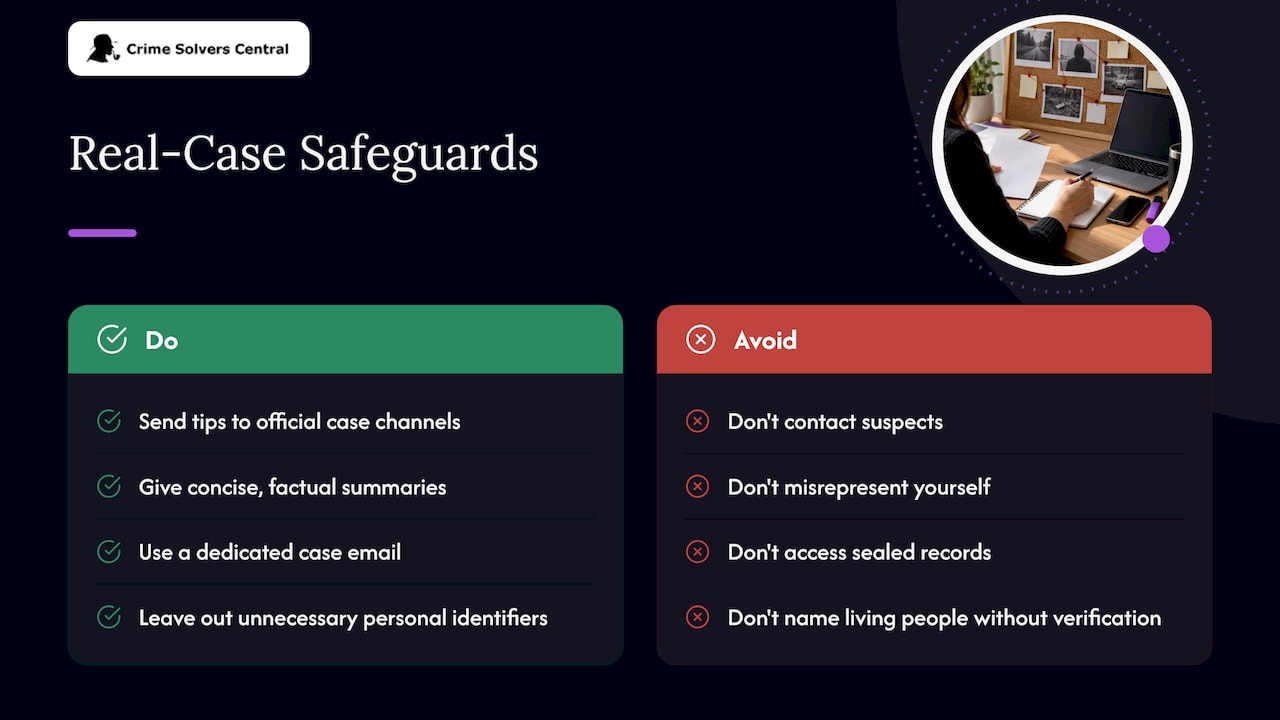
Work as a researcher, not an investigator. You have no legal powers. Do not contact suspects, misrepresent who you are, access sealed records or trespass. Do not publish unverified theories naming living people. Cold-case collaboration guidance from AdvancedBackgroundChecks lists these as the main things to avoid.
Send tips through the right door. Contact the cold case unit or the agency’s official tip line, and give concise factual summaries with the where, when and why it is relevant. Treat law enforcement as a partner. Many agencies prefer a short, dated, sourced note to a long narrative.
Protect your identity. A dedicated email address for case work keeps your personal accounts out of it.
Keep it closed until it is verified. Academic work on crowdsourced investigations from a law journal article on volunteer sleuthing argues that the risk of doxxing and misidentification falls when volunteers follow principles of accountability, competency and accuracy, and when organizations use closed, controlled forums where findings are checked before publication instead of posting to social media.
Respect the people in the case. The DOJ’s assessment of NamUs lists privacy harms that can follow from misused records, including identity theft and employment loss. Leave out personal identifiers that the summary does not need, such as home addresses of relatives and Social Security numbers.
If you are a family member, you are not required to do any of this alone. You can enter a case in NamUs at no cost and provide DNA samples through it, and you can talk to the investigating agency about what additional information would help. For a broader plan, read our safe plan for families and volunteers.
Where to start on Crime Solvers Central
Crime Solvers Central is a membership site: the database lists 264,913 cold cases, including missing persons, unsolved homicides and unidentified or unclaimed remains, categorized by state and type, and members unlock full case details, sources, videos, forums, digital evidence boards, a flyer builder, A.I. image tools and volunteer coordination. Plans are Jr. Detective at $3.97 per month or $39 per year, Sr. Detective at $9.97 per month or $99 per year, and True Crime Influencer at $39.97 per month or $399 per year. See the pricing page for what each plan includes, or browse the cold case database by state to find the case you care about.
Families can also use the flyer builder to create printable missing-person flyers, and our guide to the cold case search engine explains how to search the database efficiently.
Our perspective
We built Crime Solvers Central on a simple belief: forgotten cases move when more careful people look at them, and careful people need a place to organize what they find.
The evidence board is the heart of that. A board can make a family’s twenty years of folders legible in an afternoon. It can show a student how investigators think. It can help a volunteer see that a promising theory depends on one unsourced claim. That is why we keep the case database, the sources and the board in the same workspace: a card should never be separated from where it came from.
We also think a board is only as good as what it leads to. The goal is not a more impressive wall. It is a clear, factual summary that an agency can act on, and a community that treats every case as a person, not a puzzle. Our digital evidence boards, forums and volunteer tools are designed for that work: sourced, organized and respectful.
Crime
FAQ
What is the difference between an evidence board and a murder board?
They are the same tool under different names. People also call it a crime board, a detective board or, in fiction, a conspiracy board. For real missing-person and cold cases, we prefer “evidence board” because it puts the emphasis on sourced evidence rather than suspects.
Do real detectives use red string?
Mostly not anymore. Reporting by Cracked says no one at the FBI or CIA will admit to using tape and string to crack a case in modern times, citing wall space, the risk of exposing case details to visitors and better computer visualization tools. Digital boards do the same job with sources attached.
What should I put at the center of a cold case board?
Put the missing or deceased person in the middle, with name, age, last known location and the date last seen. Then add a sourced timeline and radiate people, places and evidence outward. One central subject and one question keep the board focused.
Is it safe to share my evidence board publicly?
Not while it contains unverified theories. Keep the board private, mark anything unconfirmed as a hypothesis, and share only a concise, sourced summary with the investigating agency through its official tip channel. Never publish names of living people who have been investigated and cleared.
How much does it cost to use digital evidence boards on Crime Solvers Central?
Membership starts at $3.97 per month for Jr. Detective, or $39 per year. Sr. Detective is $9.97 per month or $99 per year, and True Crime Influencer is $39.97 per month or $399 per year. The pricing page lists each plan.
Sources
- Blue Valley Libraries: Evidence Board guide
- Cracked: The History of the Red String Evidence Board
- Cold Case Investigative Checklist
- U.S. Department of Justice: National Best Practices for Cold Case Investigation Units
- U.S. Department of Justice: NamUs Privacy Impact Assessment
- Lawyeree: Documenting evidence during missing persons inquiries
- LegalClarity: Evidence Board
- Link Analysis, Intelligence Notes
- UCMJ Investigations: Using Case Maps and Relationship Charts
- AdvancedBackgroundChecks: Amateur researchers and cold cases
- Law journal article on crowdsourced investigations