

The Role of DNA in Cold Cases: A 2026 Guide
DNA is the most definitive biological evidence available to investigators, capable of linking a suspect to a crime scene or identifying a victim decades after death. The role of DNA in cold cases has transformed from a supplementary tool into the primary engine of resolution, particularly as forensic genetic genealogy and massively parallel sequencing have matured into standard investigative practice. Cases that sat dormant for 30 years are now closing within days of a viable DNA profile being generated. Understanding how these technologies work, where they fall short, and what they demand from investigators gives you a clearer picture of modern criminal justice than any crime documentary can.
How does modern DNA technology surpass traditional forensic methods?
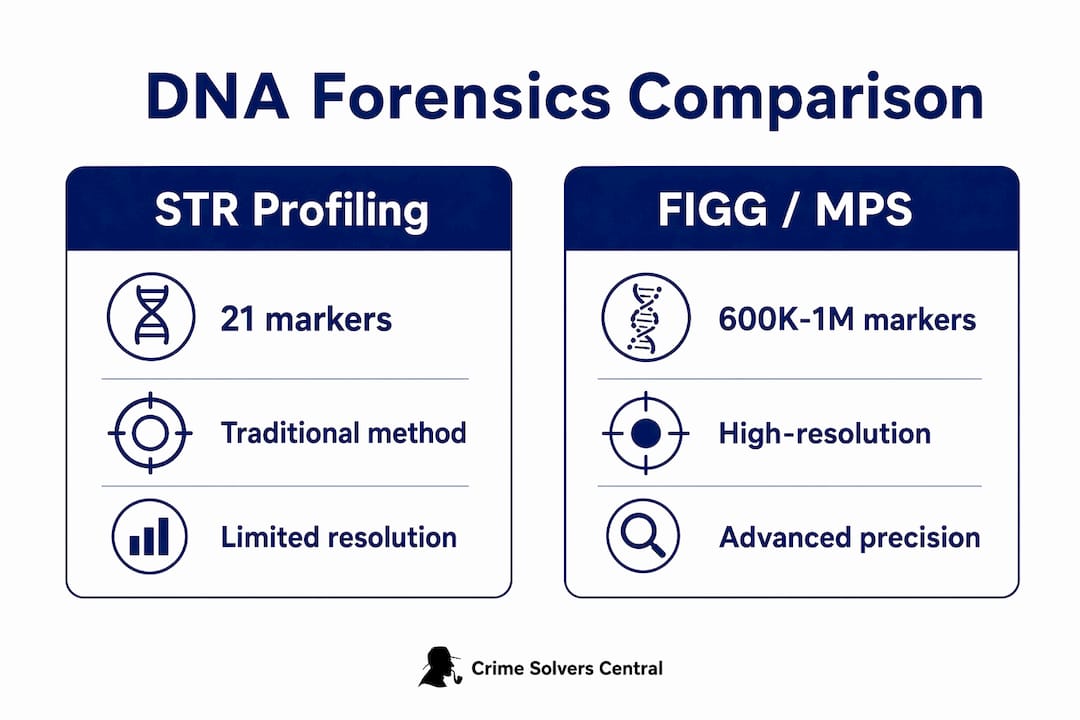
Traditional short tandem repeat (STR) profiling, the method that dominated forensic labs for decades, analyzes 21 genetic loci to produce a DNA profile. That approach works well on fresh, high-quality samples. It fails on degraded biological material, which is exactly what investigators find in most cold cases.
Forensic investigative genetic genealogy (FIGG) operates on an entirely different scale. FIGG analyzes dense SNP profiles with 600,000 to 1 million genetic markers, compared to STR’s 21 loci. That difference in resolution means investigators can extract meaningful data from samples that standard labs would discard.

Massively parallel sequencing (MPS) pushes the boundary further. MPS differentiates closely related individuals, including identical twins, by analyzing 40–50 genome variation sites simultaneously. No prior forensic method could make that distinction. The practical implication is significant: a suspect who previously could not be separated from a sibling by DNA alone can now be identified with confidence.
| Feature | STR profiling | FIGG / MPS |
|---|---|---|
| Genetic markers analyzed | 21 loci | 600,000 to 1 million SNPs |
| Works on degraded samples | Limited | Yes, with specialized extraction |
| Differentiates twins | No | Yes (MPS) |
| Database compatibility | CODIS | GEDmatch, FamilyTreeDNA |
| Cold case applications | Fresh samples only | Decades-old evidence |
Pro Tip: If a case file notes that a DNA sample was “too degraded for analysis,” that conclusion was likely reached using STR profiling. Modern MPS workflows frequently recover usable profiles from those same samples.
Modern workflows often recover usable profiles from samples that prior labs declared unusable. Cold cases close more often because of exhausted investigative leads than because of truly exhausted evidence.
What is forensic genetic genealogy and how does it work?
Forensic genetic genealogy (FGG) is the process of uploading an unknown DNA profile to a public genealogy database, identifying distant relatives through shared DNA segments, and then constructing a family tree to narrow down the identity of a suspect or victim. The Golden State Killer case in 2018 made this technique nationally known. Since then, hundreds of cold cases have been solved using this method.
The process follows a clear sequence:
- DNA extraction and profiling: Investigators generate a SNP-based profile from crime scene evidence.
- Database upload: The profile is uploaded to opt-in public databases like GEDmatch or FamilyTreeDNA.
- Match identification: The database returns a list of individuals who share DNA segments with the unknown profile, often third or fourth cousins.
- Family tree construction: A genetic genealogist builds pedigrees from those distant matches, working forward in time to identify candidates who fit the geographic and demographic profile.
- Suspect confirmation: Law enforcement collects a fresh DNA sample from the candidate, typically through discreet lawful methods.
- Legal submission: The confirmed match becomes admissible evidence.
That last step matters more than most people realize. Law enforcement uses discreet collection methods, such as retrieving discarded chewing gum, to obtain a confirmatory sample without alerting the suspect. The genealogy database hit points investigators toward a person. The fresh sample is what holds up in court.
Pro Tip: Public genealogy databases like GEDmatch require users to opt in to law enforcement searches. The size and quality of the database directly affects how quickly investigators can identify distant relatives, so cases in regions with lower database participation take longer to resolve.
Ethical debates around FGG center on privacy. Uploading your DNA to a consumer database like 23andMe or AncestryDNA does not automatically make it available to law enforcement. However, relatives who upload to opt-in databases can inadvertently make you identifiable. That reality has reshaped how legal scholars and forensic scientists think about genetic privacy.
What challenges complicate DNA evidence in cold cases?
DNA evidence in cold cases is rarely clean. Samples collected at scenes from the 1980s and 1990s were often stored improperly, contaminated by multiple contributors, or collected with techniques that introduced foreign biological material. These conditions create real obstacles, even for modern technology.
Degraded samples are the most common problem. A 2026 Georgia cold case demonstrated that DNA testing can succeed from as few as 15 human cells collected 32 years prior. That result is exceptional, not routine. Most degraded samples require multiple extraction attempts and specialized laboratory protocols before yielding a usable profile.
Mixed DNA profiles present a separate challenge. When biological material from two or more individuals is present in a single sample, separating individual contributors requires statistical modeling and expert interpretation. Secondary transfer, where DNA moves from one surface to another without direct contact, can place a person’s genetic material at a scene they never visited.
Mitochondrial DNA (mtDNA) offers a different tool when nuclear DNA is unavailable. Mitochondrial DNA excluded 99.7% of the North American population in a northern Michigan cold case, proving a victim’s presence in a suspect’s vehicle with near certainty. MtDNA is inherited maternally and does not degrade as quickly as nuclear DNA, making it valuable for skeletal remains and hair samples without roots.
“Cold cases rarely close through technology alone. Successful resolutions combine persistent investigators, media outreach, and modern DNA analysis.” Source: NBC News
Legal constraints add another layer of complexity. Privacy regulations in some states restrict how law enforcement can use genealogy databases. Investigators must document their methodology carefully to prevent defense attorneys from challenging the chain of evidence. The science can be sound while the legal process remains fragile.
How does DNA identification work for missing persons and unidentified remains?
Identifying unidentified remains is one of the most demanding applications of forensic DNA. Skeletal material recovered years after death often yields only trace amounts of nuclear DNA. Investigators rely on a combination of MPS, mtDNA analysis, and genealogical research to move from an unknown set of bones to a named individual.
Speed is possible once viable DNA is extracted. Genetic genealogy identified a victim candidate within 5 days of profile generation in the 2026 Minnesota Bone Lake Jane Doe case. That timeline would have been unthinkable a decade ago. The bottleneck is no longer the analysis. It is obtaining sufficient biological material to generate a profile in the first place.
Funding and collaboration in victim identification
Community fundraising often covers the cost of advanced genome sequencing and genetic genealogist services when law enforcement budgets fall short. Nonprofit organizations, academic forensic labs, and volunteer genealogists frequently collaborate on unidentified remains cases. That multidisciplinary structure is now standard practice rather than an exception.
The importance of cold case databases in this process cannot be overstated. Centralized records allow investigators, genealogists, and families to cross-reference missing persons reports with unidentified remains, reducing the time spent on manual searches.
The role of nonprofits and public engagement
Nonprofit organizations like the DNA Doe Project specialize in identifying unidentified individuals using forensic genetic genealogy. These groups work alongside law enforcement, often at no cost to agencies, and have resolved dozens of cases that would otherwise remain open indefinitely. Public awareness campaigns generate tips and family reference samples that accelerate the identification process. You can learn more about how awareness campaigns amplify cold case victims and drive real investigative progress.
Key takeaways
DNA evidence in cold cases is most effective when advanced genetic genealogy, modern sequencing technology, and persistent investigative work operate together rather than in isolation.
| Point | Details |
|---|---|
| FIGG surpasses STR profiling | FIGG analyzes up to 1 million SNPs versus 21 loci, enabling analysis of degraded samples. |
| Confirmatory samples are required | Genealogy database hits must be confirmed with fresh DNA before evidence is admissible in court. |
| Mitochondrial DNA fills gaps | MtDNA provides strong exclusionary power when nuclear DNA is unavailable or too degraded. |
| Funding gaps slow identification | Nonprofit organizations and community fundraising often cover costs that law enforcement budgets cannot. |
| Technology alone does not close cases | Successful resolutions require investigators, media engagement, and DNA analysis working together. |
DNA’s future in cold case investigations: my perspective
I have spent years tracking how cold case investigations evolve, and the shift I find most significant is not the technology itself. It is the change in how investigators think about evidence. Embedding a genetic genealogist in a major case unit changes the entire frame of reference. Instead of asking “does this person have a prior record?”, investigators start asking “who are this person’s biological relatives, and where do they live?” That reorientation has closed cases that traditional detective work could not touch.
What concerns me is the funding gap. The most powerful DNA tools available today, MPS, SNP microarrays, and professional genealogical research, cost money that most county sheriff’s offices do not have. Cases get resolved when a nonprofit steps in or when a family raises funds online. That is not a sustainable model for justice. Public investment in forensic genomics infrastructure would produce returns that dwarf the cost, measured in closed cases, identified victims, and families who finally get answers.
The other thing I want you to take away is this: a DNA sample that failed in 2005 is not a dead end. Labs that declared evidence unusable were working with STR profiling and the extraction methods of that era. Modern MPS workflows routinely succeed where those labs failed. If you follow cold cases closely, that fact alone should change how you read old case files.
— Crime
How Crimesolverscentral supports cold case resolution
Crimesolverscentral maintains a national database of over 264,913 missing persons and unsolved homicide cases, organized by state and situation. When DNA evidence generates a lead, investigators and families need fast access to cross-referenced case records. The cold case database by state at Crimesolverscentral provides exactly that, connecting genetic findings to documented cases in a format accessible to law enforcement, researchers, and the public. You can browse cases, submit tips, or learn how to support active investigations. Every closed case starts with someone deciding to look.
FAQ
What is the role of DNA in cold cases?
DNA serves as definitive biological evidence that links suspects to crime scenes or identifies victims, even decades after a crime. Modern techniques like forensic genetic genealogy and massively parallel sequencing have made DNA analysis viable on samples previously considered unusable.
How does forensic genetic genealogy differ from standard DNA testing?
Standard DNA testing compares a known profile against a database of convicted offenders. Forensic genetic genealogy uploads an unknown profile to public opt-in databases like GEDmatch, identifies distant relatives, and builds a family tree to narrow down a suspect or victim’s identity.
Can DNA from old or degraded evidence still be used?
Yes. A 2026 case demonstrated successful DNA identification from just 15 human cells collected 32 years earlier. Massively parallel sequencing and specialized extraction protocols recover usable profiles from samples that older STR profiling methods could not process.
Why do cold cases still go unsolved despite DNA advances?
DNA technology identifies biological candidates but cannot close a case alone. Legal requirements for confirmatory samples, privacy restrictions on genealogy databases, funding limitations, and the need for corroborating evidence all affect whether a DNA lead translates into a conviction.
What role do nonprofits play in cold case DNA analysis?
Nonprofit organizations like the DNA Doe Project fund advanced genome sequencing and provide volunteer genetic genealogists for unidentified remains cases. They fill the gap when law enforcement budgets cannot cover the cost of modern forensic genomics.