

How to Submit a Cold Case Tip to Crimesolverscentral

To submit a cold case tip on Crimesolverscentral, locate the case in the platform’s extensive database of cases, open the tip form on that case page, fill in verifiable facts, attach original unedited supporting files, choose your consent and anonymity settings, then submit. You’ll receive an on-screen confirmation and a ticket ID.
Before you open the form, have these three things ready:
- A case identifier (name, case number, or state/category from the database)
- At least one verifiable fact with a source (date, location, document, or photo)
- One supporting file in its original, unedited format
Members unlock full case files, evidence boards, and private forum threads that make tips sharper before submission. If you’re not yet a member, the basic tip form is still available.
Key Takeaways
Submitting a verifiable, source-linked tip with original unedited files is the single most effective action a contributor can take on Crimesolverscentral.
| Point | Details |
|---|---|
| Start with the case ID | Locate the case in the database before opening the form; it anchors every field you fill in. |
| Verifiable facts only | Include exact dates, locations, and named sources; label anything uncertain as “unverified.” |
| Preserve original files | Never edit files before uploading; intact EXIF and document metadata support verification. |
| Consent choices matter | Read each consent option on the form; confidential submission is available for sensitive details. |
| Crimesolverscentral membership | Full case files, evidence boards, and higher upload limits help members submit stronger, better-contextualized tips. |
Table of Contents
- How do you submit a cold case tip on Crimesolverscentral?
- What information actually makes a tip useful?
- How to prepare and upload your supporting files
- Privacy, consent, and the ethics every contributor must follow
- What happens after you submit?
- Checklist and sample tips you can copy
- How does Crimesolverscentral membership improve your tip?
- Why evidence-first contributions are the ones that matter
- Crimesolverscentral gives you the tools to contribute meaningfully
- Sources
- FAQ
How do you submit a cold case tip on Crimesolverscentral?
- Register or log in. Members access the full case file and all submission tools. Guests can proceed without an account but will have limited file-upload capacity and no access to evidence boards.
- Find the case. Use the state-based search or category filters to locate the specific case page. The database is organized by state and situation type.
- Open the tip form. The form is accessible directly from the case profile page.
- Fill in required fields. Include the case identifier, your relationship to the information (witness, researcher, family member), and the core verifiable facts.
- Attach supporting files. Members can upload larger files. Guests are limited to smaller attachments. Use original, unedited files whenever possible.
- Choose consent and anonymity settings. The form presents options for how your identity and submitted materials may be used. Read each option before selecting.
- Submit. You’ll see an on-screen confirmation immediately. An email receipt with a ticket ID follows. Keep that ticket ID; you’ll need it to check status or add information later.
Members also gain the ability to post directly to the case’s evidence board and participate in the private forum thread tied to that case, both of which let the community vet and refine a tip before it moves to formal review.
What information actually makes a tip useful?
The difference between a tip that moves a case forward and one that stalls in review is verifiability. Citizen investigation methodology is clear: fact-based, source-linked evidence is what gives peers and professional reviewers something to work with.
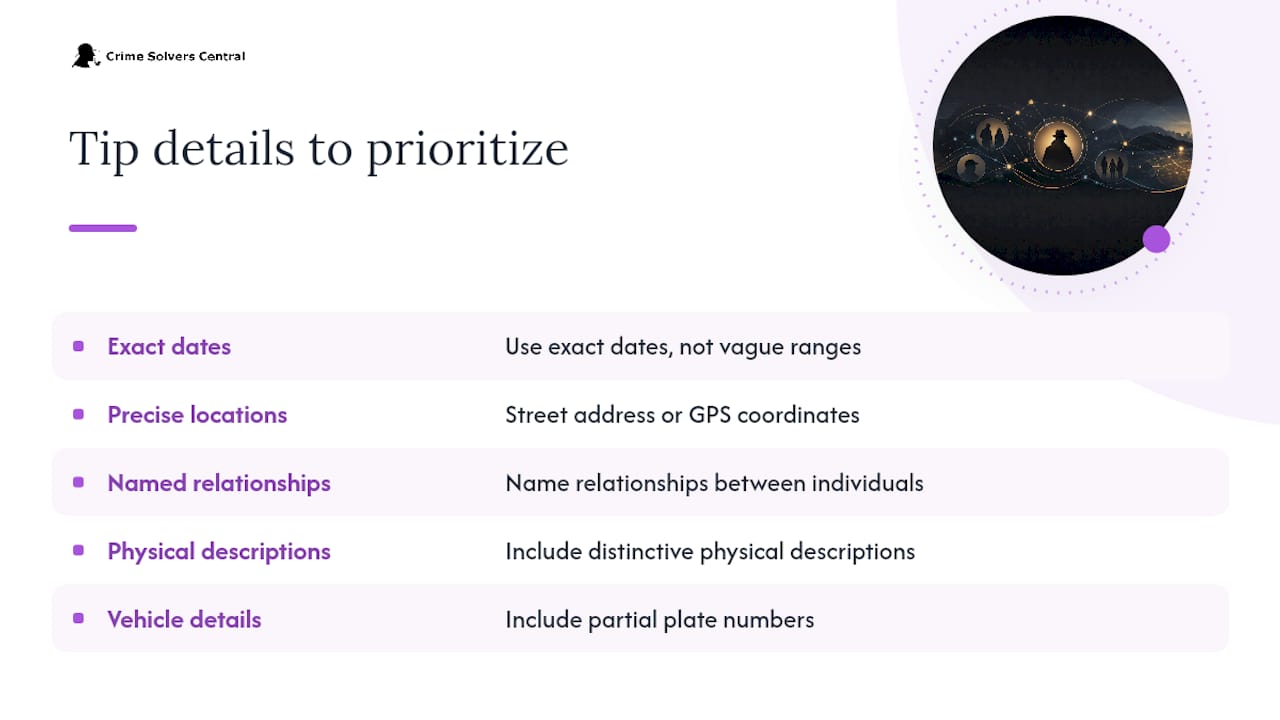
Prioritize these specifics: exact dates (not “sometime in the fall”), precise locations (street address or GPS coordinates), named relationships between individuals, distinctive physical descriptions, and vehicle details including partial plates. If you have a contemporaneous source, a receipt, a social media post, a court filing, a public record, attach it.
For photos, research on cold case review suggests dated images taken close to the time of the incident tend to produce better retrieval than later or age-progressed images, because memory encoding is more likely to match what was actually seen. When you have both, include both and label them clearly.
Speculation isn’t worthless, but it needs to be labeled. If you’re not certain, write “possible” or “unverified” and cite where the information came from. The community can evaluate a clearly labeled lead; it can’t do anything with an unmarked guess.
Pro Tip: Before drafting your tip, split a blank page into two columns: “confirmed facts” and “what I believe.” Only the left column goes into the main tip fields. The right column can appear as a clearly labeled “notes” section so reviewers know exactly what needs further verification.
How to prepare and upload your supporting files
File preparation is where most volunteer tips lose credibility. A photo with stripped metadata is harder to verify than one with its original EXIF data intact. Visual evidence guidance is direct: preserve original files and their metadata because geolocation, timestamp, and device data confirm when and where an image or video was captured.
Before uploading, run through this checklist:
- Keep the original file untouched. Upload a copy if you need to redact anything.
- Remove unrelated personal data from documents (addresses, phone numbers of uninvolved parties).
- Do not strip EXIF data from photos or video.
- Name files consistently: original filename + date + short descriptor (e.g.,
IMG_4821_20191103_vehicledescription.jpg). - Document how and when you obtained each file in the tip notes field.
| File type | What to preserve | Why it matters |
|---|---|---|
| JPEG / PNG photo | EXIF data (GPS, timestamp, device) | Confirms location and time of capture |
| Video (MP4, MOV) | Original encoding, creation timestamp | Establishes sequence and authenticity |
| PDF document | Document properties, creation date | Supports chain-of-custody context |
| Screenshot | Source URL, capture date in filename | Allows independent verification |
If your file exceeds the platform’s upload limit, do not compress or re-export the original. Instead, upload the file to a secure cloud service (Google Drive, Dropbox) with view-only sharing, and paste the link into the tip notes field with access instructions.
Pro Tip: *Create a master file index before you start uploading. A single spreadsheet listing each file, its original source, acquisition date, and what it shows will save hours during a review that can run 50–200 hours for a thorough case audit.
Privacy, consent, and the ethics every contributor must follow
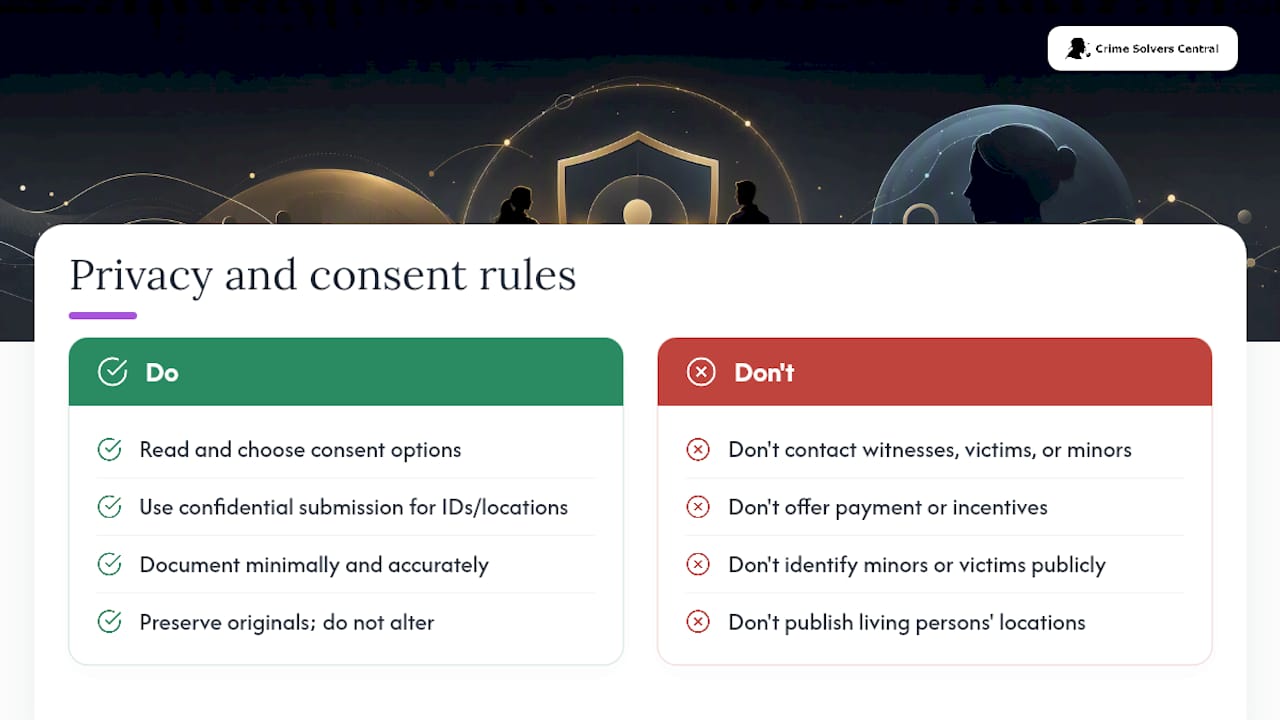
The tip form includes explicit consent options. Read them. Each option specifies what Crimesolverscentral may do with your submitted material: share with community moderators, escalate to law enforcement contacts, or keep confidential within the platform. Choose based on what you’re comfortable with, not what seems fastest.
Civil-society guidelines from Eurojust and the ICC are unambiguous on one point: organizations should avoid taking detailed accounts from vulnerable or traumatized people. That applies here. Do not contact witnesses, victims’ family members, or minors to gather information for your tip. If someone approaches you, document what they share minimally and accurately, then preserve it for transfer to appropriate authorities rather than publishing it in a forum thread.
Do not offer payment or incentives for witness accounts. Do not publicly identify minors or living victims without documented consent. If your tip involves a living person’s location or identifying details, use the platform’s confidential submission option.
Pro Tip: If you’re unsure whether sharing a detail could harm someone, leave it out of the public tip fields and note it in the confidential section instead. Reviewers can follow up with you directly.
As a tipster, you have no legal obligation to submit information to a private platform, but you do retain responsibility for how you obtained it. Material gathered through unauthorized access or surveillance may be inadmissible and could expose you to liability. Preserve your originals; do not alter them.
What happens after you submit?
Submission triggers an automated intake check that confirms the form is complete and assigns your ticket ID. After that, a human triage step begins.
- A community moderator or case manager reviews the tip for verifiability: are the facts specific, are sources cited, are files intact?
- Tips with strong supporting files and clear sourcing move faster. Vague or unsourced tips may be flagged for clarification before they advance.
- Members receive platform notifications when their tip status changes and can follow the discussion thread tied to that case. Guests receive a single status update by email.
- To add new information to an existing tip, reference your ticket ID in a new submission or use the “update tip” function if you’re logged in as a member.
Timeline varies. A well-documented tip with original files and clear sourcing can move through initial review within days. Tips that need vetting or clarification take longer. The NIJ’s best practices for cold case units recommend formal SOPs and investigation checklists to keep reviews consistent, and Crimesolverscentral’s triage process aligns with that framework.
Checklist and sample tips you can copy
Copy-ready submission checklist:
- [ ] Case ID or name confirmed in the database
- [ ] Exact dates and locations included
- [ ] Relationships between individuals named
- [ ] Each fact labeled as confirmed or unverified
- [ ] Source cited for every claim
- [ ] Supporting files attached in original format
- [ ] File index note added to tip body
- [ ] Consent and anonymity options selected
Strong tip example: “On November 3, 2019, a dark blue Ford F-150 with a partial plate of ‘KTX’ was parked at 412 Elm Street, Macon, GA, between 9:00 PM and 11:30 PM. Source: my own photo taken that evening (attached, EXIF intact). The driver matched the physical description in the case file. I have no prior relationship to the victim or suspect.”
Weak tip example: “I think the neighbor did it. He always seemed weird and was around a lot that year.”
Three edits that fix it: (1) Replace “I think” with a specific observation and date. (2) Replace “always seemed weird” with a documented behavior and source. (3) Replace “that year” with an exact date range and location.
One-line template:
On [date], at [location], I observed/obtained [specific fact or item]. Source: [document/photo/record]. Relationship to case: [state it].
How does Crimesolverscentral membership improve your tip?
A free guest submission gets the tip into the queue. Membership changes what you can do before and after that moment.
- Full case file access: Members see the complete case record, not just the public summary. That context prevents duplicate tips and helps you identify exactly which detail is missing.
- Higher upload limits: Larger files, including video, can be attached directly rather than linked externally.
- Evidence boards: Members can post to the case’s digital evidence board, where the community can annotate, cross-reference, and flag connections across cases.
- Private forum threads: Discuss a tip with other volunteers and moderators before submitting, so the final version is tighter.
- Flyer builder and AI image tools: Useful for family members creating awareness materials tied to a specific case.
- Priority notification channels: Members are alerted when a case they’ve contributed to receives new activity.
Membership does not guarantee a case will be solved or that your tip will be escalated to law enforcement. What it does is give you the tools to make your contribution as strong as it can be. The NIJ has documented that expanding cold case teams beyond law enforcement, including volunteers with data skills, academic backgrounds, and community knowledge, brings perspectives that career investigators often miss. That’s the community you’re joining.
Why evidence-first contributions are the ones that matter
The cold cases that see movement share one trait: someone submitted something verifiable. Not a theory, not a feeling, but a document, a photo with intact metadata, a court record, a dated eyewitness account with a named source. Crimesolverscentral’s database holds over 264,913 cases. Most of them have been waiting years for exactly that kind of contribution.
The citizen investigation framework that serious volunteers use, public records, corporate filings, court documents, cross-referenced with community knowledge, is the same framework the platform’s evidence boards are built to support. The checklist in this guide isn’t bureaucracy. It’s the difference between a tip that sits in a queue and one that reopens a file.
Collaborate with the community. Use the tools responsibly. And when in doubt, submit the verifiable fact and label the rest as unverified. That honesty is what makes the work credible.
Crimesolverscentral gives you the tools to contribute meaningfully
Access to over 264,913 categorized cold cases, full case files, digital evidence boards, and a volunteer community that knows how to use them: that’s what a Crimesolverscentral membership puts in your hands. For family members who’ve been waiting years for a lead, or for volunteers who want their work to count, the platform’s structured submission process and member tools make the difference between a tip that disappears and one that gets reviewed. Privacy is built into the process: consent options are explicit, confidential submission is available, and your materials are handled according to the platform’s documented guidelines. Browse the national cold case database and start your first submission today.
Sources
- Citizen Investigations: Planning and Carrying Out an Investigation
- Notes From the Field: Expanding the Cold Case Team Beyond Law Enforcement | National Institute of Justice
- Gathering Visual Evidence — The Kit 1.0 documentation
- National Best Practices for Implementing and Sustaining a Cold Case Investigation Unit
- Documenting international crimes and human rights violations for accountability purposes: Guidelines for civil society organisations
FAQ
How do I submit a cold case tip anonymously?
Select the confidential or anonymous submission option on the tip form before submitting. Your identity will not be shared with other community members, though platform moderators may still see submission metadata.
What file types does Crimesolverscentral accept for tip attachments?
Common formats including JPEG, PNG, MP4, MOV, and PDF are widely supported. Upload original, unedited files; if a file exceeds the size limit, paste a secure cloud link with view-only access into the tip notes field.
Does membership improve how my tip is reviewed?
Yes. Members can post to the case’s evidence board, participate in private forum threads to refine a tip before submission, and receive notifications when their tip’s status changes, none of which are available to guest submitters.
Can I update a tip after I’ve already submitted it?
Yes. Reference your ticket ID in a new submission or use the “update tip” function when logged in as a member. Include only new, verifiable information and label it clearly as an addition to the original submission.
What makes a tip strong enough to advance in review?
Exact dates, precise locations, named sources, and original files with intact metadata move through triage faster. Tips that consist mainly of speculation or lack source citations are flagged for clarification before advancing.